Vapes are battery-powered devices that heat a liquid into an aerosol the user inhales. The main differences between vape types come down to whether the device is disposable or refillable, how much control it gives the user, what kind of nicotine it uses, and how much maintenance it requires. This guide explains the common categories in plain language so adult readers can understand the landscape without getting lost in jargon.
Table of Contents
What are the main types of vapes?
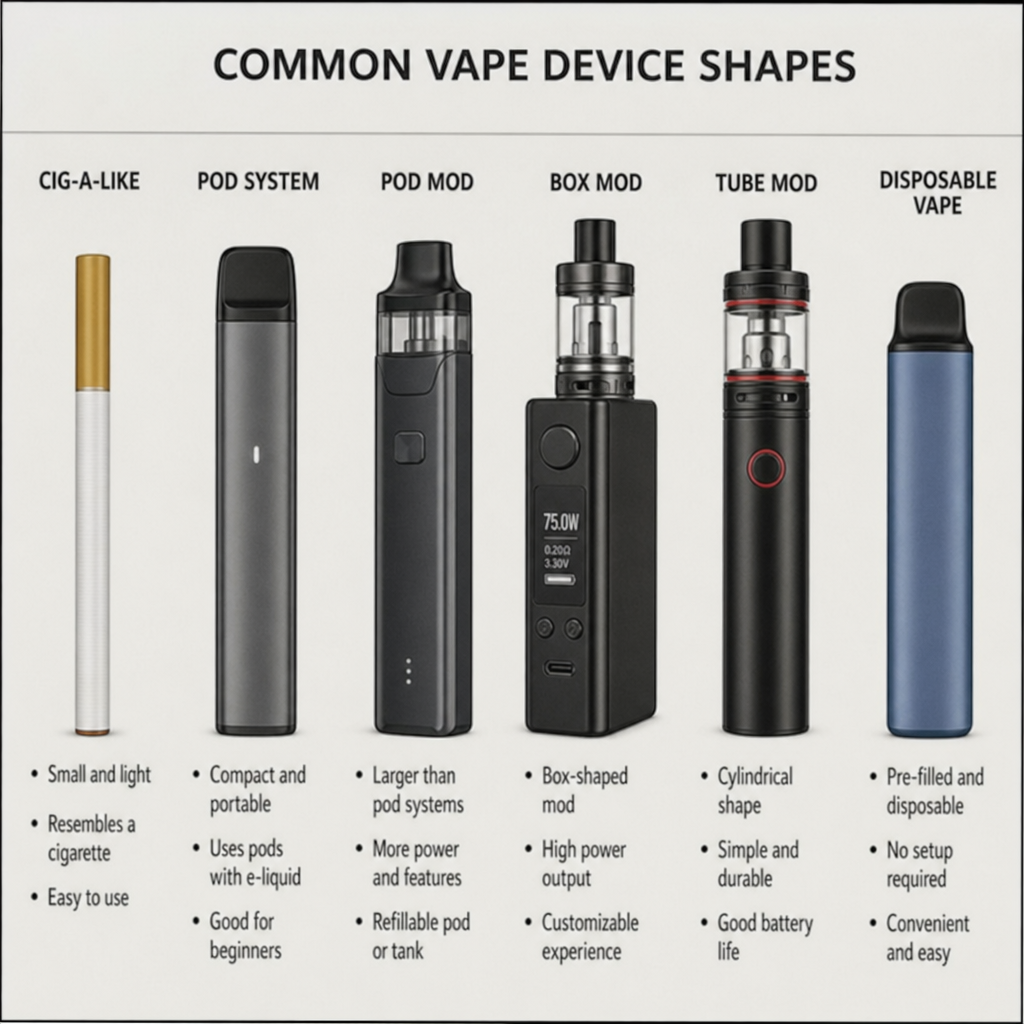
The main types of vapes are disposable vapes, pod systems, vape pens, box mods, and refillable tank devices. Each category is built around a different balance of simplicity, size, cost over time, battery life, vapor output, and customization. For example, a disposable vape is designed to be used and thrown away when finished, while a refillable pod or tank device is made to be refilled with e-liquid and reused.
It is also important to understand that “vape” is a broad term. The FDA uses the term electronic nicotine delivery systems, or ENDS, for products such as e-cigarettes, vapes, vape pens, tank systems, and mods. The agency also notes that people who do not use tobacco products should not start using e-cigarettes, and no tobacco product is considered safe.
The basic parts of most vaping devices
Most vaping devices work in a similar way even when they look very different. A battery powers a heating element, often called a coil, which warms e-liquid inside a pod, cartridge, tank, or disposable chamber. The heated liquid becomes an aerosol that is inhaled through a mouthpiece.
Knowing the parts helps make the different types of vapes easier to compare:
- Battery: Powers the device. Some are built in, while others are removable in advanced devices.
- Pod, cartridge, or tank: Holds the e-liquid.
- Coil or atomizer: Heats the liquid and creates aerosol.
- Mouthpiece: The part the user inhales through.
- Airflow system: Controls how tight or open the draw feels.
- Charging port: Found on rechargeable devices, including many pod systems and some disposables.
The simpler the device, the fewer parts the user has to manage. The more advanced the device, the more control it may offer over wattage, airflow, coils, and e-liquid choice.
Disposable vapes
Disposable vapes are among the simplest vape types because they usually come pre-filled and ready to use. Most do not require refilling, coil changes, or setup. Once the e-liquid or battery is finished, the entire device is discarded according to local waste and battery rules.
The main appeal is convenience. A disposable can be small, portable, and straightforward for adults who do not want to learn device maintenance. The tradeoff is that disposables can create more waste and usually offer less control than refillable systems. If waste is a concern but you’re not ready to give up the format, our guide on eco-friendly disposable vapes covers how to make that tradeoff a little less lopsided.
Common types of disposable vapes
The phrase types of disposable vapes can refer to several design differences:
- Standard non-rechargeable disposables: Designed for single-cycle use with no charging.
- Rechargeable disposables: Include a charging port so the battery can last long enough to use the included liquid.
- Compact disposables: Smaller devices focused on portability.
- High-capacity disposables: Larger devices with more e-liquid and a bigger battery.
- Screen or feature disposables: May show battery level, e-liquid level, or mode settings.
Disposable devices may be easy to use, but simplicity should not be confused with risk-free use. CDC explains that e-cigarette aerosol is not harmless “water vapor,” and most e-cigarettes contain nicotine, which is highly addictive.
Pod systems
Pod systems are small, reusable vaping devices that use replaceable or refillable pods. They sit between disposables and larger refillable devices: easier than a mod, but usually more flexible than a disposable. Many adults recognize them by their slim, pocketable shape and simple draw-activated or button-activated operation.
There are two main pod styles. Closed pod systems use pre-filled pods made for that device, so there is less mess and less setup. Open pod systems let the user refill the pod with compatible e-liquid, which offers more choice but also requires more attention to coil condition, liquid level, and leakage.
Pod systems are often associated with nicotine salt e-liquids, which are formulated differently from many traditional freebase nicotine liquids. That does not make them automatically better or safer; it simply means the nicotine delivery experience can feel different. People comparing types of nicotine vapes should look at both the device and the liquid, because the same device category can be sold with different nicotine strengths or formulas.
Vape pens
Vape pens are slim, pen-shaped devices that are usually rechargeable and may use a tank, cartridge, or refillable chamber. They are often more substantial than tiny pod systems but less complex than box mods. For many adult users, the appeal is a familiar shape and a middle-ground experience.
A typical vape pen may include a single-button battery, a clear tank or cartridge, and a charging connection. Some are designed for nicotine e-liquid, while others may be made for different legal substances depending on the market and product category. Because “vape pen” is used broadly, it is worth checking what the device is designed to hold before comparing it with other vaping devices.
Vape pens can be useful in guides like this because they show how blurry vape categories can be. A pen may behave like a pod system if it uses cartridges, or like a tank device if it uses refillable hardware. Shape alone does not tell the full story.
Box mods and advanced vape kits
Box mods are larger, more powerful vaping devices with a box-shaped battery section and a separate tank or atomizer. They are designed for adults who want more control over settings such as wattage, temperature, airflow, and coil resistance. Compared with beginner devices, they usually require more knowledge and maintenance.
These devices may offer stronger vapor production, longer battery life, and more customization. They also introduce more variables. The user needs to understand compatible coils, safe battery handling, tank filling, and suitable power settings.
For that reason, box mods are not usually the simplest starting point for someone who only wants to understand different types of vapes. They are best viewed as advanced devices within the broader category of refillable vape systems our guide on the benefits of refillable vapes goes deeper into that broader category if you’re deciding whether the extra control is worth the added maintenance.
Refillable tank devices
Refillable tank devices use a tank that holds e-liquid and a replaceable coil that heats it. Some tanks sit on box mods, while others attach to smaller pen-style batteries. The defining feature is the refillable tank, not the exact shape of the battery.
The benefit is flexibility. A refillable tank lets an adult choose compatible e-liquids, replace worn coils, and adjust the experience more than most disposables or closed pod systems allow. The drawback is upkeep: tanks need filling, coils wear out, and the wrong setup can cause burnt taste, leaking, or poor performance.
A refillable tank device may be a good fit for someone who values control and does not mind routine maintenance. It is less ideal for someone who wants a no-setup, no-cleaning option.
How do nicotine vape types differ?
Types of nicotine vapes differ by the device format, the nicotine formula, and the nicotine strength. A small pod, disposable, pen, or tank can all be nicotine vapes if they contain nicotine e-liquid, but the experience can vary widely depending on the liquid and hardware. The key is to read the product labeling and understand what is actually inside.
Common nicotine-related categories include:
- Freebase nicotine e-liquids: Often used in traditional refillable devices and available in various strengths.
- Nicotine salt e-liquids: Common in pods and disposables, usually designed for a smoother feel at certain strengths.
- Tobacco-derived nicotine products: Nicotine comes from tobacco.
- Synthetic or non-tobacco nicotine products: Nicotine is not derived from tobacco, though these products may still be regulated.
- Nicotine-free e-liquids: Nicotine-free e-liquids: Contain flavoring and other ingredients but no nicotine, according to labeling. If this last category is what you’re actually after, our guide on where to buy nicotine-free vape covers how to verify a 0mg claim before you buy.
Nicotine deserves special attention because it is addictive. CDC states that most e-cigarettes contain nicotine and that nicotine can harm adolescent brain development, while FDA advises youth and adults who do not use tobacco products not to start using e-cigarettes.
Open-system and closed-system vapes
Another simple way to organize vape types is by asking whether the device is open or closed. This matters because it affects cost, convenience, flavor choice, maintenance, and how much control the user has.
Closed-system vapes use sealed pods, cartridges, or built-in liquid chambers. They are generally easier to use because the user does not pour liquid or change many parts. The downside is that the user is limited to the compatible pods or cartridges made for that system.
Open-system vapes allow refilling. They give more flexibility, but they also require more care. The user has to select compatible e-liquid, avoid overfilling, replace coils or pods when needed, and keep the device clean enough to work properly.
A simple way to think about it is this: closed systems prioritize convenience, while open systems prioritize choice. Neither category is automatically the best; the better fit depends on the adult user’s priorities and willingness to maintain the device.
Mouth-to-lung and direct-to-lung styles
Vape types are also described by inhale style. Mouth-to-lung, often shortened to MTL, means the user draws aerosol into the mouth first and then inhales. This style is usually associated with smaller devices, tighter airflow, and a more restrained vapor output.
Direct-to-lung, or DTL, means the user inhales more directly into the lungs with a more open airflow. This style is more common with larger tanks, lower-resistance coils, and higher-powered devices. It generally creates more vapor and often uses lower-strength e-liquids than small pod-style devices.
This distinction is practical because it helps explain why two devices can feel completely different even if both are nicotine vapes. Airflow, coil design, power level, and liquid choice all shape the experience.
How to compare different types of vapes
The easiest way to compare different types of vapes is to focus on use case rather than hype. A device that is convenient for travel may not be the most economical over time. A powerful device may offer more control but may also be more complicated than necessary.
Use this checklist when comparing vaping devices:
- Simplicity: Do you want ready-to-use hardware, or are you comfortable refilling and replacing parts?
- Maintenance: Are you willing to clean tanks, change coils, and troubleshoot leaks?
- Portability: Will the device fit comfortably in a pocket or bag?
- Battery needs: Do you need all-day battery life, or is occasional charging acceptable?
- E-liquid choice: Do you want pre-filled convenience or more control over flavor and nicotine options?
- Waste: Are you comfortable with the waste created by disposable hardware?
- Label clarity: Can you easily identify nicotine content, ingredients, and intended use?
- Local rules: Are you following applicable age, sales, and public-use laws where you live?
A thoughtful comparison also avoids relying only on brand popularity. Searches for types of vapes brands often mix device categories with brand names, but brand alone does not explain how a device works. It is better to identify the category first, then compare specific products within that category.
Common mistakes when choosing a vape type
One common mistake is assuming all small devices are the same. A disposable, closed pod, and refillable pod may look similar but differ in cost, waste, liquid options, and maintenance. Another mistake is choosing the most advanced device without wanting the upkeep that comes with it.
People also confuse vapor size with overall quality. A device that creates large clouds is not automatically a better fit for every adult user. It may use more battery power, more e-liquid, and require more attention to settings.
A third mistake is ignoring nicotine details. Two devices can look similar while containing very different nicotine strengths or formulas. Because nicotine is addictive, the label matters more than the appearance of the device.
Key takeaways
The world of vape types becomes much easier to understand when you group devices by design and maintenance level. Disposables are usually the simplest, pod systems balance convenience and reuse, vape pens offer a familiar middle ground, and box mods or tank systems provide the most customization.
Remember these core points:
- Disposable vapes are convenient but create more waste and offer limited control.
- Pod systems can be closed and simple or open and refillable.
- Vape pens are slim devices that may use cartridges, tanks, or refillable chambers.
- Box mods are advanced devices with more settings and more responsibility.
- Refillable tanks offer flexibility but require coil changes and maintenance.
- Nicotine vapes should be evaluated by both device type and nicotine labeling.
Understanding the different types of vapes is less about memorizing every product and more about recognizing the tradeoffs. Once you know how the device is powered, filled, maintained, and used, the category becomes clear.

