
The answer is 18. The interesting part is who the law is actually aimed at, because it is not the teenager holding the vape. UK age law punishes the seller, and in many cases the adult who bought it for them, while the under-18 user sits in a stranger legal position than most people assume. And since October 29, 2026, that 18 covers considerably more products than it used to, including vapes with no nicotine in them at all. This guide untangles the whole thing: who can buy, who commits the offence, how ID checks really work, what changed this month, and how Britain compares with the rest of the world.
The short answer, then the important detail
You must be 18 or over to buy vapes or e-liquids anywhere in the UK: England, Scotland, Wales and Northern Ireland all use the same line. That has been true since 2015. What changed on October 29, 2026 is the scope. From that date, the age-18 rule applies to all consumer nicotine products, not just the ones containing nicotine. The full timeline of that change is in our breakdown of the October 29 rule changes, but the headline for this guide is simple: the legal age stayed 18, and the net got wider.
Three people, three different rules
Almost every confused conversation about vaping age law comes from treating it as one rule. It is really three separate rules aimed at three different people.
| The buyer | The seller | The adult in the middle | |
|---|---|---|---|
| Who | Anyone under 18 trying to purchase | The shop, website or market stall making the sale | A parent, sibling or friend buying on a minor’s behalf |
| The rule | Cannot legally be sold vapes or nicotine products | Commits a criminal offence by selling to an under-18 | Commits a proxy-purchasing offence |
| The consequence | Sale refused; product may be confiscated | Fine of up to £2,500 per offence, licence at risk | Prosecution and a fine |
| What the law wants | To block access at the point of sale | To make every retailer an enforcement point | To close the “my older brother bought it” loophole |
And then there is a fourth person the law treats differently from all three: the under-18 who already has a vape. Using or possessing a vape is not itself a criminal offence for a minor in the way the sale is for the seller. That does not make it consequence-free, as the confiscation section below explains, but it is the distinction the whole system turns on.
What 18 covers after October 29
Before this month, the age gate sat on nicotine-containing products. Retailers often extended it voluntarily to zero-nicotine lines to keep things simple, but the law itself has now caught up. From October 29, 2026, the minimum age of sale of 18 covers:
- Nicotine vapes and e-liquids, at every strength from 20mg down to the weakest freebase
- Zero-nicotine vapes, because the rule now follows the product type rather than the nicotine content
- Nicotine pouches, which had no age restriction at all before this date
- Online sales, with no digital loophole: websites must verify age just like a till does
- The routes around the till, which are now closed: vape vending machines are banned outright, and free samples, giveaways and heavy promotional discounting of these products are prohibited
If a shop still has a vending machine humming in the corner or a free-sample counter running, that is no longer a grey area. It is a shop breaking the law.
Buying, using, possessing: the distinction nobody explains
Retailer blogs ranking for this keyword tend to blur three different acts into one warning. Separating them is what makes the law make sense.
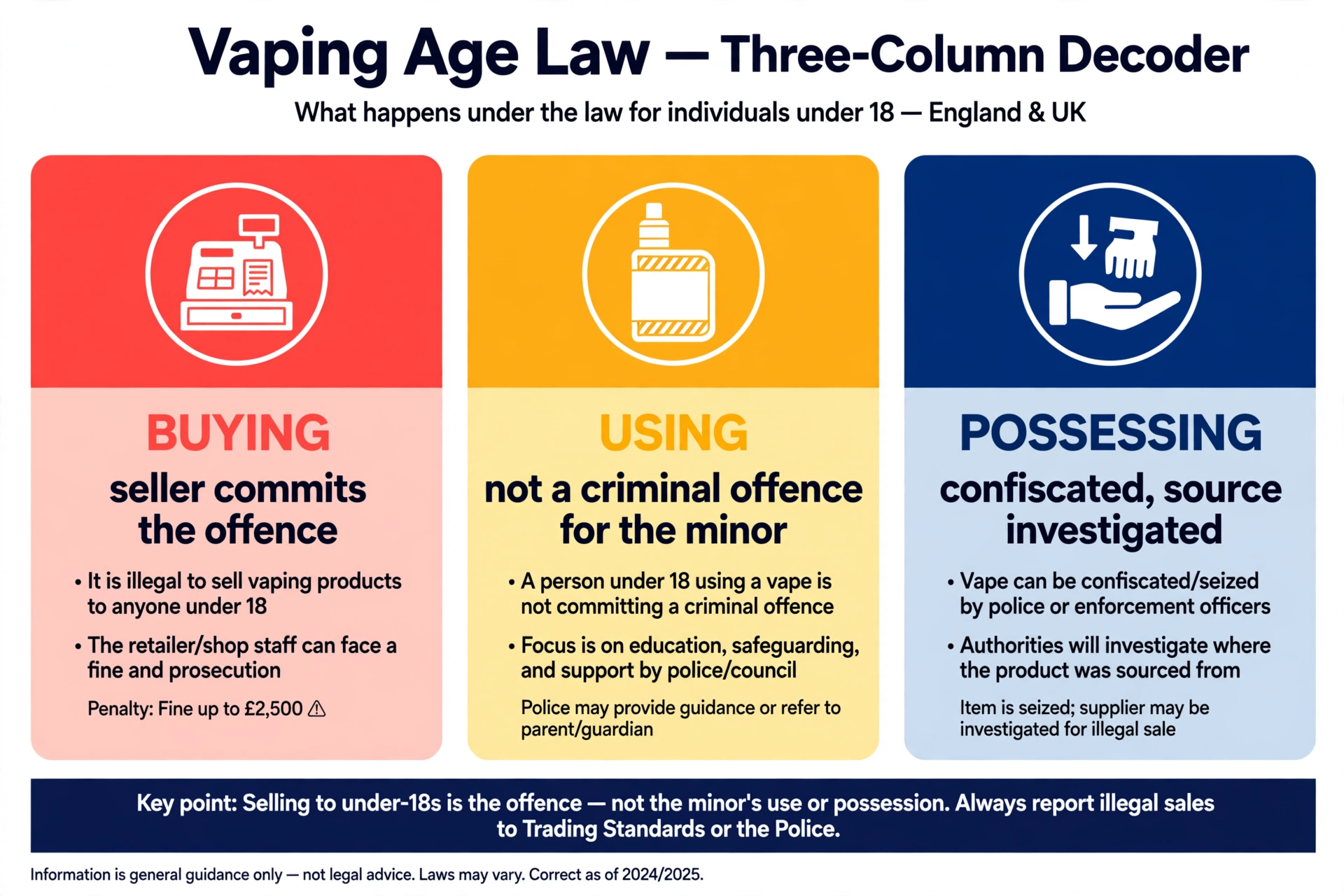
Buying under 18. The offence belongs to the seller, not the young buyer. A shop that sells a vape to a 16-year-old has committed the crime; the 16-year-old has not, by attempting the purchase. This is deliberate. Parliament wanted every transaction to have an adult legally responsible for it, and that adult is the one behind the counter.
Using under 18. There is no criminal offence of “vaping while underage” in the way there is an offence of selling. A teenager caught vaping will not be arrested or fined for the act of vaping itself. But “not a crime” is doing a lot of quiet work in that sentence. Schools treat it as a disciplinary matter, frequently with suspension. Police and trading standards officers can confiscate vapes from young people, and they will want to know where the device came from, which leads back to the seller or the proxy buyer, both of whom have committed offences.
Possessing under 18. Possession shades into the confiscation powers. Officers have long been able to seize tobacco from under-16s in public places as a deterrent, and the new Act extends practical enforcement powers across nicotine products. The product gets taken, the source gets investigated, and the minor gets a lecture rather than a criminal record. That asymmetry is the point: the system is designed to punish supply, not to criminalise teenagers.
At the till: how Challenge 25 actually works
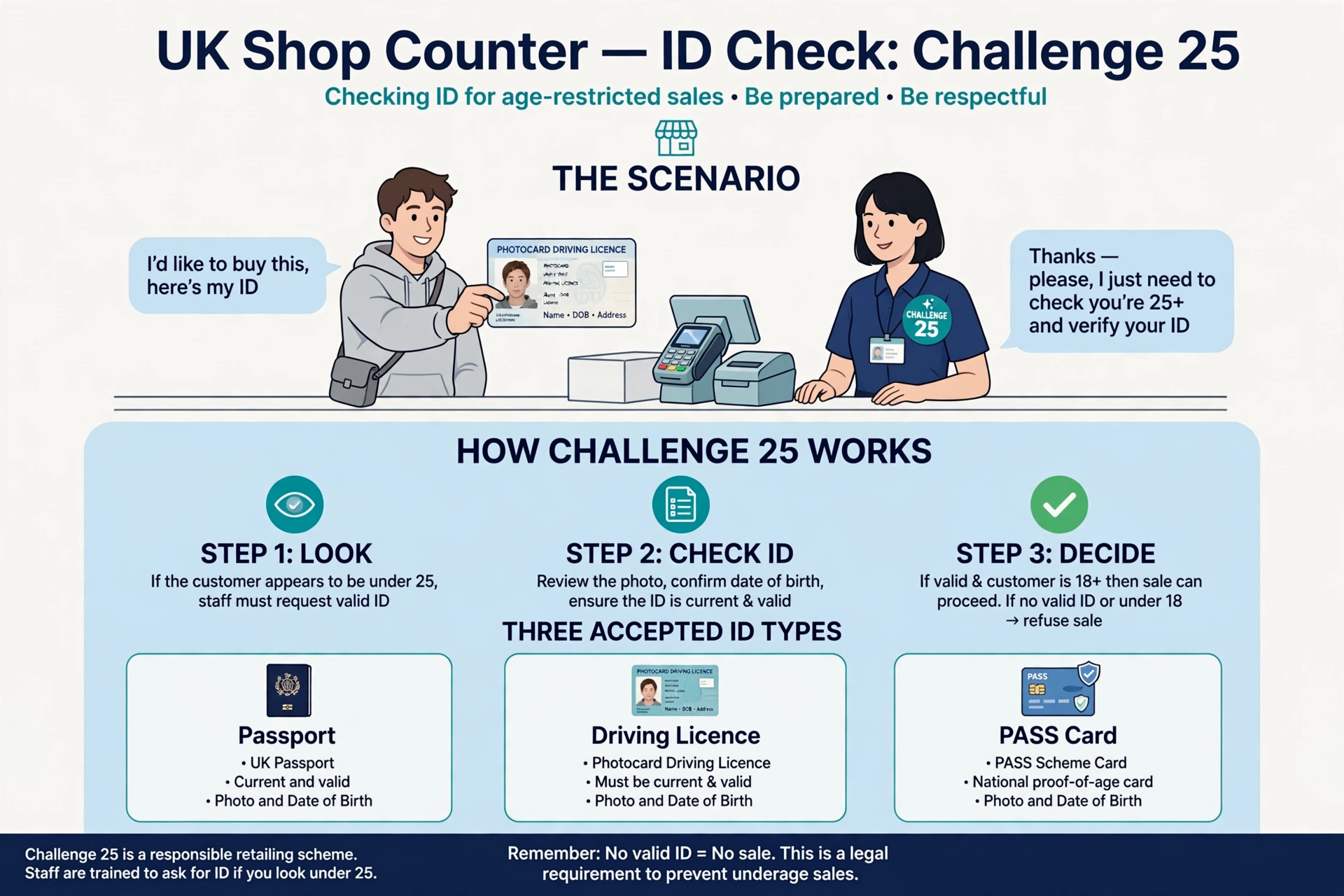
Walk into any compliant vape shop in Britain and the ID check follows a script most customers never notice. The industry standard is Challenge 25 (some shops run Think 21 or Think 25, same idea): if you look under 25, you get asked for ID, no debate. Staff are trained to ask, signage sits by the till, and refusals get logged as part of the shop’s due-diligence defence. A shop with a tidy refusals log is a shop that can show a court it takes the law seriously.
Accepted ID is narrower than people expect:
- A passport, even expired within reason at some shops’ discretion
- A photocard driving licence (full or provisional)
- A proof-of-age card carrying the PASS hologram, the national standard for age cards
Student cards, bank cards and photocopies do not count. If you are 19 and left your driving licence at home, the refusal is not the assistant being difficult. It is the law working exactly as written.
Online, the check moves but does not vanish. Responsible websites run third-party age-verification checks at checkout, matching details against reference data or requesting a one-off document check, and couriers can ask for an adult signature on delivery. A site that sells to you with nothing more than a “click to confirm you are 18” tick box is telling you everything about how seriously it takes the rest of the regulations too. Our checklist for buying vapes online safely walks through what a compliant checkout looks like.
The penalties, in real numbers
The headline figure: magistrates can fine a retailer up to £2,500 per offence for selling vapes to someone under 18. Around that sit fixed penalty notices for less serious breaches, licence reviews where licensing applies, and the slower punishment of reputation. Vape shops live on local trust, and a prosecution for underage sales is the kind of news that travels down a high street faster than any advertising.
Enforcement is not theoretical. Trading standards teams run test-purchase operations with underage volunteers, and the results regularly make local news. The pattern is international: a New Zealand retailer fined the equivalent of tens of thousands of pounds for underage sales shows how seriously regulators take it, and the Doncaster shop closure is a domestic reminder that persistent offenders lose the shop itself, not just money. October 29 widened the product net, and enforcement attention follows the net.
Proxy purchasing: the offence adults commit
This is the section to send to any adult who has ever thought “it is just one device, what is the harm.” Buying a vape or nicotine product for someone under 18, a practice the law calls proxy purchasing, is a criminal offence. It covers parents buying for their teenager, older siblings doing a favour, and friends acting as the intermediary outside the shop. From October 29 it applies across the full range of nicotine products, including the zero-nicotine vapes and pouches that are newly age-restricted.
Shop staff are trained to spot it: the adult taking quiet instructions from a teenager hovering nearby, the young person waiting outside with cash in hand, the second transaction that follows a refused first one. Staff who suspect a proxy purchase are expected to refuse the sale, and a shop that knowingly facilitates one inherits the legal exposure. The “I did not know they were underage” defence gets very thin when the teenager was standing next to you.
For parents
If you are reading this because you found a device in a school bag, the legal summary above is less useful than the practical one. Confiscate it, obviously, but know that the productive move is tracing the supply: where it was bought tells you whether a local shop is selling to minors, which is exactly what trading standards wants to hear. Schools will have their own policy, usually confiscation plus disciplinary action, and they deal with this weekly now.
The conversation that works is the honest one. Teenagers know vapes are age-restricted; telling them again changes nothing. What lands better is the supply-chain reality: every device in a minor’s hands came from an adult who broke the law to put it there, whether a corner shop chasing a sale or an older friend. And if your teenager argues that zero-nicotine vapes should not count, October 29 settled that argument. They count now.
The world in one table
Britain’s 18 looks typical until you look closely. A few comparisons worth knowing:
| Place | Legal age | The detail that matters |
|---|---|---|
| United Kingdom | 18 | Since October 29, 2026 the net covers zero-nicotine vapes and nicotine pouches too |
| United States | 21 | Federal Tobacco 21 law; applies to all tobacco and vaping products nationwide, and the FDA authorises products one by one rather than by retail rule. See the FDA authorized vapes list for what is actually legal to sell there |
| Most of the EU | 18 | Standard across Germany, France, Italy, Spain and the Netherlands, all TPD-compliant |
| Australia | Pharmacy-only | Since the 2024 reforms, all vapes, nicotine or not, are sold only in pharmacies for cessation purposes |
| Singapore, Thailand, India | Banned | E-cigarettes fully prohibited; possession alone can mean fines or arrest |
Two notes for travellers. First, the UK’s age is about sale, while some countries criminalise possession itself, so the device that is legal in your pocket at Heathrow can be an offence in your pocket at Changi. Second, the smokefree-generation direction is spreading: from January 1, 2027, England makes it illegal to sell tobacco to anyone born on or after January 1, 2009. Vaping stays at a fixed 18 for now, but the direction of travel is unmistakable.
Once you are 18: three things to know before you buy
Legal to buy is not the same as cheap or safe to buy. Three facts new adult vapers usually learn the expensive way:
You still pay the duty. The Vaping Products Duty charges £2.20 per 10ml of liquid regardless of nicotine content, so a zero-nicotine bottle carries exactly the same tax as a 20mg one. Our UK vape tax guide breaks down what that does to shelf prices, and the duty stamp scheme explains the stamps every legal product must carry from April 2027.
Buy from shops that check ID. It sounds backwards, but a shop with a strict Challenge 25 policy is also a shop that buys from legitimate distributors. The places that wave through a 16-year-old are the same places selling counterfeits. Our guide to spotting fake vapes shows what to check before money changes hands.
Check the rules before you fly. Age limits, liquid allowances and outright bans vary wildly by destination, and some countries will confiscate devices at the border. Our guide to travelling with vapes covers UK and US rules, packing, and what to do when the destination bans them entirely.
Frequently asked questions
Can you vape at 16 in the UK?
You cannot legally buy vapes or nicotine products at 16, and since October 29, 2026 that includes zero-nicotine vapes and nicotine pouches. Using one is not itself a criminal offence for the minor, but the device can be confiscated by schools or police, and whoever supplied it has committed an offence.
Can a parent buy a vape for their 16-year-old?
No. That is proxy purchasing, and it is a criminal offence regardless of the relationship. Parents, siblings and friends are all covered.
Is it illegal for a minor to use a vape, or just to buy one?
Just the supply side is criminal: selling to an under-18, or an adult buying on their behalf. The minor faces confiscation and school discipline rather than prosecution, but the source of the device gets investigated.
Can you buy zero-nicotine vapes under 18?
Not since October 29, 2026. The age-18 rule now follows the product type, so 0mg vapes are treated exactly like nicotine vapes at the till.
Do you need ID to buy vapes online?
Yes. Websites must verify your age, usually through a third-party check at checkout and sometimes an adult signature on delivery. A site with no real verification is a red flag for everything else it sells.
What happens to a shop caught selling to under-18s?
Fines of up to £2,500 per offence, fixed penalty notices, licence reviews, and in persistent cases closure. Trading standards run test purchases with underage volunteers.
Can police take a vape off a teenager?
Yes. Police and trading standards officers can confiscate vapes from young people, and they will ask where it came from. Schools can also confiscate and discipline.
Is the legal age the same in Scotland, Wales and Northern Ireland?
Yes, 18 across the whole UK, and the October 29 extension to all nicotine products applies UK-wide.
How old do you have to be to vape in the US?
21, under the federal Tobacco 21 law, which covers all tobacco and vaping products in every state.
Will the UK raise the vaping age to 21?
There is no such proposal on the table. The current direction is different: keep the vaping age fixed at 18 while the smokefree-generation law phases tobacco out by birth year from January 2027.