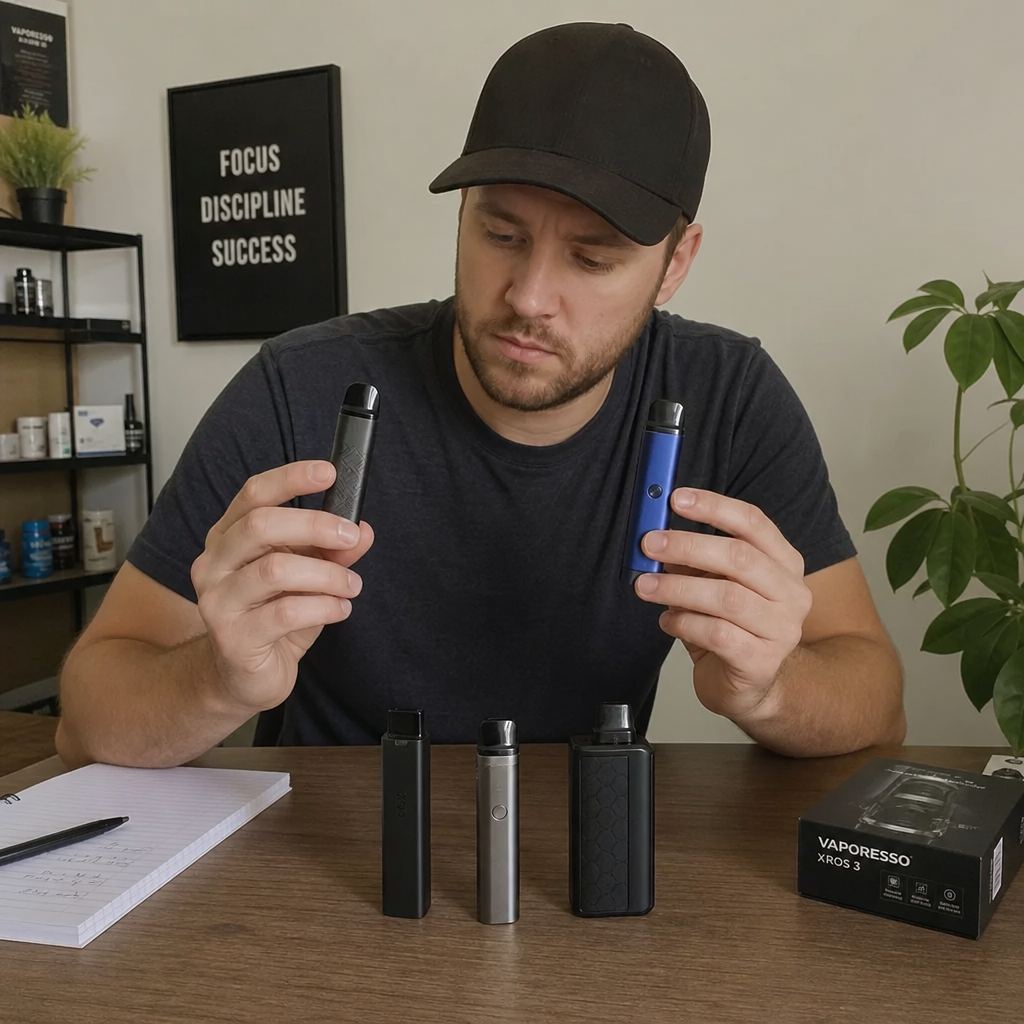

Most smokers who try vaping and fail do not fail because vaping does not work. They fail because of three fixable errors: a device that does not suit them, a nicotine strength that misses their needs, and quitting cigarettes cold turkey on day one. Fix those three things and the switch gets dramatically easier.
This guide is a practical plan, not a theory lecture. It is written for adult smokers who want to replace cigarettes with vaping, with a realistic week-by-week timeline. If you do not smoke, vaping is not for you, and nothing here should convince you otherwise. The information below is general guidance, not medical advice.
For the wider picture of why switching is worth the effort, see our breakdown of cigarettes vs vaping.
The gear decision that decides everything
Smokers who start with the wrong device usually relapse within a week. The logic is simple: your first setup needs to feel familiar, hit fast, and require zero tinkering.
Get a refillable pod kit. Pod kits are small, cheap, and draw like a cigarette. They are the closest thing to the ritual you are replacing, and refilling a pod takes ten seconds. Disposables work as a trial for a day or two, but as a long-term switch device they cost far more and create a mountain of waste. A short list of genuinely beginner-friendly options is in our roundup of the best beginner vapes. If you know you want to refill your own e-liquid from the start, our refillable pod kits guide covers the strongest options.
Use nicotine salt e-liquid, not freebase. This is the detail almost every failed switch has in common. Standard freebase nicotine gets harsh at high strengths, which pushes beginners down to weak liquids that never satisfy their cravings. Nicotine salt stays smooth at higher strengths and absorbs faster, so it kills a craving the way a cigarette does. The difference is explained in full in our nic salt vs freebase guide.
Start with a tobacco or menthol flavour. This sounds dull, and it is supposed to. In the first two weeks, the goal is continuity, not adventure. Familiar flavour makes the swap feel like a change of brand rather than a change of habit. Once cigarettes are out of your life, experiment freely.
Buy spare pods and at least two bottles of e-liquid before your first vape puff. Running out of juice on day three is one of the most common reasons people buy a pack of cigarettes.
Choosing your starting nicotine strength
Too weak and you will vape constantly, still crave, and conclude that vaping does not work. Too strong and you will feel dizzy and put the device down. Match the strength to your current smoking level:
| Cigarettes per day | Recommended nic salt strength | Notes |
|---|---|---|
| 1 to 5 | 10 mg/ml | Light smokers, social smokers |
| 6 to 15 | 20 mg/ml | Average pack-a-day territory starts here |
| 16 or more | 20 mg/ml | The UK legal maximum; chain smokers can start here without issue |
A note on the numbers: in the UK, 20 mg/ml is the legal ceiling, and it is plenty for heavy smokers when paired with a decent pod kit. If you smoke heavily and still feel unsatisfied at 20 mg/ml, the answer is almost never more nicotine; it is usually your technique (see the next section). Heavy smokers often need extra reassurance during the first week, and our guide to vapes for heavy smokers covers setups and habits built for the hardest switches.
The throat-hit adjustment nobody warns you about
Almost everyone coughs on their first vapes. That is normal and it is not a sign that something is wrong. Cigarette smoke and vapour are physically different, and your throat needs a few days to recalibrate. Here is how to get through it:
- Draw slowly. Cigarettes reward a hard, quick pull. Vapes punish it. Take a slow, steady draw of two to three seconds. Think sipping hot tea, not a deep drag.
- Use the mouth-to-lung technique. Pull the vapour into your mouth first, hold it a beat, then inhale to your lungs. This mimics exactly how you smoke and is far gentler than inhaling straight to the lungs. Our how to inhale guide walks through the technique with diagrams.
- Hydrate. Vapour dries your mouth more than smoke does. Keep water nearby and drink more than usual in week one.
- Expect a coughing phase. For most switchers it lasts two to four days. If coughing persists beyond a week, try a slightly lower strength or a different PG/VG ratio rather than abandoning the plan.
Your 4-week switch plan
You do not need to quit cigarettes on day one. The plan below is built around gradual replacement, which produces better long-term results than cold turkey for most people.
| Week | Cigarette target | What you are doing |
|---|---|---|
| Week 1: The overlap | Cut your usual count in half | Vape freely whenever you would normally smoke. Dual use is normal this week. Note which cigarettes you still crave most. |
| Week 2: The squeeze | 2 to 3 per day | Replace the morning cigarette and the after-meal cigarette first. These are the two most people keep longest. |
| Week 3: The last few | 0 to 1 per day | Pick a date for your last cigarette and tell someone. Keep your vape charged and on you at all times. |
| Week 4: The hold | Zero | No cigarettes at all. If cravings spike, vape more, not less. Adjust strength or flavour rather than reaching for a pack. |
Week 1: the overlap. Do not fight the cigarettes you cannot replace yet. A smoker who vapes ten times a day and smokes five cigarettes has already halved their smoking. That is progress, not failure. The cigarettes that survive this week tell you where your real triggers are.
Week 2: the squeeze. Go after the two sacred cigarettes first: the one with your morning coffee and the one after dinner. Replace them with your longest, most deliberate vape sessions. Once those fall, the rest are logistics.
Week 3: the last few. Choose your quit date and announce it to one person. Buy one extra bottle of e-liquid so there is no supply excuse. Most people find that by this point, cigarettes taste worse than they remember. That is your senses recovering, and it is working in your favour.
Week 4: the hold. Zero cigarettes. This is the week where most people either make it or relapse, and relapse almost always comes from one of the mistakes in the next section. Expect cravings to come in waves of a few minutes. They pass whether you smoke or not; vaping just makes them easier to ride out.

The craving playbook: beating your triggers
Cigarettes are not just nicotine. They are a set of rituals attached to moments in your day. You beat them by replacing the ritual, not by white-knuckling through it.
- Morning coffee. Your strongest cigarette of the day. Vape before the coffee is ready, while your hands are busy. Keep the device next to the kettle, not in another room.
- After meals. The meal is over; your brain expects the punctuation mark. Stand up and vape on the spot you used to smoke, or walk while you vape.
- Driving. The commute is autopilot time. Keep the vape in the cup holder or your hand before you turn the key. Never drive somewhere thinking you will resist; set up the replacement first.
- Drinking. Alcohol lowers every resolution you have. If you are drinking with smokers in week one or two, vape more before you go, bring a charged spare pod, and give yourself permission to leave if cravings get serious.
- Stress. This is the one people underestimate. Smoking was your five-minute break from stress, and vaping can be the same break without the cigarette. Step outside, slow draws, five minutes. The pause is the point.
- The two-minute rule. When a craving spikes, vape and wait two minutes. Nicotine salt hits fast. If the craving survives two minutes, vape again. It almost never survives the second round.
The 5 mistakes that cause relapse
These five account for nearly every failed switch. Check yourself against them honestly.
1. Starting on too little nicotine. The number one killer of quit attempts. If you are constantly craving and vaping nonstop, your strength is too low. Step up before you buy a pack.
2. Treating dual use as failure. Vaping while still smoking some cigarettes is how most successful switchers begin. It is a transition, not a cheat. The only failure is giving up the vape entirely.
3. Running out of supplies. Empty pod, dead battery, no spare e-liquid: any one of these sends you to the shop, and the shop sells cigarettes. Always carry a charged device and a spare pod.
4. Expecting vaping to feel identical. It will not feel exactly like smoking. It will feel close enough to satisfy you, and then better, because you can breathe. If you wait for a perfect replica of a cigarette, you will never switch. Accept the 90 percent.
5. Switching flavours too early. A new flavour you hate becomes an excuse to buy cigarettes. Stick with tobacco or menthol for the first month. The dessert flavours can wait.
When to step down your nicotine strength
Do not think about reducing strength until cigarettes are fully gone and have stayed gone for at least a month. Reducing too early is just another way to relapse.
Signs you are ready to step down:
- You regularly forget to vape for hours at a time.
- 20 mg/ml now feels harsh instead of satisfying.
- You want to reduce nicotine for its own sake, not because someone told you to.
The standard ladder is 20 to 10 to 6 to 3 to 0 mg/ml, spending a few weeks at each step. Drop one level, stay there until it feels normal, then drop again. Some people stop at 3 mg/ml and stay there indefinitely. That is fine. The goal was ending cigarettes, and you already won that.
If your end goal is zero nicotine, our nicotine-free vapes guide covers how to make the final jump without the hand-to-mouth habit dragging you back.
The money angle
Here is the motivational math, kept deliberately simple: most daily smokers spend more in a single week on cigarettes than a full starter setup costs. A pod kit, two bottles of e-liquid, and a pack of spare pods usually lands below one week of pack-a-day spending, and from then on your weekly cost is a bottle or two of e-liquid. Every week you stay switched is money that used to go up in smoke. Put the difference in a jar for the first month. Watching it fill is one of the best relapse preventers there is.
FAQs
Is it okay to smoke and vape at the same time while switching? Yes. Dual use in the first couple of weeks is the norm, not a failure. It only becomes a problem if you stop reducing the cigarettes over time.
How long does it take to fully switch from smoking to vaping? Most people who follow a gradual plan are cigarette-free in two to four weeks. Some do it in days, some take a couple of months. The timeline that works is the one you can stick to.
Why do I cough when I start vaping? Your throat is adjusting to vapour, which behaves differently from smoke. Slow mouth-to-lung draws and staying hydrated fix it for most people within a few days. Persistent coughing may mean trying a lower strength.
Should I start with disposables instead of a pod kit? Disposables are fine for a two-day trial to see if vaping clicks for you. For an actual switch, a refillable pod kit is cheaper within weeks, more reliable, and lets you fine-tune your strength.
How long does nicotine stay in your system after I quit? Nicotine itself clears from your blood within a few days of your last exposure, though its main metabolite lingers longer. Read our guide on how long nicotine stays in your blood for the full timeline.
What if I slip and smoke a cigarette? One cigarette is a slip, not a collapse. Do not use it as an excuse to buy a pack. Vape through the next craving, figure out what triggered the slip, and plan around that trigger next time.
Is vaping actually safer than smoking? Vaping is not risk-free, and it is only intended as an alternative for adult smokers, never for non-smokers or young people. That said, removing combustion removes the tar and carbon monoxide that cause most of smoking’s damage.
Your first three moves, today
Do not file this guide away for someday. Three things, today: buy a refillable pod kit with nic salt e-liquid at a strength matched to your smoking level, keep the device on you from the moment you wake up, and replace just two cigarettes tomorrow. That is the entire plan in miniature. Everything else in this guide is just making sure those first steps stick.
One last honest note: this guide is general information for adult smokers, not medical advice. If you have a health condition, are pregnant, or are taking medication, talk to a doctor or pharmacist about quitting options before you start.