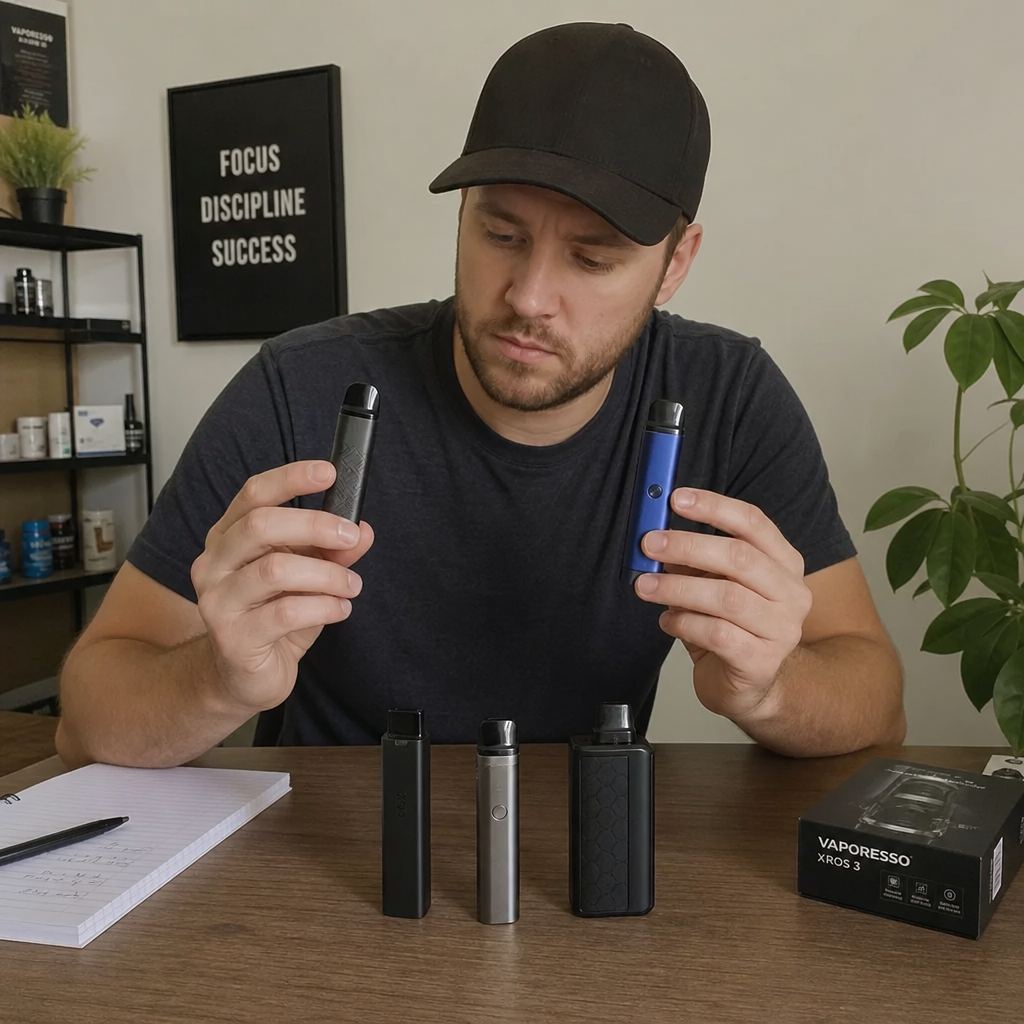

If you have just bought a kit with a screen and a couple of buttons, wattage can feel like a test you did not study for. It is not. Wattage is simply how much power your device sends to the coil, and the coil turns that power into heat. More power means a hotter coil, more vapour, and usually a stronger throat hit. Less power means a cooler, gentler vape and a longer lasting battery.
The right number is the one where flavour tastes full, the draw feels comfortable, and the coil stays happy. That number changes with your coil, your liquid, and the way you inhale.
The 30 second answer
Most vapers land in one of these bands. Find your device type, start at the low end of its band, and work up slowly.
| Device type | Typical wattage | Who it suits |
|---|---|---|
| Disposable or fixed-output pod | 7-12W, no adjustment | Anyone who wants zero settings |
| Mouth-to-lung pod kit | 8-20W | Ex-smokers and discreet, everyday vapers |
| Restricted lung pod or pod mod | 15-35W | Vapers who want more vapour and a looser draw |
| Sub-ohm tank on a mod | 40-80W | Cloud and flavour chasers with low nicotine liquid |
| Rebuildable tank or dripper | 30-90W, build dependent | Experienced vapers who build their own coils |
Read your coil before you touch a button
Every coil has a recommended wattage range printed on the coil itself, on the pod, or on the box it came in. That printed range beats any chart, including the ones in this guide, because it was set for that exact coil. A general chart is a fallback for when the printing has rubbed off or the box is long gone.
Look for two numbers, for example 12-18W. The lower number is your safe starting point. The higher number is a ceiling, not a target. Most coils taste best somewhere in the lower to middle part of their range, not at the top.
Two details on the coil matter as much as the wattage range. The first is resistance, measured in ohms. Lower resistance coils need more power, and higher resistance coils need less. The second is the wick inside the coil. A fresh coil needs time to soak up liquid before you fire it, or you will scorch dry cotton on the first puff. Fill the pod or tank, wait five to ten minutes, and only then start at the bottom of the range.
If your device sets wattage automatically when you insert a new pod, let it do its job. Smart and auto modes read the coil resistance and pick a sensible starting point. You can still nudge the number up or down from there.
The five puff method to find your wattage
Forget guessing. Use this method every time you fit a new coil or switch to a very different liquid.
- Set the wattage to the bottom of your coil’s printed range, or 2-3W below the middle of the range if your device only shows a single suggested number.
- Take two or three normal puffs and pay attention to flavour, warmth, and throat hit, not cloud size.
- Raise the wattage by 2W and take two or three more puffs.
- Repeat until flavour suddenly tastes fuller and warmer without turning harsh. That is your sweet spot.
- Stop there. Going higher from that point usually adds heat and vapour but takes flavour away.
Give each step a fair test. Chain vaping five puffs in a row at each setting will overheat the coil and confuse the result. Pause between puffs, let the wick re-soak, and judge the second or third puff at each setting rather than the first.

How resistance, liquid, and draw pull together
Wattage never works alone. Three things decide how a setting feels: the coil resistance, the liquid, and how you inhale.
Resistance sets the power band. A 1.2 ohm coil is built for low power and a tight, cigarette-like draw. A 0.4 ohm coil is built for much more power and a loose, lung-filling draw. Trying to force a high resistance coil to behave like a cloud coil, or a low resistance coil to run at 10W, will disappoint you either way.
Liquid type matters just as much. Nicotine salts are smooth at higher strengths and are made for low power, mouth-to-lung vaping. Run a 20mg nic salt at 40W and the hit will be harsh, and you will likely feel lightheaded from taking in too much nicotine too fast. Freebase nicotine is harsher at higher strengths but shines at lower strengths in bigger, warmer devices.
Then there is the thickness of the liquid, described by its PG/VG ratio. PG is thin and carries flavour and throat hit sharply. VG is thick, slightly sweet, and makes bigger clouds. Thin 50/50 liquid wicks fast and suits low power pods. Thick 70/30 liquid needs bigger wick openings and more power, which is why it belongs in sub-ohm tanks. Put thick liquid in a small pod coil and you will get dry hits, because the wick cannot keep up. Put thin liquid in a high power tank and you will get flooding and spitback, because the coil is drowned.
Here is the quick reference table for the coil resistances most pod vapers actually meet. Treat the sweet spot column as the place most people settle, and always check your own coil’s printed range first.
| Coil resistance | Full range | Sweet spot | Draw style | Best liquid match |
|---|---|---|---|---|
| 1.2 ohm | 8-14W | 10-12W | Tight mouth-to-lung | Nic salts 10-20mg, or 50/50 |
| 1.0 ohm | 10-16W | 12-14W | Mouth-to-lung | Nic salts, or 50/50 freebase |
| 0.8 ohm | 12-20W | 14-17W | Loose mouth-to-lung | Nic salts, or 50/50 freebase |
| 0.6 ohm | 15-25W | 18-22W | Restricted lung | 50/50, or 60/40 VG/PG |
| 0.4 ohm | 20-35W | 25-30W | Restricted or direct lung | 60/40, or 70/30 VG/PG |
Notice how the sweet spot climbs as resistance falls. That pattern holds across almost every kit: lower ohms, higher watts, more vapour, lower nicotine strength.
When you cannot change the wattage at all
A huge number of kits give you no wattage button, and that is a feature, not a flaw. Fixed-output pods and disposables are set at the factory to suit the coil and liquid they ship with, usually somewhere around 7-12W.
If your fixed device tastes too harsh, too weak, or just wrong, change something other than wattage, because wattage is off the table. Try a different coil resistance in the same pod range if your kit supports it: a higher resistance coil will give a cooler, tighter vape, while a lower resistance coil will give a warmer, looser one. Try a different nicotine strength, since dropping from 20mg to 10mg often fixes harshness faster than any setting change. Open or close the airflow slider if your kit has one, because more air cools the vapour and softens the hit, while less air warms it and concentrates flavour.
Auto-wattage devices sit in the middle. They pick a starting wattage when they detect a new coil, and some let you adjust from there while others lock you in. If yours locks you in and the vape tastes burnt from the first pod, the coil may be faulty or the liquid may be too thick for it.
If you are moving from disposables to a refillable kit and want a similar feel, a low power pod with nic salt liquid is the closest match, as our roundup of the best disposable vapes shows. The honest test for a fixed device is simple: does it satisfy you without fuss? If it does, you do not need adjustable wattage at all. Adjustable power is for people who enjoy tuning, switch liquids often, or use several coil types. It is not a requirement for a good vape.
Battery life, coil life, and staying safe
Wattage is a trade. Every extra watt costs battery life, liquid, and coil life. If your liquid budget matters, vape juice prices are worth checking before you commit to a thirsty sub-ohm setup. A pod running at 12W can easily last a full day on a single charge, while the same battery running a sub-ohm tank at 60W may need charging by lunchtime. That is normal physics, not a faulty battery.
Running too hot is the fastest way to kill a coil. When the coil runs hotter than the wick can handle, liquid vaporises faster than it can soak in, the cotton scorches, and the burnt taste stays even after you turn the power back down. A scorched coil cannot be rescued. Turn the wattage down and fit a fresh coil.
A healthy coil usually lasts one to two weeks for a mouth-to-lung vaper, and a few days to a week for a heavy sub-ohm vaper. Sweet, dark liquids gunk up coils faster than clean fruit or menthol liquids, because sweetener caramelises on the coil. Signs your coil is done include flavour that stays muted or slightly burnt after a fresh fill, and a draw that feels tighter than it used to.

Battery safety is mostly common sense, and it matters more as wattage climbs. Use the charger and cable your device came with, or a reputable replacement. Do not charge a device on a soft surface under a pillow, and do not leave loose spare batteries rattling around in a pocket with keys or coins, since damaged battery wraps can short. If a battery wrap is torn or the battery is swollen, dented, or gets hot while charging, stop using it.
Now for the myths, because wattage advice is full of them.
Myth: more watts always means more flavour. Reality: flavour peaks in the middle of a coil’s range. Past that point, heat flattens delicate notes, so flavour gets worse, not better.
Myth: you must use the maximum wattage your device offers. Reality: the maximum is a headline number, not a recommendation. Almost nobody vapes a 200W device at 200W all day.
Myth: low wattage means a bad vape. Reality: some of the most satisfying everyday setups run at 10-15W with the right nicotine strength.
Myth: one wattage suits every liquid. Reality: a thin fruit nic salt and a thick dessert shortfill want different power levels even on the same kit.
Troubleshooting: what the symptom is telling you
Use this table like a diagnosis chart. Match your symptom, try the fix in order, and only change one thing at a time so you know what actually worked.
| Symptom | Most likely cause | Fix to try first |
|---|---|---|
| Burnt or harsh taste | Wattage too high, or coil scorched | Drop 3-5W, pause between puffs, fit a new coil if the taste stays |
| Weak, thin flavour | Wattage too low, or coil worn out | Raise wattage by 2W steps, replace the coil if flavour stays flat |
| Gurgling or leaking | Wattage too low, or liquid too thin for the coil | Raise wattage slightly, check the pod seal, switch to a thicker liquid |
| Spitback, hot droplets | Flooded coil, or power too low to vaporise properly | Raise wattage a little, flick the pod gently over tissue, avoid overfilling |
| Harsh throat hit | Nicotine too strong for the power level | Drop the nicotine strength, drop 2-3W, open the airflow |
| Battery dying fast | High wattage, or old battery | Lower wattage, carry a charged spare, replace an ageing battery |
| Coil lasting only a day or two | Wattage above the coil range, or very sweet liquid | Stay inside the printed range, prime new coils fully, try a cleaner liquid |
If you are still deciding what kind of device suits you before you worry about settings, the SBX vape review is a useful look at a fixed-output style device. The guide to SBX vape modes shows how preset power modes work when a device gives you a choice without a full wattage dial. For the wider question of how vaping compares with smoking, our piece on vaping versus smoking puts the whole habit in context.
Quick questions, answered
What wattage should a beginner start at? Start at 10-15W with a 0.8 or 1.0 ohm pod coil and nic salt or 50/50 liquid. That band is gentle, flavourful, and forgiving. Move up only if the draw feels too cool or weak.
Is 20W a lot for a pod kit? Not for a 0.6 ohm restricted lung pod, where 20W sits near the sweet spot. It is too much for a 1.2 ohm mouth-to-lung coil, where 20W is well above the printed range. The coil decides, not the number alone.
What happens if I vape below the recommended range? You will get thin flavour, weak vapour, and possibly gurgling, because the coil is not hot enough to vaporise the liquid cleanly. Nudge the power up in 2W steps until flavour fills out.
What happens if I vape above the recommended range? The wick dries out faster than it can re-soak, flavour turns burnt, and the coil dies early. Drop back inside the range immediately. If the burnt taste survives a fresh fill at the right wattage, the coil is already scorched and needs replacing.
Your starting number, in one checklist
Before your next puff, run through this list. It takes ten seconds and prevents most wattage problems.
- Check the coil’s printed range and start at its low end.
- Prime a new coil: fill, wait five to ten minutes, start low.
- Climb in 2W steps, tasting as you go, and stop at the sweet spot.
- Match liquid to coil: nic salts and 50/50 for low power, thicker liquid for higher power.
- If it tastes burnt, drop the power or change the coil. Do not push through it.
- If it tastes weak, raise the power a little or check whether the coil is worn out.
- If you cannot change the wattage, change the coil, the liquid strength, or the airflow instead.
Wattage is not a score to maximise. It is a dial to tune until the vape tastes like it should: full, smooth, and comfortable, puff after puff. Find your number with the five puff method, write it down for each coil you use, and you will stop thinking about wattage altogether.