
In a Brussels meeting room a decade ago, a handful of officials settled the exact size of the vape bottle on your desk. Ten millilitres. Two millilitres for the tank. Twenty milligrams of nicotine per millilitre, no more. Those numbers were not picked by the market, they were written into law, and they still shape every legal vape sold across Europe today.
The law in question is the Tobacco Products Directive, formally Directive 2014/40/EU, and Article 20 of it is the section that turned e-cigarettes from a grey-market curiosity into one of the most tightly specified consumer products in the EU. Here is what it actually requires, why the numbers are what they are, where Britain now goes its own way, and what a revision in Brussels could change next.
The directive behind the numbers
The original Tobacco Products Directive dates back to 2001, but it said nothing about vaping. The revision that matters was adopted in April 2014, entered into force on 19 May 2014, and gave member states until 20 May 2016 to write it into national law. Article 20 was the first piece of pan-European legislation ever written specifically for e-cigarettes.
Its stated aims were twofold: make the internal market function smoothly for these products, and protect health, particularly among young people. Every rule below flows from that double mandate, and every member state had to transpose it, meaning the directive itself binds governments, and the national laws that governments wrote bind businesses and shoppers. That is also why enforcement details vary a little from country to country even though the core numbers are identical everywhere.
The six numbers that design every European vape
If you want the whole directive in one glance, this is it. Every other section of this article is just these six rules explained.
| Rule | The limit | Where it sits in the law |
|---|---|---|
| Maximum nicotine strength | 20 mg/ml (2%) | Article 20(3)(b) |
| Refill bottle volume | 10 ml maximum | Article 20(3)(a) |
| Tank, pod or cartridge capacity | 2 ml maximum | Article 20(3)(a) |
| Health warning size | 30% of the two largest pack surfaces | Article 20(4)(b)(i) |
| Product notification deadline | 6 months before going on sale | Article 20(2) |
| Child-proof and leak-free design | Mandatory | Article 20(3)(g) |
Why twenty is the magic number
The 20 mg/ml cap is the single most consequential number in the TPD. Above that threshold, nicotine liquid cannot be sold as an ordinary consumer product at all. Products with higher strength, or products marketed with therapeutic claims such as helping you quit smoking, are pushed out of the consumer lane and into the medicines framework, where they need a full marketing authorisation like any drug.
For ordinary vapes, the label math is simple: 20 mg/ml is 2% nicotine, and that is the ceiling printed on every legal bottle from Lisbon to Helsinki. Anything advertised at 5%, the figure you still see on non-compliant imports and parallel-market webshops, is 2.5 times over the legal maximum in the EU. The 20 mg/ml line also explains why the old cig-a-like and refillable markets split the way they did: manufacturers had to reformulate for the cap, and the 2% figure became the standard strong strength across Europe.
Why your juice comes in tiny bottles
The 10 ml refill container limit and the 2 ml tank limit are the rules you feel most directly as a shopper. A nicotine-containing e-liquid can only be placed on the market in dedicated refill containers of no more than 10 ml. Disposable e-cigarettes, single-use cartridges, pods and tanks are capped at 2 ml of liquid each.
These limits were written to restrict how much nicotine a single unit can hold. They are also why shortfills exist: nicotine-free e-liquid falls outside the volume caps, so larger bottles of zero-nicotine juice are sold with a separate nicotine shot that the user mixes in. That workaround is entirely legal under the directive, though it irritates regulators, because the nicotine-containing component itself still obeys the 10 ml rule.
The small bottles carry a price consequence in Britain now. The UK vape tax adds £2.20 per 10ml of e-liquid, a levy designed to map neatly onto the TPD bottle size. It is one more reason vape juice prices look very different in 2026 than they did a few years ago.
What must be printed on the box
Open any TPD-compliant pack and the information density is deliberate. The directive dictates the packaging as carefully as the liquid.
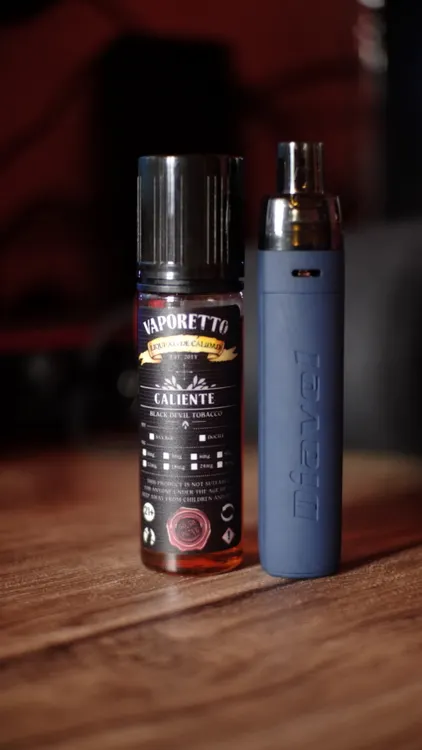
First, the health warning. Every unit packet and any outside packaging must carry the words “This product contains nicotine which is a highly addictive substance” on the two largest surfaces, covering at least 30% of each surface. It must be printed in the official language or languages of the country where the product is sold, in black Helvetica bold on a white background, and it must be visible, legible and indelible.
Second, the leaflet. Every pack must include instructions for use and storage, including a note that the product is not recommended for use by young people and non-smokers. It must list contraindications, warnings for specific risk groups, possible adverse effects, addictiveness and toxicity, a full list of all ingredients in descending order of weight, the nicotine content, and the nicotine emission per dose. The batch number must be on the pack, along with a recommendation to keep the product out of reach of children.
Third, the design itself. E-cigarettes and refill containers must be child-resistant and tamper-evident, protected against breakage and leakage, and fitted with a mechanism that ensures refilling without leakage. They must also deliver nicotine doses at consistent levels under normal conditions of use, a requirement that pushed manufacturers toward proper dosing engineering rather than guesswork.
Fourth, what the pack may not say. Promotional elements are restricted: packaging cannot suggest health benefits, cannot imply the product is less harmful than alternatives, cannot carry flavour imagery that evokes food or cosmetics, and cannot claim the presence of vitamins or stimulants. Only ingredients of high purity may be used in the liquid, and additives listed in Article 7(6), such as caffeine, taurine and colourings with carcinogenic, mutagenic or reprotoxic properties, are explicitly banned from nicotine-containing liquids.
The six-month paper trail nobody sees
Before a vape ever reaches a shelf, its maker must file paperwork most shoppers never hear about. Manufacturers and importers have to submit a notification to the competent authority of each member state where they intend to sell, and it must land six months before the product is placed on the market. A new notification is required for every substantial modification of the product.
The dossier is serious. It must name the manufacturer and the responsible person within the EU, list every ingredient and every emission the product produces when used, with quantities, provide toxicological data on those ingredients and emissions as inhaled, describe the nicotine doses and uptake under normal or reasonably foreseeable use, detail the components including the opening and refill mechanism, and describe the production process along with a declaration that the maker takes full responsibility for the quality and safety of the product.
In practice this is submitted through the EU Common Entry Gate, the EU-CEG portal, and member states may charge proportionate fees for receiving and analysing the filings. The practical effect is a slow, deliberate pipeline: a genuinely new device takes at least half a year from finished design to legal sale in a given country, and tweaks to the formula or hardware restart the clock.
Where the advertising line is drawn
The directive treats vape advertising much like tobacco advertising, with restrictions that are broad but not total. Commercial communications in information society services, meaning online advertising, along with press, other printed publications, radio and television, are prohibited when they aim, directly or indirectly, at promoting e-cigarettes or refill containers.
There are carve-outs. Publications intended exclusively for professionals in the trade are exempt, as are printed publications printed and published in third countries, provided they are not principally intended for the EU market. Member states also got two optional powers: they may ban cross-border distance sales, meaning online sales into their territory from abroad, and around a dozen of them have done so. The result is a patchwork where a vape ad that is legal in one member state can be unlawful in the next, which is why most brands simply do not run cross-border campaigns at all.
Compare that with the United States, where the system is authorisation-first rather than notification-first. Manufacturers must win marketing orders from the FDA before selling, and the FDA authorized vapes list shows how few products have actually cleared that bar.
Across the Channel: Britain’s fork in the road
Brexit changed the landlord, not the building. When the UK left the EU, it kept the TPD framework in domestic law through the Tobacco and Related Products Regulations 2016, and the MHRA took over the notification role that EU-CEG plays on the continent. For years after Brexit, a vape legal in Paris was legal in London, down to the same 20 mg/ml, 10 ml and 2 ml numbers.
Now the divergence is real. On 29 April 2026, the Tobacco and Vapes Bill received Royal Assent and became the Tobacco and Vapes Act 2026. Its first enforcement wave lands on 29 October 2026, closing the loopholes the TPD never covered: the minimum age of 18 for buying vapes and nicotine products now extends to zero-nicotine vapes, promotional giveaways and nominal-price discount gimmicks are restricted, and unattended pub vending machines lose their place. Local authorities gain new enforcement powers, including £200 fixed penalty notices for certain offences.
Then comes the bigger break. On 1 January 2027, the UK introduces its generational tobacco ban: it becomes illegal to sell tobacco products, herbal smoking products or cigarette papers to anyone born on or after 1 January 2009, with the cut-off moving forward one year each year. The TPD contains nothing like this, and Brussels has no equivalent on the table.
| EU (TPD) | UK (post-Brexit) | |
|---|---|---|
| Nicotine cap | 20 mg/ml | 20 mg/ml (unchanged) |
| Bottle and tank limits | 10 ml / 2 ml | 10 ml / 2 ml (unchanged) |
| Product notification | EU-CEG, 6 months | MHRA, 6 months |
| Advertising | Cross-border and media bans under Article 20(5) | Equivalent domestic bans, plus new powers under the Tobacco and Vapes Act 2026 |
| Zero-nicotine vapes | Outside nicotine rules | 18+ age of sale from 29 October 2026 |
| Generational tobacco ban | No equivalent | From 1 January 2027 for those born on or after 1 January 2009 |
The revision brewing in Brussels
The TPD is now more than a decade old, and everyone in Brussels knows it. The directive was written before disposable vapes existed in their current form, before nicotine pouches became a mass-market product, and before influencer marketing rewired how these products reach young people. A revision is on the way, and eight health ministers have just tried to write its opening chapter.
On 6 October 2026, the health ministers of the Netherlands, Belgium, Finland, France, Hungary, Latvia, Slovenia and Spain sent a joint letter to Olivér Várhelyi, the European Commissioner for Health and Animal Welfare. Their argument is that the 2014 rules have regulatory gaps the market has already driven through. Their wish list is sweeping: a market freeze that would stop any new nicotine or nicotine-like product from entering the EU market, permission for member states to ban nicotine pouches outright, stricter nicotine limits, an EU-wide flavour ban, standardised plain packaging and standardised devices, tougher advertising restrictions aimed at social media influencers, and a complete ban on cross-border distance sales within the bloc. The stated goal is a smoke-free generation in Europe by 2040, the ambition set out in Europe’s Beating Cancer Plan.
Expect heavy resistance. Harm-reduction advocates argue that freezing the market would shield cigarettes from competition and push smokers back toward the one legal nicotine product that kills them, pointing to Sweden, where snus and pouches are legal and the smoking rate is the lowest in the EU. Industry voices warn the proposals would make the European market unprofitable for legal manufacturers while leaving the parallel market of non-compliant imports untouched. Whether the Commission adopts the ministers’ speed as well as their substance is the open question, but the political pressure for an accelerated revision is now on the record.
For shoppers, the revision matters because it could redraw the table at the top of this article. A flavour ban or a tighter nicotine cap would change what legal products look like far more than any tax. The shift is already visible in the best disposable vapes conversation, where reusable pod systems are steadily replacing single-use puffs as France and others move against disposables.
What this means for the person actually vaping
Strip away the legalese and the TPD has done two big things for European vapers. It made the products safer and more consistent: child-proof bottles, honest labels, tested liquids, and a notification system that keeps mystery hardware off the market. And it made them smaller and weaker than what you find in many other parts of the world: 2% nicotine, 2 ml tanks, 10 ml bottles, no exceptions.
Whether the next version of the directive tightens those numbers further or finally addresses the black market that ignores them entirely is the fight now beginning in Brussels. It is worth following closely, because the eight ministers’ letter shows how fast the debate is moving. And if you are wondering why any of this matters for health at all, our cigarettes vs vaping comparison lays out what the evidence actually says about the two alternatives Europe’s lawmakers are choosing between.