
Vaping is legal for adults in the UK, but advertising a vape is one of the most restricted things a business can do in Britain. No newspaper ads, no website ads, no social media posts, no influencer deals, no sports sponsorship. And from 1 June 2027, no advertising at all. This guide pulls the whole system together: the law, the advertising watchdog’s code, the social media minefield, retailer point-of-sale rules, how the October 2026 age-restriction changes interact with advertising, and the penalties for getting it wrong. It is part of our ongoing vape news coverage.
Two referees, one rulebook
Two systems police UK vape advertising in parallel, and both can punish you.
The first is criminal law: Part 7 of the Tobacco and Related Products Regulations 2016, in force since 20 May 2016, bans the advertising of unlicensed, nicotine-containing e-cigarettes and their components in certain media. Breaches are criminal offences enforced by Trading Standards. The second is the advertising industry’s own watchdog: the Advertising Standards Authority (ASA) enforces the CAP Code (the UK Code of Non-broadcast Advertising and Direct and Promotional Marketing), whose section 22 covers electronic cigarettes whether or not they contain nicotine.
The two systems deliberately overlap. The CAP Code’s media ban (rule 22.12) mirrors the criminal ban in the 2016 Regulations, while rules 22.1 to 22.11 add detail about what an ad may say, who may appear in it, and who it may target. The 2016 Regulations even instruct enforcement authorities to favour established self-regulatory means first, a nod to the ASA. In practice, complaint-driven brand cases land with the ASA, while Trading Standards handles the retail end.
Where vape ads are already banned outright
Since 2016, ads that directly or indirectly promote unlicensed nicotine vapes have been prohibited in:
- Newspapers, magazines, and periodicals
- Online media and other electronic media, including paid search ads, banner ads, paid social placements, and commercial email
- TV and radio (through the broadcast codes and Communications Act amendments)
- Sponsorship of radio and TV programmes that promotes e-cigarettes
- Cross-border event, activity, or sponsorship deals with a promotional effect
The net is cast wide: anything with the direct or indirect effect of promoting a vape counts, not just explicit ads. ASA rulings have caught even an incidentally visible brand logo in a store photo and a paid video-platform ad featuring devices and a discount code.
| Media channel | Vape ads allowed today? |
|---|---|
| Newspapers, magazines, periodicals | Banned |
| Online and social media (paid or promotional) | Banned |
| Paid search, banners, commercial email | Banned |
| TV and radio | Banned |
| Billboards and outdoor posters | Allowed (content rules apply) |
| Cinema | Allowed (content rules apply) |
| Leaflets, direct mail, private correspondence | Allowed (content rules apply) |
| Point-of-sale displays in shops | Allowed (content rules apply) |
| Trade-only publications and events | Allowed (content rules apply) |
| Sponsorship with cross-border effect | Banned |
Where you can still advertise, for now
The media the law does not cover remain open, but everything published there is still bound by the CAP Code’s content rules: outdoor advertising including digital billboards, posters on public transport that do not leave the UK, cinema, direct hard-copy mail, leaflets, trade-only media, and private correspondence with individual consumers.
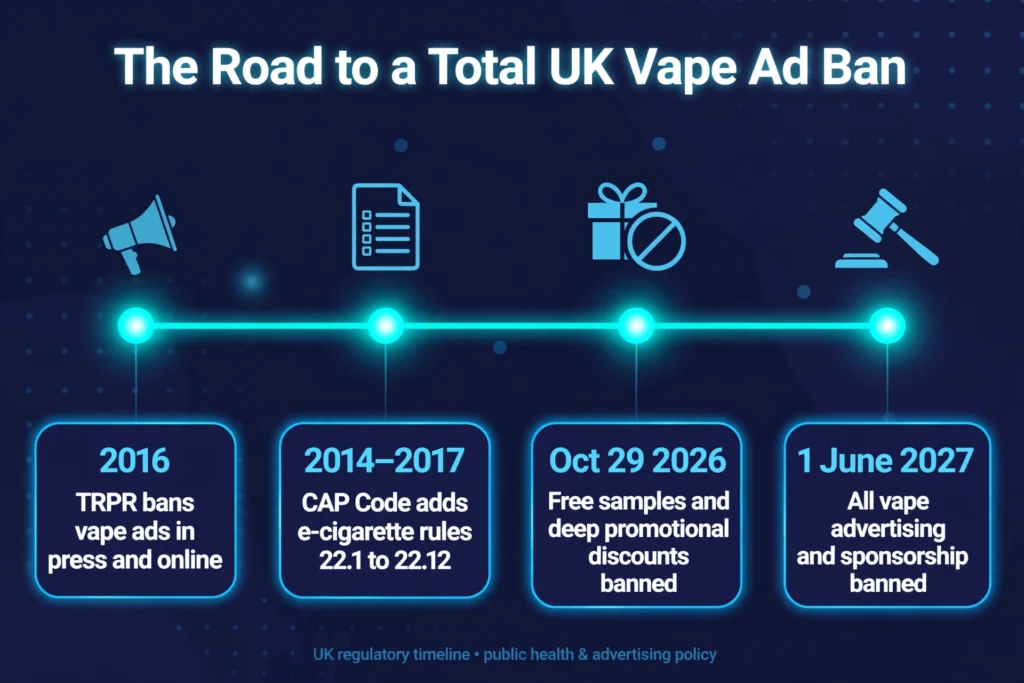
Every channel on this list is curtailed from 1 June 2027, when the Act switches on its full advertising and sponsorship ban. The squeeze is not only about ads either: the new UK vape duty has reshaped pricing across the market, and the advertising ban is the second half of that pincer.
What your ad is allowed to say
Even where ads are permitted, the CAP Code’s content rules dictate what they may contain. They apply whether or not the product contains nicotine:
| Rule area | What it means in practice |
|---|---|
| Social responsibility | Ads must be socially responsible overall |
| Tobacco imagery | No borrowing tobacco branding, logos, or design styles; nothing may promote tobacco use or show it in a positive light |
| Honest identity | The ad must make clear the product is an e-cigarette and not a tobacco product |
| Health and medical claims | No medicinal claims, including stop-smoking claims, unless the product holds MHRA authorisation. Health claims need robust evidence specific to your own product, not vaping in general |
| Quit messaging | Vapes may be presented as alternatives to tobacco, but ads must not undermine the message that quitting tobacco entirely is best for health |
| Endorsements | Health professionals must not be used to endorse e-cigarettes |
| Nicotine disclosure | If the product contains nicotine, the ad must say so clearly |
| Non-smokers | Ads must not encourage non-smokers or non-nicotine users to take up vaping |
| Under-18 appeal | Ads must not appeal particularly to under-18s, especially through youth culture; characters likely to appeal to them are off limits |
| Age of models | Anyone shown using a vape or playing a significant role must be, and seem to be, at least 25 |
| Media targeting | Ads must not target under-18s through media choice; no medium may be used if more than 25 percent of its audience is under 18 |
The 25 percent audience rule means a billboard near a school or a cinema slot before a family film is effectively off limits, and the under-25 model rule kills most lifestyle creative.
Factual versus promotional: the line that decides everything
This distinction is the most important concept in UK vape advertising law. Promotional content for unlicensed nicotine vapes is banned in the listed media, while factual claims are permitted on a marketer’s own website and, in some circumstances, in other non-paid-for online space under the marketer’s control.
A retailer’s own website may carry factual product information: specifications, ingredients, price. It may not turn that space into a promotional campaign. A discount code splashed across an Instagram post was treated by the ASA as clearly promotional, not factual, and banned. The current CAP position is that promotional content on social media is prohibited, and only factual claims in non-paid-for space under the marketer’s control have any protection. Brands should treat their social feeds as factual-information-only channels and assume anything designed to encourage a purchase will be treated as an ad.
Social media and influencers: the danger zone
CAP guidance treats ads in paid-for social media placements, advertisement features, or contextually targeted branded content as likely prohibited, and ASA rulings back that up. The regulator has repeatedly upheld complaints over influencer activity, including one case where an influencer’s posts promoting a brand’s devices breached the media ban, and another where an Instagram ad featuring branded devices alongside a discount code was banned as promotional content in a prohibited medium.
The lesson for brands is blunt: paying or gifting an influencer to feature your vapes is treated as your own marketing communication and judged against the same media ban as a newspaper ad. A creator “reviewing” a free device is not independent editorial content if there was a commercial relationship. Independent editorial reviews with no commercial arrangement, such as our device reviews, are different: journalism is not a marketing communication made in the course of business.
What retailers can still do at the till
For vape shops, the point of sale remains the last real promotional channel. Retailers may display vapes and accessories in store, talk to customers about the products, and show responsible, factual, or educational posters and materials. An in-store display that would be illegal in a magazine is legal behind the counter. But everything shown must still satisfy the CAP Code’s content rules, and the shop’s social media pages are judged by the online rules, not the point-of-sale rules: posting an in-store promotion to Facebook or Instagram instantly moves it into a banned medium.
How the 29 October 2026 changes tighten the net
The Tobacco and Vapes Act 2026 took effect in its first wave on 29 October 2026, and three provisions reach into advertising and promotion.
First, the age of sale of 18 now applies to every vaping and nicotine product, including zero-nicotine vapes, e-liquids, nicotine pouches, strips, and pearls, with an offence for adults buying them for under-18s. This widens the pool of products whose marketing must avoid under-18s and brings zero-nicotine products inside the regulatory frame.
Second, promotional practices are criminalised. Giving away vaping or nicotine products, or coupons for them, for promotional purposes is an offence, as is selling them at a substantial discount with a promotional purpose or effect. Normal clearance sales, bulk discounts, and trade discounts remain permitted, but free samples and steep promotional pricing are gone, in store and online. Products supplied through publicly supported stop-smoking programmes are excluded.
Third, enforcement got teeth: a £200 fixed penalty in England, Wales, and Scotland (£250 planned for Northern Ireland), temporary sale restrictions for repeat violations, and an outright ban on vending machines for vapes and nicotine products, except in adult inpatient mental health settings in England and Wales.
Shoppers still want guidance on what to buy, which is why independent roundups like our best disposable vapes guide matter more than ever: when brands cannot promote themselves, editorial coverage fills the gap.
1 June 2027: the total ban
From 1 June 2027, the Tobacco and Vapes Act 2026 bans the advertising and sponsorship of vaping and nicotine products across the UK, treating them the same way tobacco advertising has been treated for years.
Publishing, designing, printing, or distributing an advertisement in the course of business becomes a criminal offence where its effect is to promote a vaping or nicotine product. Providing an internet service by means of which such an ad is published is also caught. The ban explicitly covers online advertising: paid website adverts, social media posts, and sponsored influencer content. Sponsorship is criminalised too: contributing under a sponsorship agreement is an offence where anything done as a result promotes a vaping or nicotine product in the UK.
What survives is deliberately narrow: factual, non-promotional information on retail websites, and public-health activity outside the course of business, such as GPs promoting non-branded vapes under agreed arrangements. Detailed government guidance is due before implementation, alongside updated Ofcom and CAP codes.
What breaking the rules costs
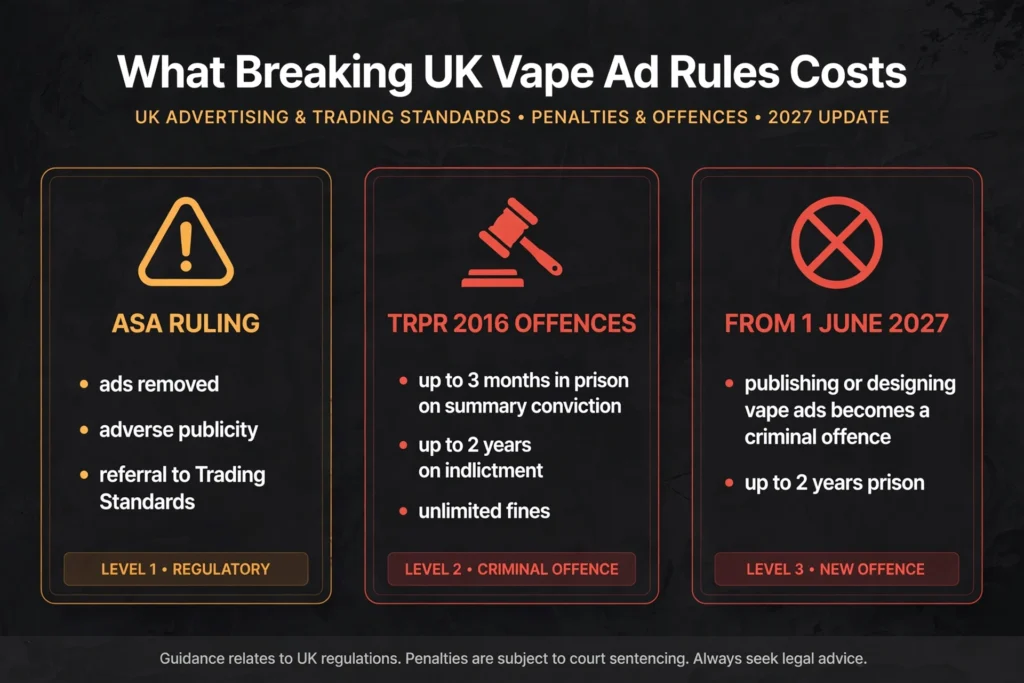
There are three layers of consequences, and they stack. The ASA is the first: upheld rulings mean ad withdrawal and publication of the ruling, with persistent offenders referred to Trading Standards or Ofcom, and the ASA can also work with search engines to remove paid-for ads. The second layer is criminal prosecution under the 2016 Regulations for breaching the advertising and sponsorship provisions (regulations 42 to 44), with defences including all due diligence and not knowing, or having no reason to suspect, the material was an e-cigarette advertisement. Corporate officers can be personally liable where the offence had their consent or connivance, or stemmed from their neglect. The third layer, from 1 June 2027, is prosecution under the Tobacco and Vapes Act 2026.
| Regime | Offence | Maximum penalty |
|---|---|---|
| ASA (self-regulatory) | Breach of CAP Code section 22 | Ad withdrawal, published ruling, referral to Trading Standards or Ofcom |
| TRPR 2016, reg 51 (summary, England and Wales) | Breach of advertising/sponsorship rules (regs 42-44) | Up to 3 months imprisonment, a fine, or both |
| TRPR 2016, reg 51 (summary, Scotland) | Breach of advertising/sponsorship rules (regs 42-44) | Up to 12 months imprisonment, a fine up to level 5, or both |
| TRPR 2016, reg 51 (summary, Northern Ireland) | Breach of advertising/sponsorship rules (regs 42-44) | Up to 3 months imprisonment, a fine up to level 5, or both |
| TRPR 2016, reg 51 (on indictment) | Breach of advertising/sponsorship rules (regs 42-44) | Up to 2 years imprisonment, a fine, or both |
| Tobacco and Vapes Act 2026, ss 118-119 (on indictment) | Publishing, designing, or printing vape/nicotine ads; sponsorship | Up to 2 years imprisonment, a fine, or both |
| Tobacco and Vapes Act 2026, ss 118-119 (summary, England and Wales) | Publishing, designing, or printing vape/nicotine ads; sponsorship | Up to 12 months imprisonment, a fine, or both |
| Tobacco and Vapes Act 2026, s 15 | Free distribution or substantial promotional discounts (from 29 Oct 2026) | Up to 2 years imprisonment on indictment; up to 12 months on summary conviction in England and Wales, a fine, or both |
A practical checklist for shops and brands
If you sell or market vapes in the UK, this is the compliance shape of the current law.
- Keep website product pages factual: specifications, ingredients, nicotine strength, price. No promotional campaigns there.
- Use the remaining permitted channels: in-store displays, billboards, cinema, leaflets, trade press. Every one must follow the CAP Code’s content rules.
- Age-gate everything: every product now carries an 18-plus age of sale, including zero-nicotine vapes and nicotine pouches.
- Do not run paid ads on social media, search engines, or any website for unlicensed nicotine vapes.
- Do not pay influencers, gift them products, or incentivise them to feature your devices. The ASA treats it as your ad.
- Do not post in-store promotions to your shop’s social media pages. That moves them into a banned medium.
- Do not give away free samples, free coupons, or steep promotional discounts. Since 29 October 2026 that is a criminal offence.
- Do not make stop-smoking or health claims without MHRA authorisation, and never use health professionals to endorse products.
- Prepare for 1 June 2027: audit every channel you use, because the full ban will criminalise most of them.
Quick answers to common questions
Can a vape shop promote products on Instagram? No, not promotionally. Paid-for social media placements and promotional content for unlicensed nicotine vapes are banned in online media. Only factual claims in non-paid-for space under the marketer’s control have any protection, and anything designed to encourage a purchase is treated as promotional.
Can an ad say vaping is healthier than smoking? Not without MHRA authorisation as a medicine. A vape may be presented as an alternative to tobacco, but the ad must not undermine the message that quitting tobacco entirely is best for health.
Do the rules cover zero-nicotine vapes? The CAP Code’s content rules apply whether or not the product contains nicotine. The press and online media ban targets unlicensed nicotine-containing products, but zero-nicotine products are caught by the content rules, were brought under the age-of-sale law on 29 October 2026, and fall under the 2027 ban.
Can retailers still hand out free samples? No. Since 29 October 2026, promotional giveaways of vaping or nicotine products and coupons are a criminal offence, as are substantial discounts with a promotional purpose or effect.