
The British vape market has changed more in the last eighteen months than in the entire decade before it. Single-use disposables have vanished from the shelves. Every millilitre of e-liquid now carries a government duty. And a fresh wave of rules lands on October 29 that changes who can buy what. Whether you are switching from cigarettes, already vape, or just trying to make sense of the new prices, this is the one page that puts the whole picture together: the laws, the costs, the legal formats, and the brands worth your money in 2026.
The 60-second briefing
- Disposables are banned. Since 1 June 2025 it has been illegal for any UK business to sell or supply single-use vapes.
- There is now a vape duty. From 1 October 2026, Vaping Products Duty adds £2.20 per 10ml of e-liquid, with or without nicotine.
- Stamps are coming. Duty stamps are appearing on packaging now and become mandatory on all sales from 1 April 2027.
- New rules land October 29. The age-18 rule extends to all nicotine products, vending machines go, and advertising tightens.
- You must be 18 to buy. That has not changed, and enforcement is getting stricter every year.
- Vaping is still far cheaper than smoking. Even after the duty, the maths favours vaping by a wide margin.
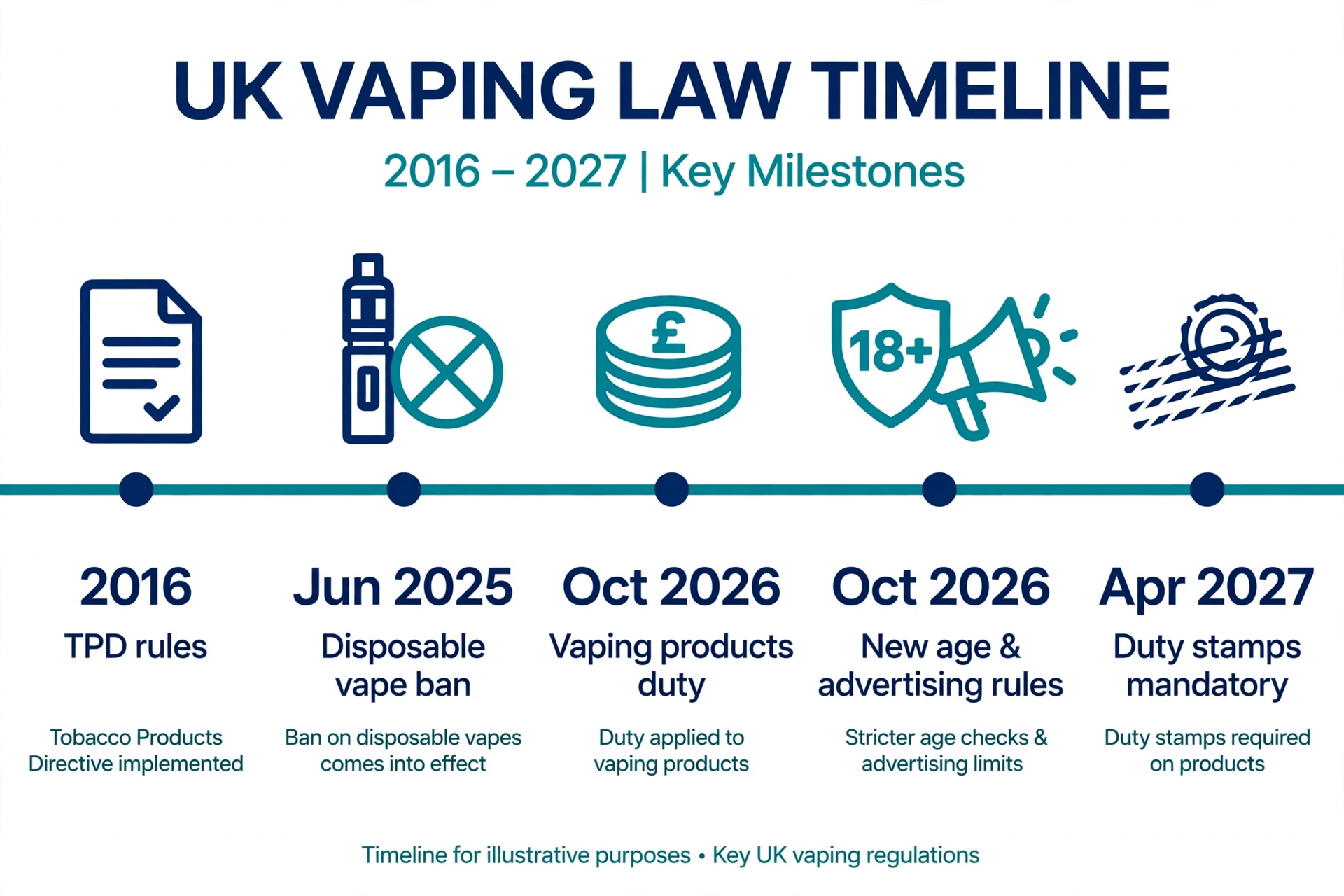
A decade of UK vape law in one timeline
2016: the TPD era begins. European Tobacco Products Directive rules take effect in the UK: nicotine capped at 20mg/ml, bottles limited to 10ml, tanks to 2ml, with health warnings and child-resistant packaging. It is the framework that still shapes every product on the shelf.
1 June 2025: disposables banned. The sale and supply of single-use vapes becomes illegal across the UK. The driver was waste: millions of lithium batteries a week ending up in bins, and fires in bin lorries and recycling plants. Overnight, the market pivots to rechargeable, refillable systems.
1 October 2026: the duty arrives. Vaping Products Duty starts at £2.20 per 10ml of vaping liquid, regardless of nicotine strength. With VAT on top, the real-world addition is about £2.64 per 10ml. Duty stamps must appear on newly produced stock from the same date.
29 October 2026: the next rule wave. Fresh provisions tighten the market further: the age-18 rule extends to every nicotine product including zero-nicotine vapes, vending machines are banned outright, and promotion and advertising face new restrictions.
1 April 2027: stamps or nothing. The sell-through grace period ends. From this date, selling vaping products without a valid duty stamp is a criminal offence, and HMRC can seize unstamped stock.
What you can actually buy in the UK now
Forget the old wall of disposables in convenience stores. The legal UK market now runs on four formats, and knowing the difference is the single most useful thing in this guide.
Prefilled pods. A small rechargeable battery plus sealed 2ml pods you swap when empty. The closest thing to the old disposable experience: no filling, no coils, no fuss. This is where the big former disposable brands now live.
Refillable pods. The same pocket-friendly idea, but you fill the 2ml pod yourself from a 10ml bottle and replace the pod or coil every week or two. Slightly more effort, dramatically lower running costs.
Big-puff kits. The market’s direct answer to the disposable ban: a rechargeable device paired with a pod plus a separate refill container, typically delivering around 6,000 puffs per kit. You keep the battery and replace the liquid, which is where the long-term savings live.
Box mods and sub-ohm tanks. The hobbyist end of the market: high-power devices, large tanks, serious vapour production. Highest liquid consumption and therefore the highest absolute duty cost, but still the cheapest per millilitre of liquid before tax.
The four legal formats, compared
| Format | Typical kit price | How the liquid works | Duty impact | Best for |
|---|---|---|---|---|
| Prefilled pods | £8-15 | Sealed 2ml pods, swap when empty | About +£1.06 per twin-pack (21%) | Simplicity, ex-disposable users |
| Refillable pods | £13-35 | Fill a 2ml pod from 10ml bottles | About +£2.64 per 10ml bottle (67%) | Most vapers, best balance |
| Big-puff kits | £8-12 | Pod plus refill container, roughly 6,000 puffs | Duty charged on the liquid inside the kit | Value seekers after the ban |
| Box mods | £30-60+ | Large tanks, high power, high consumption | Highest absolute duty, cheapest per ml | Hobbyists and cloud chasers |
No format escaped the duty, but it did not land equally. Because the tax is charged per millilitre, the cheapest bulk liquid takes the biggest percentage hit while remaining the cheapest in absolute terms. That paradox now shapes every buying decision in the country.
What the 2026 duty does to your wallet
The headline is simple: £2.20 of duty per 10ml, plus 20% VAT on top, works out at roughly £2.64 extra per 10ml at the till. What that means in practice depends entirely on format:
| Product | Duty and VAT added | Typical price rise |
|---|---|---|
| Prefilled pods, 2 x 2ml twin-pack | +£1.06 | 21% |
| 2ml pod topped up from a 10ml bottle | +£3.17 | 46% |
| 10ml nic salt or freebase bottle | +£2.64 | 67% |
| 50ml shortfill + 1 nic shot | +£15.84 | 159% |
| 100ml shortfill + 2 nic shots | +£31.68 | 245% |
Two things soften the blow. First, shops may sell through pre-duty stock until 31 March 2027, so prices are climbing gradually rather than jumping overnight. You will see different prices on different flavours of the same product for a while, depending on which stock is on the shelf. Second, the format you choose matters more than ever. A prefilled 2ml pod now works out near £1.50 per ml with duty included, while filling the same pod from a 10ml bottle costs roughly 84p per ml. Same device, same draw, nearly half the liquid cost.
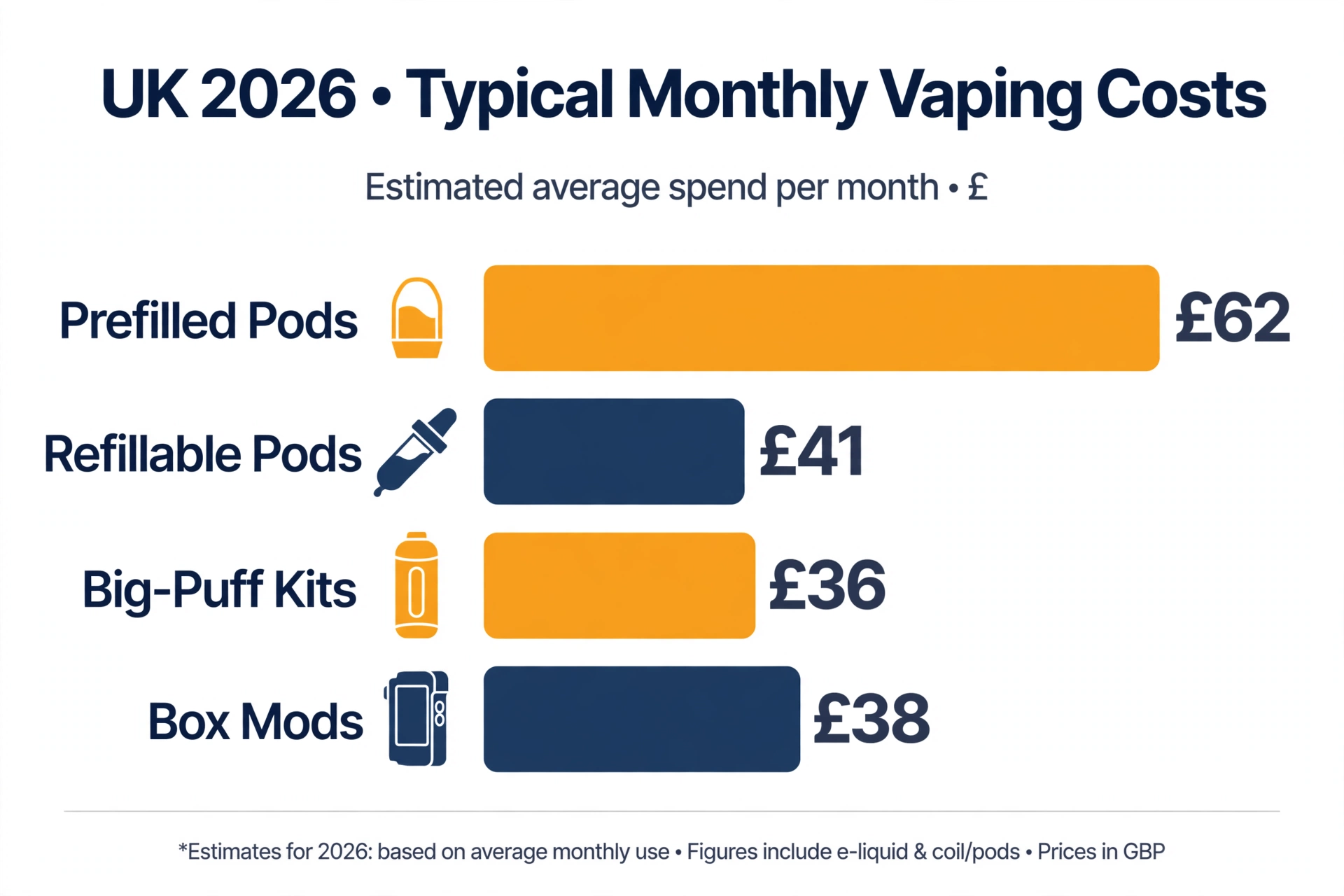
What does that look like per month?
| Vaper profile | Typical setup | Monthly cost, duty-paid |
|---|---|---|
| Light, a few times a week | Prefilled pods, one twin-pack a week | Around £24 |
| Moderate, daily MTL vaper | Refillable pod kit, three 10ml bottles | Around £22 |
| Heavy, sub-ohm all day | 100ml shortfill + 2 nic shots | Around £45 |
For the full per-product breakdown, see our UK vape duty guide. Compare bottle prices in our vape juice prices guide.
The best vape brands in Britain right now
The ban cleared the shelves of no-name disposables, which turned out to be good news for quality. The brands thriving in the new market are the ones that pivoted to compliant formats early instead of fighting the change.
Lost Mary remains the biggest name in British vaping, now leading with prefilled pod systems that recreate the old disposable feel without breaking the law. SKE Crystal owns the prefilled pod shelf, and its Crystal line is the default recommendation in half the vape shops in the country. Hayati and IVG are the two great British success stories of the post-ban era, IVG made in Preston and built for the duty-stamp world. Elf Bar still matters enormously, its pod systems sitting alongside everything else on the shelf. For refillable hardware, Vaporesso, Uwell and OXVA make the kits most shops recommend first, with flavour consistency the deciding factor.
Start with our best disposable vapes ranking for the current standouts. For the two biggest names head to head, read Elf Bar vs Lost Mary.
Buying legally: shops, stamps and fakes
Every legal vape sale in the UK now sits under three layers of control: age verification at 18+, compliant products, and from April 2027, duty stamps on every pack. Buy from established retailers, high-street vape shops or their websites, and treat prices that undercut the market by half as a warning sign: the illicit trade loves a bargain hunter.
From 1 April 2027 the duty stamp becomes your quickest authenticity check. A pack without one is either pre-duty old stock, which is fine until the deadline, or illegal afterwards. Until then, learn how to spot fake vapes before you hand over money. Blurry packaging, missing documentation and loose-fitting pods are the classic tells, and counterfeits mean untested coils with no safety oversight.
The October 29 rule changes
Later this month the market tightens again, and this wave is about who can buy rather than what things cost. The headline changes: the age-18 rule extends to all nicotine products including zero-nicotine vapes, vending machines selling vapes are banned outright, and advertising plus promotional discounting face new restrictions. Retailers are already adjusting their shelves and their marketing. Our October 29 rules guide covers every change in detail.
Vape UK: your questions answered
Is vaping legal in the UK?
Yes. Vaping is legal for adults and is endorsed by health authorities as a smoking-cessation tool. What is regulated is the sale: age limits, product standards, advertising rules, and now the duty.
How old do you have to be to vape in the UK?
You must be 18 to buy vaping products, and retailers are required to verify age. From 29 October 2026 the 18+ rule extends to all nicotine products, including zero-nicotine vapes.
Are disposable vapes really banned?
The sale and supply of single-use vapes has been illegal since 1 June 2025. Owning or using one you already had is not an offence, but no shop anywhere in the UK may sell you a new one.
Can you vape in pubs?
There is no national ban equivalent to the smoking ban, so pubs, bars and restaurants set their own policies. Many allow it, many restrict it to outdoor areas. Ask before you puff.
Can I take my vape on a plane from the UK?
Yes, in your carry-on bag only, never in checked luggage, with batteries protected against short circuits. Vaping on board is banned on all airlines, and e-liquid bottles follow the usual 100ml liquids rule at security.
Do I need a prescription to vape?
No. Vapes are consumer products, not medicines, and no prescription is required to buy one. Some stop-smoking services supply them through schemes such as Swap to Stop, but that is a support route, not a requirement.
What is the strongest nicotine I can buy?
20mg/ml. That is the legal cap and it applies to every compliant product in the UK, from sealed pods to bottled e-liquid.
Is vaping still cheaper than smoking after the duty?
Comfortably. Even the heaviest duty-paid vaping habit in the table above costs a fraction of a pack-a-day smoking habit. The duty narrowed the gap but did not come close to closing it.
Can I bring vapes back from holiday?
Yes for personal use, within the usual customs allowances. Be aware that products bought abroad may not meet UK labelling and standards rules, and anything you resell must be compliant.
Will flavours be banned next?
Not currently. Flavour restrictions have been discussed in consultations, but no ban is in law. It is the most likely next battleground, so expect it to stay in the headlines.
The bottom line
The UK in 2026 is the most regulated vape market in the English-speaking world: no disposables, a per-millilitre duty, duty stamps on the way, and an October rule wave still to land. It is also, by design, a market that rewards informed buyers. Choose a refillable format, buy from legitimate shops, watch for the stamps from April, and the new rules will cost you far less than the headlines suggest. Bookmark this guide. The rules will keep moving through 2027, and this page will stay current as each change lands.