
The same speed, a different source
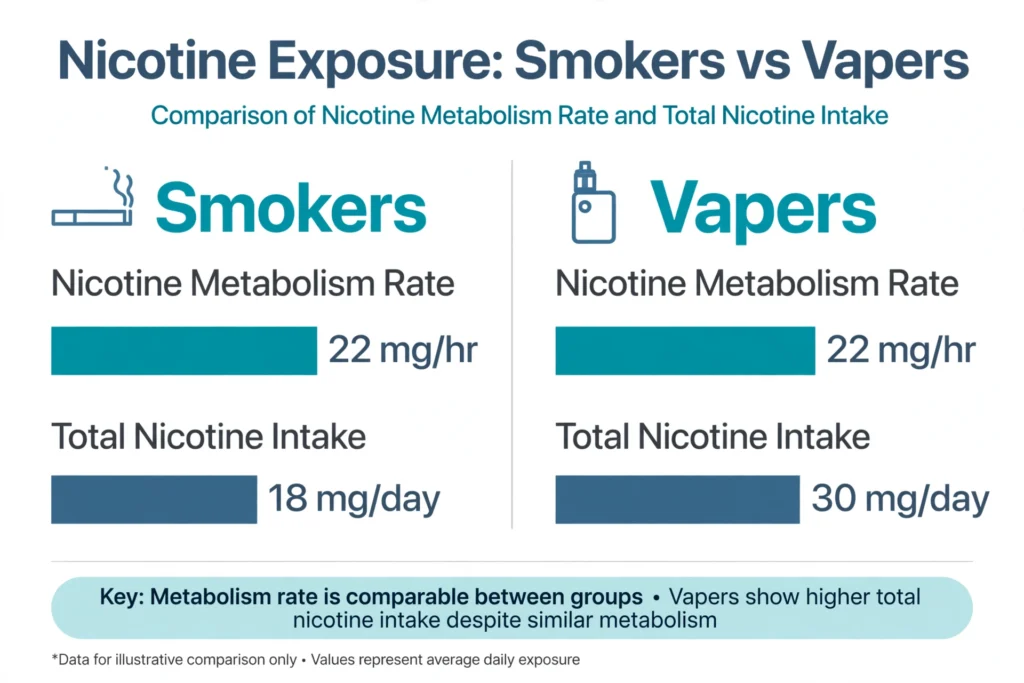
Switch from cigarettes to a vape and your body still handles nicotine at exactly the same pace. That is the headline finding from a new University of Queensland study: the speed at which people metabolize nicotine is a property of the person, not of the product they use.
The team, led by Min-Tz Weng and Kathryn Steadman, recruited 42 daily users in Brisbane, 22 smokers and 20 vapers. Each provided 24-hour urine samples, which were analyzed with mass spectrometry. The researchers focused on the urinary nicotine metabolite ratio (NMR), the standard biomarker of how fast the body breaks down nicotine.
The number that did not move
The liver enzyme CYP2A6 converts nicotine into cotinine, then cotinine into 3-hydroxycotinine. The ratio of the two is the NMR, and it simply did not differ between smokers and vapers.
| Group | Nicotine metabolite ratio (NMR) |
|---|---|
| Smokers | no difference |
| Vapers | no difference |
| Women | 3.49 (faster than men) |
| Men | 2.43 |
| White participants | 2.99 (faster than Asian participants) |
| Asian participants | 1.94 |
Sex and ethnicity shaped metabolism speed far more than product choice. Women metabolized faster than men, and White participants faster than Asian participants.
What vapers do differently: take in more
The products were not identical in effect. Vapers excreted significantly higher levels of cotinine, 3-hydroxycotinine and total nicotine equivalents, likely because modern vape liquids are higher in nicotine and more palatable, encouraging heavier intake. The vapers in the study also averaged 26 years old versus 34 for smokers. For readers curious about what is actually in their device, our explainer on nicotine content breaks down the options.
Why doctors care about the NMR
The finding matters for quitting. The NMR is studied as a way to match quitters to the best cessation therapy, and these results suggest guidance developed for smokers should apply to vapers too.
A fair caveat: 42 people is a small sample, and the authors call the subgroup analyses exploratory, with at-home urine collection deserving cautious interpretation. Still, it is a clean answer to a question that had no human data. Researchers examining vaping health risks will welcome the baseline.
Source: Weng, M.-T. et al. (2026), “Exploring nicotine metabolism among people who smoke and vape”, published open access in Heliyon 12(15), Article e45549, DOI 10.1016/j.heliyon.2026.e45549.