

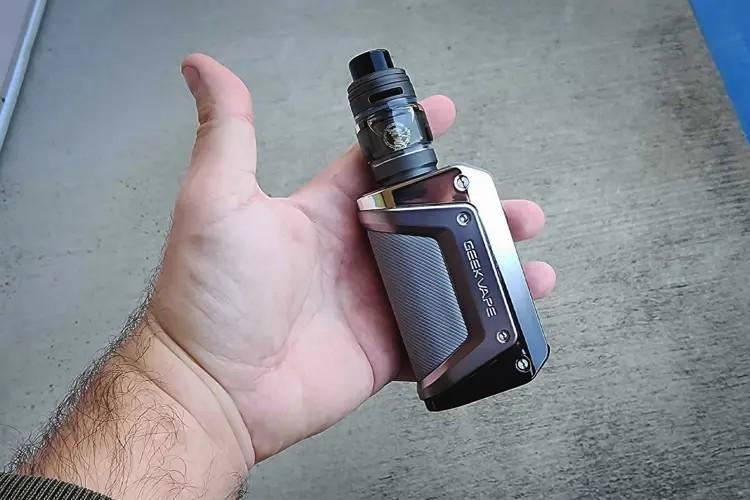
A mod is the part of a vape that thinks. Strip the tank off any serious setup and what remains in your hand is a battery, a chipset and a threaded socket: the mod. The tank on top makes the vapor; the mod decides how much power it gets, how steadily, and with what protections standing between the battery and your face. The name is a fossil from the hobby’s early days, when users modified flashlights and battery boxes into vaping devices. Modern mods are designed products, but the word kept its meaning: the power unit, sold and judged separately from whatever screws onto it.
Table of Contents
The Four Parts of a Mod
| Part | Its job | What goes wrong with it |
|---|---|---|
| Battery | Stores the energy: a built-in pack or removable 18650/21700 cells | Age and abuse; see the safety section below |
| Chipset | Reads the coil, holds your set output steady, runs the protections | Cheap chips fire slowly and read resistance poorly; good chips are a brand’s signature |
| 510 connector | The threaded socket on top; its sprung pin carries power and reads the tank | Dirt and a stuck pin are the classic cause of check-atomizer errors |
| Controls and screen | Fire button, adjustments, and the display of watts, resistance and battery | Screens fail before chips do; buttons are why you lock the device in a pocket |
The atomizer, the tank, is deliberately not on this list: it is the other half of the setup, with its own guide on this site. A mod plus a tank plus coils is the full machine.
The Mod Families
| Family | Shape and idea | Who it serves |
|---|---|---|
| Box mod | Rectangular body, one or two removable cells or a big built-in pack, full screen and modes | The mainstream: sub-ohm tanks, high wattage, all-day battery |
| Tube mod | Cylindrical, pen-like but wider; mostly simple regulated or mechanical | Minimalists; the classic mechanical form |
| Pod mod | A pod device with mod ambitions: screen, adjustable watts, sometimes a removable cell | Pod users who want control without a tank |
| Squonk mod | A soft bottle inside the body feeds a rebuildable atomizer from below | Rebuildable enthusiasts; a niche within a niche |
A kit is simply the matched box: mod, a tank chosen to suit it, starter coils and a cable. Buying the kit is the sane first move; buying a mod alone is for people who already own the tank it will carry.
Regulated vs Mechanical: The One Safety Distinction
A regulated mod keeps its chipset between the battery and the coil at all times. It measures the coil’s resistance before every draw, delivers the wattage you set rather than whatever the battery happens to hold, and refuses to fire into a short circuit, a reversed battery, an overheated board or a button held down too long. Output on a regulated mod feels the same on the last draw of a charge as on the first.
A mechanical mod removes all of that. It is a metal tube or box, a battery, a switch and a connector; pressing the button connects the cell straight to the coil, power fades as the battery drains, and nothing protects you if the coil is shorted or the build is wrong. Mechanical mods are expert equipment for people who can work Ohm’s law in their heads and test every build. This site’s position is plain: if you are reading an introductory guide, you want a regulated mod, and so does everyone this page is written for.
Batteries: Built-In vs Removable, and the Safety Rules
| Choice | Upside | Cost |
|---|---|---|
| Built-in pack | Nothing to handle; charge by USB-C; the device is sealed and simple | When the pack dies, the mod dies; capacity fixed at purchase |
| Single removable cell | Swap a fresh 18650 or 21700 and keep vaping; replace cells, not devices | You now own battery handling: cases, wraps, a charger |
| Dual removable cells | The 200-watt class and the longest runtime | Two cells to marry, inspect and carry safely; heaviest option |
Cell names are dimensions: an 18650 is 18 millimeters across and 65 long; a 21700 is 21 by 70, with more capacity in the extra size. Mods are built for one size or the other, and the manual’s cell is the only cell.
The rules that are not optional
The wrap is insulation, not decoration. The metal can under an 18650’s plastic wrap is its negative terminal; a torn or nicked wrap can short the cell against the mod or loose metal. A damaged wrap takes the cell out of service until it is professionally rewrapped, and tape is not a repair.
Marry dual cells. In a two-battery mod, the pair is bought together, same brand, model and batch, charged together, used together and retired together. A strong cell paired with a weak one gets stressed by it.
Never carry a loose cell. Spares travel in a plastic case, every time. Keys and coins in the same pocket can bridge a cell’s terminals and vent it; this is the single most common cause of vape battery incidents.
Inspect at every swap: dents, corrosion, leaking, a damaged insulator ring at the positive end. Any of them retires the cell, which goes to battery recycling with its terminals taped.
Charge on a hard surface, with the right charger, and stay in the house. External cells are best charged in a dedicated charger, as the makers themselves advise.
The FDA’s own battery guidance says the same things from the regulator’s side: Tips to Help Avoid Vape Battery Fires or Explosions.
The Modes, Without the Mystique
| Mode | What it does | Will you use it? |
|---|---|---|
| Variable wattage (VW) | You set watts; the chip computes voltage for your coil and holds it steady | Yes. This is 95 percent of mod life |
| Variable voltage (VV) | You set voltage directly; wattage follows the coil | Rarely; the older system VW replaced |
| Temperature control (TC) | Caps the coil’s temperature by watching its resistance change; needs nickel, titanium or stainless coils | If you hate dry hits and own TC-wire coils; kanthal cannot do it |
| Bypass | Feeds raw battery voltage like a mechanical mod, with the chip’s protections still watching | A flavor of nostalgia; output fades with the charge |
| Curves and preheat | Programs wattage second by second across a puff, or soft/normal/hard ramp-up | A hobbyist’s fine-tuning, set once and forgotten |
Underneath all of it sits one formula, watts equals voltage squared divided by resistance, and the chip is doing that arithmetic so you do not have to. Chipsets are also where brands differentiate: VOOPOO’s GENE, Vaporesso’s AXON, GeekVape’s AS and Evolv’s DNA boards are names regulars genuinely choose between, mostly on firing speed, accuracy and how the menus behave.
Two Brand Searches, Answered Straight
GeekVape mods
GeekVape’s mod identity is the Aegis family: ruggedized box mods rated IP67 or IP68 against water, dust and shock, leather-and-metal bodies built to be dropped. The Legend line is the flagship: dual 18650 cells, up to 200 watts on the current Legend 3, the AS chipset, and smaller single-cell versions under the same idea (the Solo class at 100 watts). If a mod will live in a work bag, a truck cab or a jacket pocket outdoors, this is the family built for that life.
Lost Vape, and why people like them
The recurring search behind this cluster’s strangest keyword is really asking why Lost Vape mods cost more and get talked about differently. The answer is positioning the brand has held for years: premium materials and finish, and flagship lines built around Evolv’s DNA chipset, the board enthusiasts treat as the reference for accuracy and temperature control, in families like Thelema and Paranormal. You pay for the chip and the build, not for wattage, which is a commodity everywhere else.
Who Should Not Buy a Mod
Most vapers, honestly. If a pod system already gives you the draw and the day you want, a mod adds weight, size, settings, battery handling and a tank to maintain, in exchange for power you may never use. The mod earns its place when you want sub-ohm vapor production, any tank you like on a universal connector, swappable batteries, or the hobby itself. Until one of those is true, the smaller formats on this site are the better tools:
the pod systems guide for the mainstream, and the vape pens guide for the tube format. And if your searches started from wanting everything in one sealed unit, the pillar you want is the disposable vapes guide.
Coil choice, the other half of every mod setup, is owned by the replacement coils guide.
FAQ
What wattage do I need from a mod?
Match the coil, not the brochure. MTL coils live around 10 to 20 watts, restricted-DTL around 20 to 40, and sub-ohm DTL coils commonly 40 to 100 or more. A 200-watt ceiling is headroom and dual-battery runtime, not a target; almost nobody vapes at a mod’s maximum.
Can I use any tank on any mod?
Mechanically, nearly: the 510 thread is universal. Electrically, the mod must cover the coil’s resistance and wattage needs, and physically the tank’s diameter should not overhang the mod’s top plate. All three checks take a minute and save a return.
Are dual-battery mods better than single?
They are longer-running and higher-powered, and heavier, with twice the battery discipline. For MTL and moderate DTL use a single cell is enough; dual cells earn their weight above roughly 60 watts of regular use.
Do I need temperature control?
No. It is a refinement for specific coil wires and a particular kind of consistency. Variable wattage, used inside the coil’s printed range, is the complete experience for most people.
Is a mechanical mod more powerful?
It is less controlled, which is not the same thing. A regulated mod delivers its set wattage flat until the battery is done; a mechanical mod starts at raw battery voltage and fades from the first draw, with no safety net. Power was never the reason to choose one.