

Charcoal is the best and worst part of a hookah session. It makes the smoke, and it also makes the ash, the carbon monoxide, the burnt spots, and the ten minutes of waiting before the first pull. An electric hookah removes the charcoal from that equation and replaces it with a controlled electric heating element, while the shisha itself stays exactly the same.
This guide covers what an electric hookah actually is, how the heating works step by step, what the devices cost, how they compare with a traditional charcoal setup, and who should and should not make the switch.
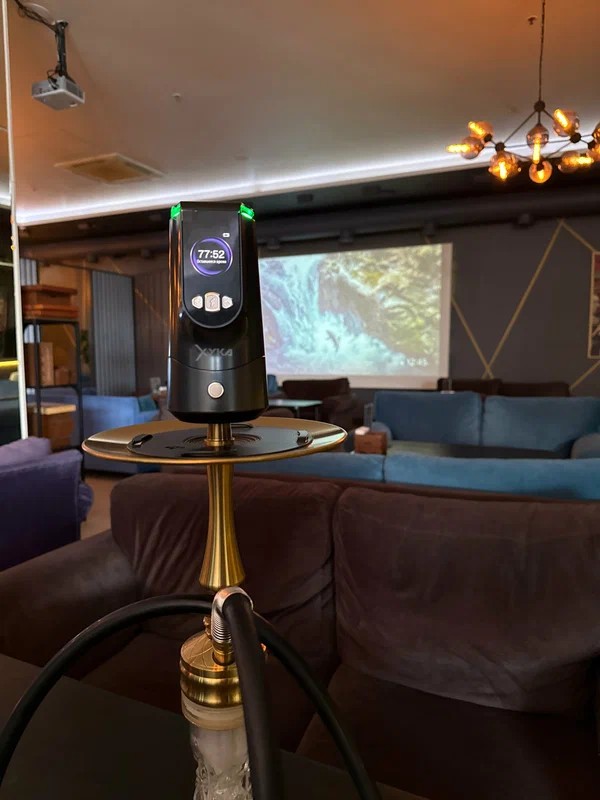
Which “electric hookah” do you mean? An electric hookah is a device that heats real shisha tobacco with electricity instead of charcoal. It comes in two forms: a complete electric hookah system, or an electric head (e-bowl) that sits on a hookah you already own. It is not a hookah pen, which is a small disposable or refillable vape shaped like a pen. It is also not a disposable e-liquid “e-hookah head” that screws onto a hookah and vaporises flavoured liquid instead of tobacco. Those are vapes in hookah clothing, covered further down.
What Is an Electric Hookah?
An electric hookah does one job: it holds shisha at smoking temperature using electric heat, so no charcoal is lit at any point in the session.
There are two hardware forms:
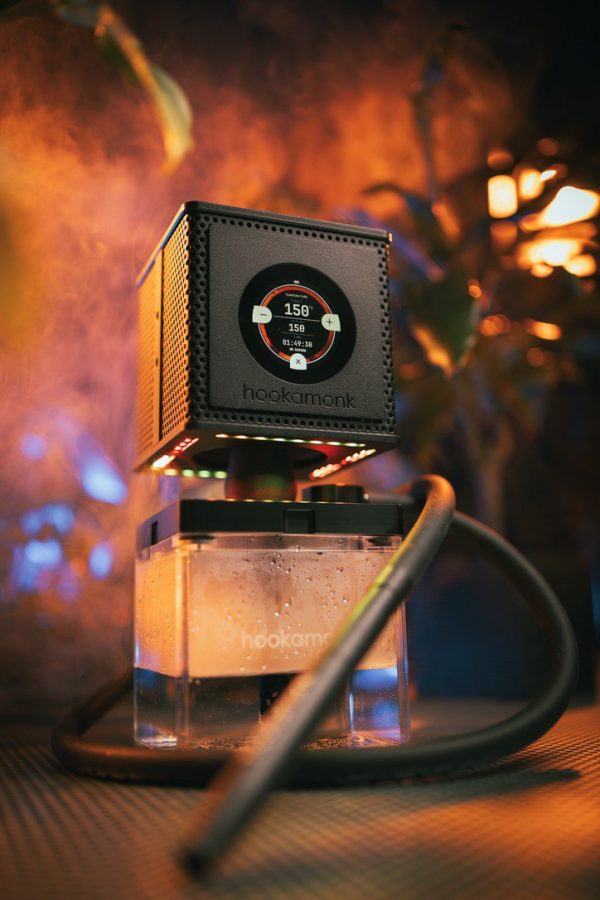
- Full electric hookah systems. Complete, self-contained units with their own base, chamber, battery or mains power, and temperature electronics. Current examples include the ENSO 2026 Edition (~$495) and the IMOTO G2 (from ~$528).
- Electric hookah heads, e-bowls and E-HMDs. A heated head that replaces the bowl, foil and charcoal on a standard hookah. Examples include the XKAH Pro (~$350), the plug-in XKAH Lite (~$269), the IMOTO G1 Head (~$297) and the Square E-Head (~$99).
Both forms heat the same thing: real shisha, meaning tobacco leaf (or herbal molasses) soaked in glycerin and flavouring. Nothing about the smoke changes except where the heat comes from, and that turns out to change quite a lot about the session.
How an Electric Hookah Works, Step by Step
Every electric hookah, whether a $99 e-head or a $500 system, follows the same chain:
- Power source. Mains power through an adapter, or a built-in battery. The ENSO, for example, carries a 5,000 mAh battery good for roughly 90 to 120 minutes of heating, which covers one long session or two shorter ones.
- Heating element. A resistive coil or ceramic plate converts electricity into heat. Unlike charcoal, which peaks early and fades, the element can hold one temperature for the whole session.
- Temperature controller. A dial, buttons or an app sets the target temperature, and a sensor holds it there. The ENSO adjusts from 180 °C to 330 °C in 5 °C steps; XKAH heads run a tighter 260 °C to 310 °C band tuned for shisha.
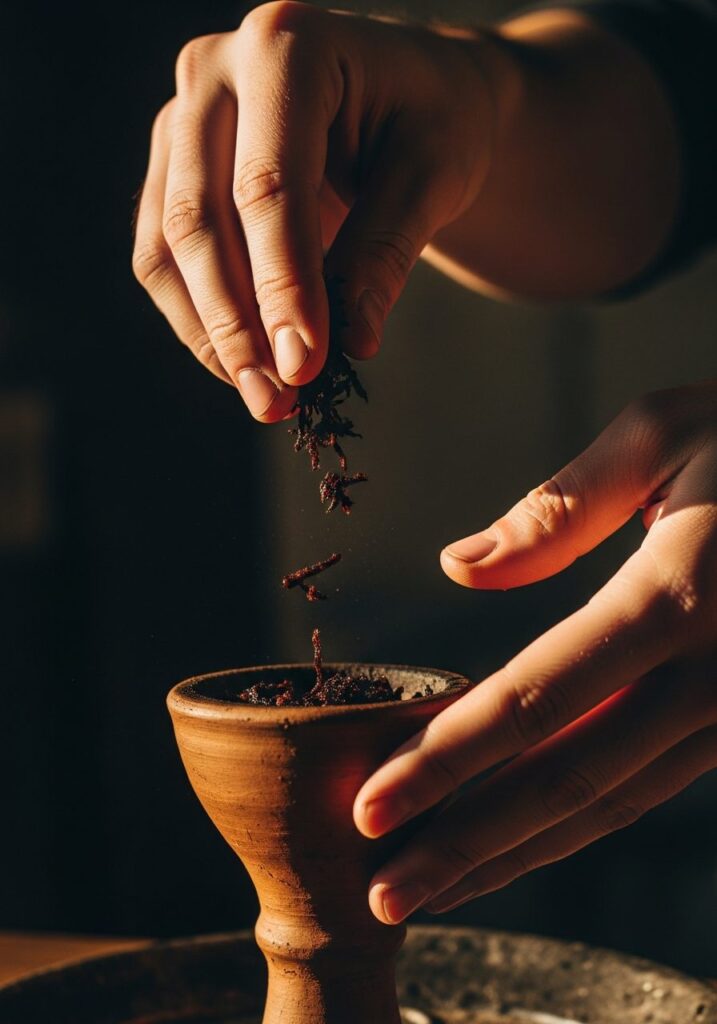
- Chamber or bowl. You pack shisha into the device’s chamber, or into the e-head itself. Electric setups need far less: roughly 7 to 12 g of shisha per session, against around 25 g in a typical charcoal bowl, because the heat is applied evenly instead of blasting the top layer.
- Preheat. Expect 5 to 8 minutes for the chamber to reach temperature and the shisha to start producing smoke. Slower than a quick-light coal, faster than natural charcoal on a burner.
- Airflow and water. From here the hookah works exactly as it always has. You draw, air passes over the heated shisha, smoke travels down the stem, bubbles through the water in the base, and up the hose. The water filtration and cooling are unchanged.
A typical session cycle on an XKAH head runs about 50 minutes at temperature, and because the heat never fades or spikes, minute 45 tastes much closer to minute 10 than it does on charcoal.
Electric Hookah vs Traditional Charcoal: Full Comparison
| Factor | Electric hookah | Traditional charcoal hookah |
|---|---|---|
| Heat source | Electric element, mains or battery | Burning charcoal briquettes or cubes |
| Temperature control | Precise, adjustable, held steady all session | Managed by adding, removing or moving coals |
| Setup time | Pack, switch on, 5 to 8 min preheat | Light coals 10 to 15 min, heat management throughout |
| Session consistency | Same heat at minute 50 as minute 5 | Strong start, fades, needs fresh coals |
| Carbon monoxide | None from the heat source | Significant; charcoal is the main CO source in a session |
| Ash and mess | None | Ash everywhere, coal trays, burn marks |
| Open flame | None | Lit coals are a genuine fire and burn risk |
| Running costs | Electricity, a few cents per session | Charcoal and foil or HMD wear, every session |
| Cleaning | Chamber and bowl rinse, wipe the head | Plus ash disposal and coal residue |
| Portability | Needs a socket or a charged battery | Works anywhere you can light coals safely |
| Flavour character | Cleaner, truer shisha flavour, no coal taste | Slight coal note many smokers consider part of the taste |
| Ritual | Press a button | The coal ritual is the point for many smokers |
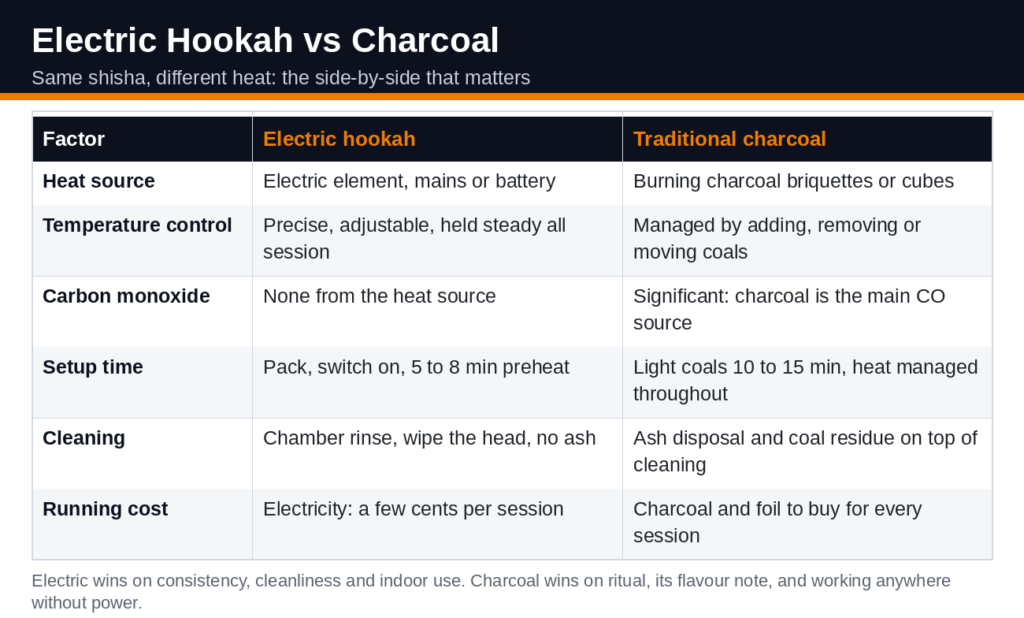
The honest summary: electric wins on consistency, cleanliness and indoor practicality. Charcoal wins on ritual, on the flavour note it adds, and on working anywhere without power.
How Much Does an Electric Hookah Cost? The Price Ladder
Prices in this category spread wider than most buyers expect, because four different products share similar names. From cheapest to most expensive:
Tier 1: Disposable e-liquid heads, $15 to $40
Brands like Kori, Heybar and the Al Fakher Crown Bar sell disposable heads that attach to a hookah and vaporise e-liquid. They are not electric hookahs in the shisha sense: there is no tobacco and no heating of molasses. If you want the hookah shape with vape liquid, these are cheap and simple, and the disposable vape category works on the same principle. Best for: curious beginners who do not actually want tobacco.
Tier 2: Budget e-bowls, around $99
The Square E-Head is the reference point here. It replaces your bowl and charcoal with a basic heated head at the lowest real entry price. Temperature control is cruder than the premium heads, but the core experience, real shisha with no coals, is all there. Best for: hookah owners who want to test the concept on their existing setup.
Tier 3: Premium electric heads, $269 to $400
This is where the category gets serious. The XKAH Lite (~$269, plug-in), IMOTO G1 Head (~$297) and XKAH Pro (~$350) offer precise temperature bands, better build quality and proper grommet kits. Best for: regular smokers who already own a good hookah and smoke at home.
Tier 4: Full electric systems, $400 to $530
The ENSO 2026 Edition (~$495) and IMOTO G2 (from ~$528) are complete appliances: chamber, electronics, battery and base in one unit. No separate hookah needed. Best for: buyers who want the whole setup in one box and the longest, most controlled sessions.
Running costs after purchase are minimal. Electricity for a session costs a few cents, and the smaller 7 to 12 g shisha pack per sesion roughly halves your tobacco spend per sesion compared with a 25 g charcoal bowl.
Is an Electric Hookah Safer Than Charcoal?
Safer in specific, limited ways. It is important to be precise here, because ‘safer’ gets abused in this category.
What electric heat removes:
- Carbon monoxide from the heat source. Charcoal is the main CO source in a hookah session. The World Health Organization’s hookah fact sheet notes that a one-hour charcoal session can expose the smoker to many times the carbon monoxide of a single cigarette, and burning charcoal reaches temperatures around 650 °C. Remove the charcoal and you remove that CO stream and the coal smoke that comes with it.
- Open flame and burns. No lit coals means no dropped-coal carpet burns, no coal changing with tongs mid-session, and no ash drifting onto furniture.
- Coal additives. Quick-light coals in particular carry chemical accelerants that end up in the smoke path.
What electric heat does not remove:
- Tobacco and nicotine. The shisha is unchanged. Nicotine exposure, and the long-term risks of inhaling tobacco smoke, remain. The CDC’s hookah page is clear that hookah smoke contains many of the same toxic compounds as cigarette smoke, regardless of heat source.
- Smoke itself. Heated tobacco still produces smoke with tar and fine particles. Electric heat is a harm-reduction step for the charcoal problem, not a clean bill of health. If your goal is to avoid nicotine entirely, that is a different product category altogether; see the nicotine-free vape guide for how zero-nicotine options work.
Indoor use is where the difference is most practical. No CO build-up from coals and no ash makes electric hookahs far more reasonable indoors, though ventilation still matters because tobacco smoke is tobacco smoke. Note that local rules on indoor smoking and vaping vary widely; the US vape and tobacco regulation overview tracks how the uneven state-level picture is.
Battery and electrical basics: buy from the manufacturer or an authorised seller, use the supplied charger, never leave a charging device unattended overnight, and keep liquids away from the electronics top. These are mains and lithium devices operating at up to 330 °C; treat them with the same respect as a kettle or a hair dryer.
Compatibility: Will an Electric Head Fit Your Hookah?
For e-heads and e-bowls, compatibility is usually simple:
- Electric heads sit on the standard hookah bowl port at the top of the stem, the same place your current bowl sits.
- The seal comes from grommets. XKAH, for example, supplies small and large grommets in the box to cover different port sizes.
- Check before buying: your hookah’s bowl port diameter, whether the head needs a specific adapter for very narrow or very wide ports, and whether the head’s weight suits a small or tabletop hookah. A heavy premium head on a lightweight mini hookah can make the setup top-heavy.
- Full systems (ENSO, IMOTO G2) skip this entirely; there is nothing to match.
If your current hookah takes a standard Egyptian or phunnel bowl with a normal grommet, an e-head will almost certainly fit. Exotic or proprietary ports are the exception worth an email to the manufacturer before ordering.
Cleaning and Maintenance
Electric hookahs are easier to keep clean than charcoal setups, with one hard rule: the electronics never get wet.
After each session:
- Empty the chamber once it has fully cooled. Heated shisha residue wipes out more easily while the chamber is still slightly warm, not hot.
- Rinse the removable bowl parts, grommets and any glass or silicone pieces in warm water.
- Wipe the electronics top with a dry or barely damp cloth. Never submerge it, never run it under a tap.
Weekly or every few sessions:
- Deep clean the chamber with a soft brush to clear baked-on glycerin residue, which otherwise starts to flavour every session.
- Check grommets for cracks and replace worn ones; a poor seal costs you smoke density.
- Inspect the power cable and connector for damage, especially on plug-in models that live near water-filled bases.
Skipping the chamber clean is the most common cause of the “electric tastes burnt” complaint. Nine times out of ten it is old residue cooking, not the device.
Honest Verdict: Who Should Switch, and Who Should Not
Switch to electric if:
- You smoke indoors and are tired of CO, ash and coal smell in the room.
- You want consistent flavour from the first pull to the last without coal management.
- You smoke alone or in pairs and like the smaller 7 to 12 g packs.
- You are new to hookah and the coal ritual is the barrier putting you off.
Stay with charcoal if:
- The ritual is the point. Lighting coals, managing heat by hand and the whole ceremony is a feature, not a bug, for many smokers.
- You are a charcoal flavour purist. Coal adds a note to the smoke that some experienced smokers actively prefer and electric heat deliberately removes.
- You smoke outdoors, at gatherings, or anywhere without reliable power, where a $500 appliance is a liability.
- Your sessions are occasional. At a few sessions a month, the hardware cost takes a long time to justify itself against a box of coals. Occasional users comparing options may find a simpler device from a best disposable vape roundup covers their needs at a fraction of the price, though it is a different experience entirely.
For the regular home smoker, the premium e-head tier is the sweet spot: your hookah, your shisha, no charcoal, and a payback period measured in saved coals and saved shisha.
FAQ
Does an electric hookah need charcoal?
No. Charcoal is the one thing it is designed to eliminate. The heating element does the charcoal’s job, and foil and a separate heat management device are also unnecessary on most models, since the head manages its own temperature.
Can you adjust the temperature?
Yes, and this is the main advantage over coals. Depending on the model, you set the temperature with a dial, buttons or an app. Ranges run from about 180 °C to 330 °C on the ENSO, and 260 °C to 310 °C on XKAH heads. Lower temperatures favour flavour, higher temperatures favour thicker smoke.
How long is a session?
Plan on 45 to 90 minutes. An XKAH head runs a cycle of about 50 minutes at temperature, and a battery system like the ENSO delivers roughly 90 to 120 minutes of heat per charge. Because the temperature never fades, sessions tend to end when you are done, not when the coals die.
Does an electric head work with my existing hookah?
Almost certainly, if your hookah has a standard bowl port. E-heads mount where your bowl mounts and seal with grommets, usually supplied in two sizes. Check your port diameter against the manufacturer’s spec if your hookah is unusually small or uses a proprietary fitting.
Is an electric hookah safer than charcoal?
It removes the charcoal-specific harms: carbon monoxide from burning coals, open flame, ash and coal additives. It does not remove the risks of the tobacco itself. The FDA’s hookah tobacco page covers what is in shisha smoke regardless of how it is heated. Electric is a reduction in harm, not an absence of it.
What shisha can I use?
Any standard shisha tobacco or herbal molasses you already use in a charcoal bowl. Pack it looser and lighter than a charcoal bowl, roughly 7 to 12 g, since the heat is applied evenly. Very wet, high-glycerin blends work particularly well because the steady temperature vaporises the glycerin without scorching the leaf.
How much does it cost to run?
Very little. Electricity for a full session costs a few cents, there is no charcoal or foil to buy, and the smaller shisha pack per session cuts tobacco cost roughly in half per session. The real cost of electric hookah is the upfront hardware, from ~$99 for a budget e-head to ~$530 for a full system.