
New Jersey just moved one step closer to making vape manufacturers pay for the waste their products leave behind.
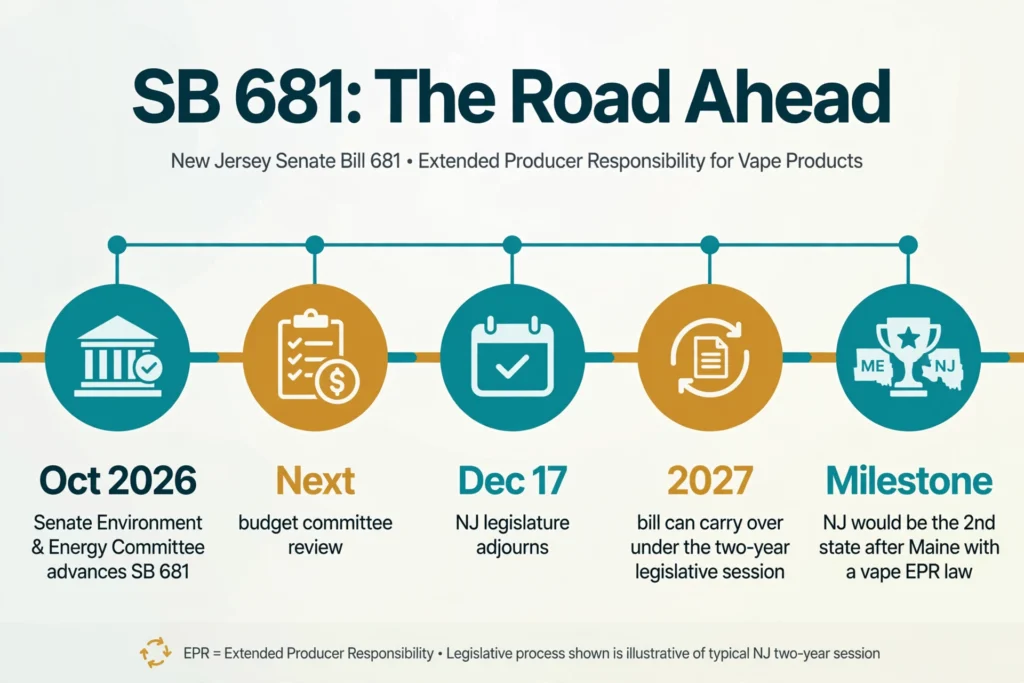
The state Senate Environment and Energy Committee voted to advance SB 681, a bill that would create an extended producer responsibility (EPR) program for vape pens. The measure now heads to the Senate budget committee.
What SB 681 would do
The bill calls for a producer-run responsibility organization tasked with promoting the refurbishment, reuse, and recycling of e-cigarettes, including vaporizers and batteries. That group would build convenient collection and processing programs to keep dead devices out of the waste stream.
| Bill fact | What SB 681 says |
|---|---|
| Committee status | Passed Senate Environment and Energy; headed to the budget committee |
| Program model | Producer-run responsibility organization with a DEP-approved stewardship plan |
| Mission | Refurbishment, reuse, and recycling of e-cigarettes, vaporizers, and batteries |
| Coverage target | Collection site within 15 miles for at least 90% of residents, one per county |
| Retailers | Become collection sites within three years of plan approval |
| Funding | Manufacturer fees based on sales volume plus environmental impact |
| Next deadline | Legislature adjourns Dec. 17; the bill can carry into 2027 |
The ecomodulation twist
This is the feature that sets the bill apart. Fees would not be flat: they would reflect each product’s environmental impact, with lower fees for reusable e-cigarettes and devices containing recycled content. Hanz Atia of the Product Stewardship Institute called the provision unique among U.S. vape EPR bills, noting it makes sense to incentivize reusables in a category dominated by single-use devices.
If lower fees steer brands toward longer-lasting products, shoppers can compare models in our guide to the best disposable vapes.
Why fires forced the issue
The bill notes that discarded vapes spark fires in waste and recycling trucks, transfer stations, and sorting and processing facilities. Their small lithium-ion batteries are hard to spot on tipping floors, and the devices can leak chemicals such as nicotine. Supporters say municipalities and businesses are not equipped to handle hazardous, combustible devices and lack an efficient, environmentally sound disposal method.
What happens next
If signed, New Jersey would become the second state after Maine to enact vape EPR. The legislature adjourns on Dec. 17, but the bill can carry into 2027 under the state’s two-year session. Illinois, which introduced its own vape EPR bill this year, is expected to reintroduce it with updates next session.
On the regulatory front, the only vapes with full federal market clearance appear on the FDA authorized list.
Source: Waste Dive, Oct 14, 2026