
The next time you pick up a bottle of e-liquid in Britain, look closely at the box. Somewhere near the seal you may spot a tiny rectangular sticker you have never seen before. It is small, it is tamper-proof, and from this month onward it is the difference between a legal vape product and an illegal one.

That sticker is a vaping duty stamp, the centrepiece of the UK vaping duty stamp scheme, which went live alongside the new Vaping Products Duty on 1 October 2026. Together the duty and the stamps mark the biggest shake-up of the British vaping market in years. Manufacturers, importers, wholesalers and shop owners all face new paperwork, new deadlines and new penalties, while shoppers face higher prices and a new way to tell a legitimate product from a dodgy one.
This guide walks through the whole scheme in plain language: what the stamp is, every date that matters, who has to do what, what happens when someone breaks the rules, and what it all means for the price you pay at the till.
Read this first: the scheme in 60 seconds
Short on time? Here is the whole story in five lines.
- Since 1 October 2026, every vaping product manufactured or imported in the UK must carry a duty stamp on its retail packaging. The stamp proves the new £2.20 per 10ml duty has been paid.
- The stamp is a small rectangular security label, 18mm by 42mm, applied so that opening the product damages the stamp or the packaging.
- Shops got a six-month sell-through grace period. Unstamped stock made before 1 October 2026 can still be sold until 31 March 2027. From 1 April 2027, every vape on sale must carry a valid stamp.
- Transitional stamps without a digital feature may be used until 31 December 2026. From 1 January 2027, only digitally enabled stamps can be put on new products.
- Retailers caught selling non-compliant stock face fines of up to £10,000, with higher penalties for repeat offences.
What the stamp actually is
Think of it as the vaping equivalent of the duty stamps you already see on cigarette packs and bottles of spirits. The UK has used physical tax stamps on tobacco and alcohol for years. Vaping has now joined that club.
Physically, it is modest: a rectangular security label measuring 18mm by 42mm. It is stuck across the seal of the retail packaging, on the box or the bottle, in a way that makes the packaging impossible to open without damaging the stamp. That tamper-evident design is deliberate. A stamp that survives an opened box intact is a stamp that was never really attached, and trading standards officers know exactly what to look for.
The stamps come in two generations. Transitional stamps, the first batch, are straightforward security labels with no digital feature. They are a stopgap, allowed on products made or imported up to 31 December 2026. The real long-term version is the digitally enabled stamp, which carries a scannable digital feature that lets HMRC trace a product through the supply chain. From 1 January 2027, only the digital version may be affixed to new products.
For shoppers, the practical takeaway is simple: a stamped box means the duty on the liquid inside has been paid and the product came through legitimate channels. No stamp, after the grace period ends, means the product should not be on sale at all.
The seven dates that run the whole scheme
The rollout is phased, not a single cliff edge, which is where most of the confusion comes from. Here is every date in one place.
| Date | What happens | Who it affects |
|---|---|---|
| 1 April 2026 | HMRC approval applications opened for manufacturers, importers and warehousekeepers | Manufacturers, importers |
| 1 September 2026 | Digitally enabled stamps became available to order | Approved businesses |
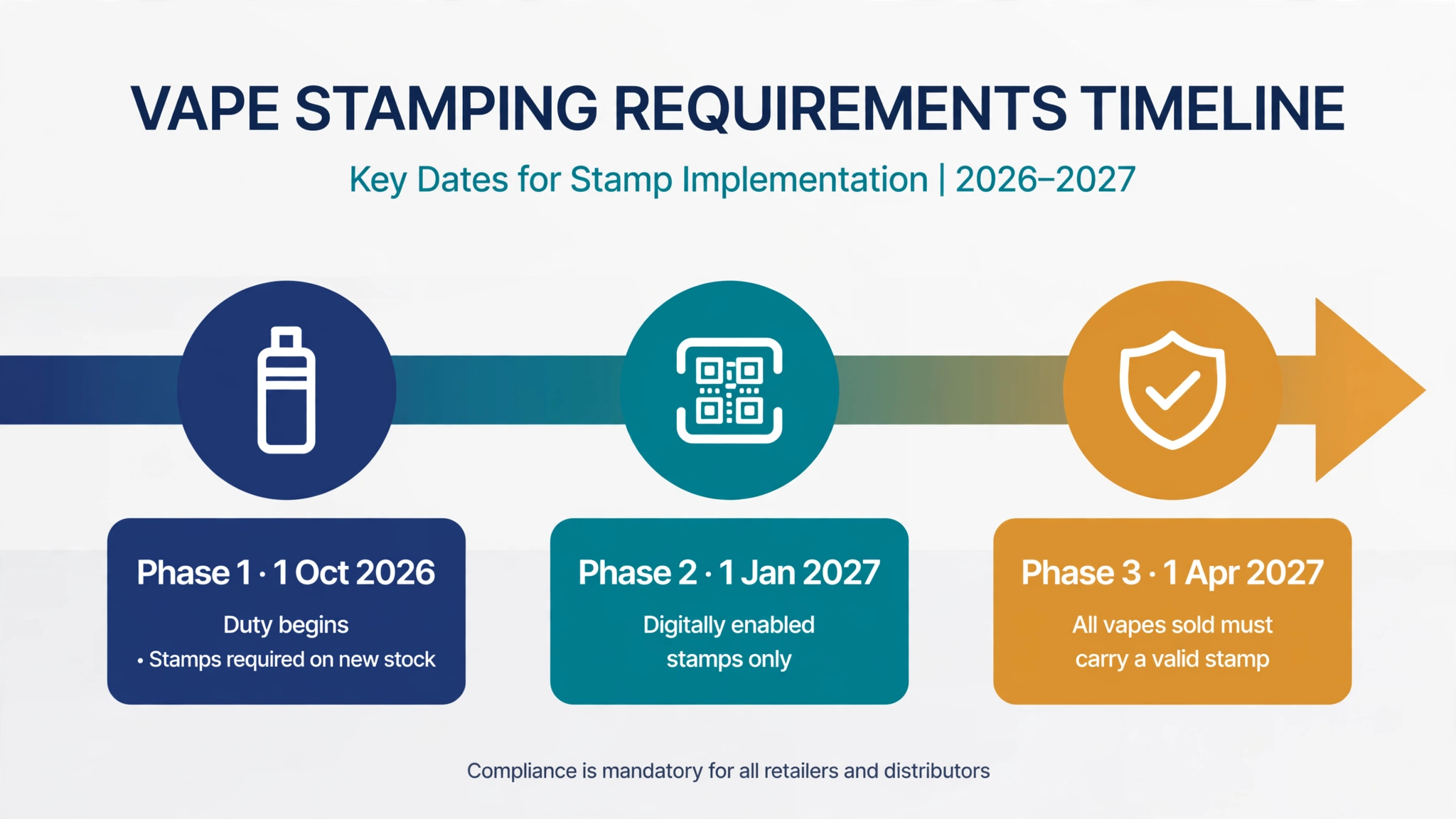
| 1 October 2026 | Vaping Products Duty began; all newly manufactured or imported products need a duty stamp; transitional stamps allowed | Everyone in the supply chain |
| 31 December 2026 | Last day transitional (non-digital) stamps can be affixed to new products | Manufacturers, importers |
| 1 January 2027 | Only digitally enabled stamps may be affixed from this date | Manufacturers, importers |
| 31 March 2027 | Six-month sell-through grace period ends; unstamped pre-October stock must be off the shelves | Retailers, wholesalers |
| 1 April 2027 | Every vaping product sold in the UK must carry a valid stamp; selling unstamped stock becomes illegal | Everyone |
Three of those dates deserve extra attention because they change what sits on shop shelves.
First, 1 October 2026 was the starting gun. From that day, anything manufactured or imported needed a stamp and the £2.20 per 10ml duty became payable. But anything made before that date kept its old status, which is what created the transition period.
Second, 31 December 2026 is the quiet deadline that only the industry feels. It is the last day the simpler transitional stamps can go onto new products. After New Year, the digital feature becomes mandatory on anything newly stamped.
Third, 1 April 2027 is the date that matters most to shop owners and shoppers alike. The grace period closes, and from that morning every vape product on sale in the country must carry a valid stamp. Unstamped stock left on the shelf after that date is illegal to sell, not just frowned upon.
Why the stamps exist at all
The stamps are the enforcement arm of the UK vape tax, the £2.20 per 10ml duty on vaping liquid that launched on the same October day. A tax is only as good as the system that proves it was paid, and that is the job the stamps do.
The stated goals are threefold. The first is traceability. With a digital stamp on every unit, HMRC can follow products through the supply chain and spot where legitimate stock ends and grey-market stock begins. The second is tackling illicit sales. Fake and smuggled vapes have flooded parts of the UK market for years, undercutting compliant shops and dodging every tax going. A physical, tamper-evident stamp makes those products far harder to pass off as genuine. The third is revenue. The Treasury expects the duty to raise over £550 million a year by 2030-31, and stamps are what make that number collectable rather than theoretical.
None of this is new thinking. Tobacco and alcohol have operated under duty stamp systems for years, and the vaping scheme is explicitly modelled on them. What is new is that vaping, a market that barely existed a decade ago, now carries a full excise regime of its own.
Who has to do what
This is the section that causes the most anxiety in vape shops, so let us be precise about where the paperwork lands.
The heavy lifting sits at the top of the chain. Manufacturers, importers and certain wholesalers pay the duty itself, and they are the ones who must hold HMRC approval to handle duty-stamped products. Approval applications have been open since April 2026, and these businesses are also responsible for getting the stamps affixed to retail packaging before products move down the chain. Stamps are only issued to approved businesses, so an unapproved importer cannot simply buy stamps and stick them on.
If you are a retailer or wholesaler who only buys and sells duty-paid stock, the rules are lighter. You do not need HMRC approval. But you are not off the hook either. You must work with your suppliers to make sure everything you stock is compliant, and from April 2027 that means checking that every unit on your shelves carries a valid stamp. The grace period is your window to clear old unstamped stock and get your supply chain in order, not a reason to ignore it.
One more wrinkle worth knowing: products can sit in approved warehouses without the duty being paid until they are released for sale. That is standard excise practice, and it is why the stamp only becomes relevant at the point a product heads toward retail.
The part nobody wants to read: penalties
The scheme comes with real teeth, which is worth knowing whether you sell vapes or just buy them.
Retailers who sell non-compliant products face fines of up to £10,000, and the penalties climb higher for repeat offences. That figure applies per breach, so a shelf of unstamped stock after April 2027 is not a single slap on the wrist. The legislation also gives enforcement officers powers including forfeiture of goods, civil penalties and, in serious cases, criminal offences. Where there has been criminal dealing in stamps, a court can even order that the premises be banned from operating as a vape shop, a measure aimed squarely at organised groups that would otherwise reopen under a new company name at the same address.
HMRC has also been given new information-sharing powers, allowing it to pass data to other public authorities with enforcement responsibilities for vaping products. In practice, that means trading standards, Border Force and HMRC can join up investigations in a way that was harder before.
For a shopper, the penalty regime matters for one simple reason: it gives your retailer a powerful reason to stock only legitimate, stamped products. A shop that keeps selling unstamped stock into 2027 is gambling its business.
What shoppers actually notice: prices and spotting legal vapes
Let us be honest about the bit everyone asks first. The duty costs money, and manufacturers, importers and wholesalers are allowed to pass it on. Most of them will, which means prices rise.
The duty is a flat £2.20 per 10ml of vaping liquid, whether or not it contains nicotine. VAT then applies on top of the duty-inclusive price, so the real increase on a 10ml bottle works out at about £2.64. Here is how that scales across common product sizes.
| Product | Liquid inside | Duty | Duty plus 20% VAT |
|---|---|---|---|
| 10ml e-liquid bottle | 10ml | £2.20 | £2.64 |
| 2ml prefilled pod | 2ml | £0.44 | £0.53 |
| 60ml shortfill | 60ml | £13.20 | £15.84 |
Those figures are the tax element only, not predictions of exact shelf prices, since brands and shops set their own margins. But they show why the duty bites harder on bigger bottles and why cheaper products feel it proportionally more. If you want to see how this plays out across the market, our e-liquid price guide tracks what vapers are actually paying.
Because the duty is charged on volume rather than nicotine strength, nicotine-free liquid is taxed exactly the same as high-strength liquid. Shortfills, nic shots and prefilled pods are all in scope too, since what counts is liquid meant for vaping, not what is in it.
The second thing shoppers notice is the stamp itself. Once stamped stock becomes the norm, that little label becomes your quickest authenticity check. Buying a prefilled pod kit? Look for the stamp on the box. Big-puff devices like the Geek Bar Pulse X hold their liquid in prefilled pods, so the duty and the stamp follow the pods inside the retail packaging. A product with damaged, missing or suspicious-looking stamping after April 2027 is a product to walk away from, and a shop full of them is a shop to report.
If you are choosing hardware to go with your stamped liquid, our best disposable vapes roundup covers the devices worth your money. The duty does not touch devices, kits, coils or batteries at all. Only the liquid pays.
Landing in Britain with vapes in your bag
The scheme also changed the rules for travellers, and this one catches people out. If you arrive in Great Britain carrying vaping liquid, you get a personal allowance of 50ml duty-free. Up to 50ml, no duty and no tax to pay.
Go over 50ml and the rules turn sharp. You must declare the liquid, and duty plus tax becomes payable on the whole amount, not just the bit above 50ml. Bring 60ml and you pay on 60ml. It is an all-or-nothing threshold, so frequent travellers and anyone stocking up abroad should do the maths before they pack.
The bottom line
The UK vaping duty stamp scheme is the visible proof of an invisible tax. The duty itself, £2.20 per 10ml on all vaping liquid regardless of nicotine, quietly raises the price of almost everything you vape. The stamp, that 18mm by 42mm tamper-evident label, is the part you can see, and from April 2027 it will sit on every legal vape product in the country.
For the industry, the message is unforgiving but clear: get approved, get stamping, clear old stock by the end of March 2027, or face fines of up to £10,000. For shoppers, the message is simpler. Expect prices to rise, expect to see stamps on your boxes, and treat the stamp as your guarantee that the product in your hand came through the legal market.
The transition period means shelves will carry a mix of stamped and unstamped stock for a few more months. After 1 April 2027, there is no mix. Stamped or illegal. That is the whole scheme, on a sticker smaller than a postage stamp.