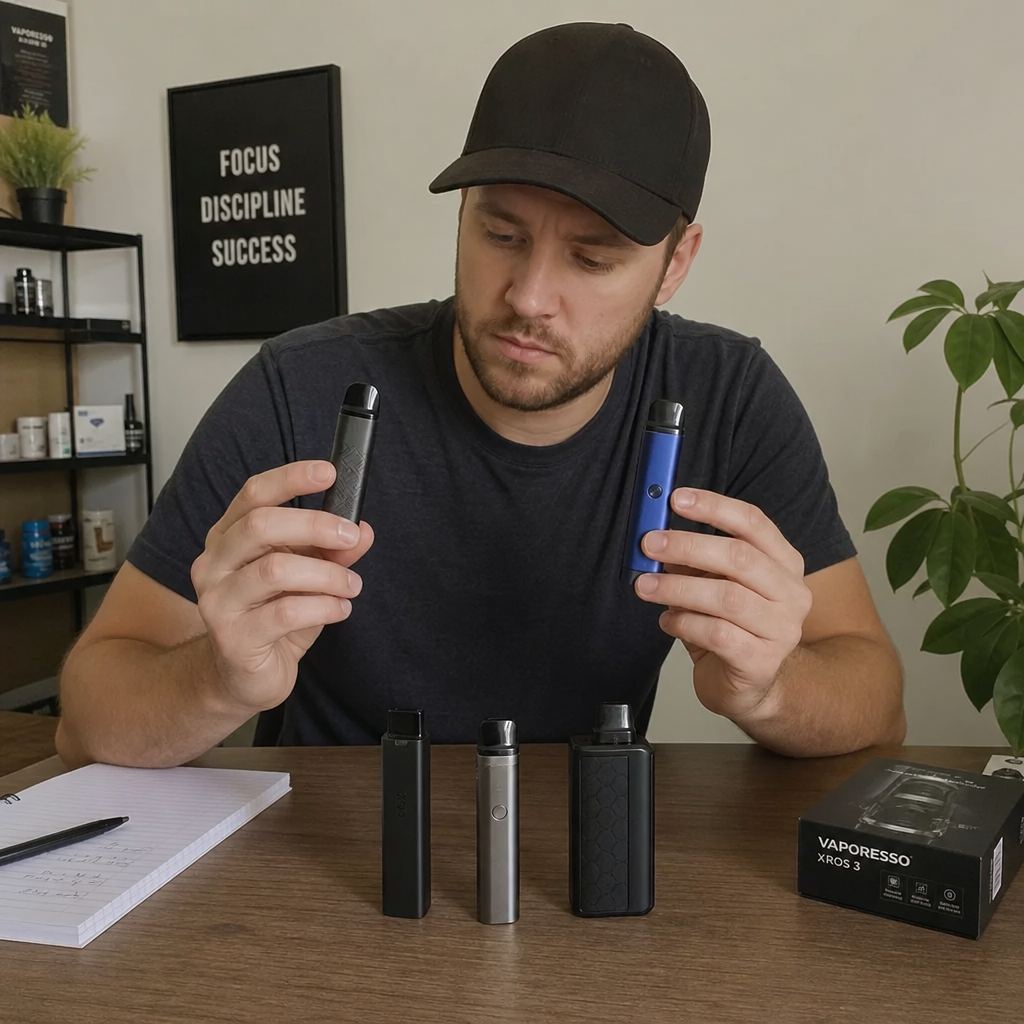

The answer depends entirely on where you are standing. In Dubai, vaping is legal if you follow the rules. In Mexico and Thailand, bringing a vape can end with confiscation, a fine, or worse. In a UK pub, it is not the law that decides, it is the landlord. This guide gives you all four answers in one place, with the penalties, what you can bring, and what to do if customs takes your vape.
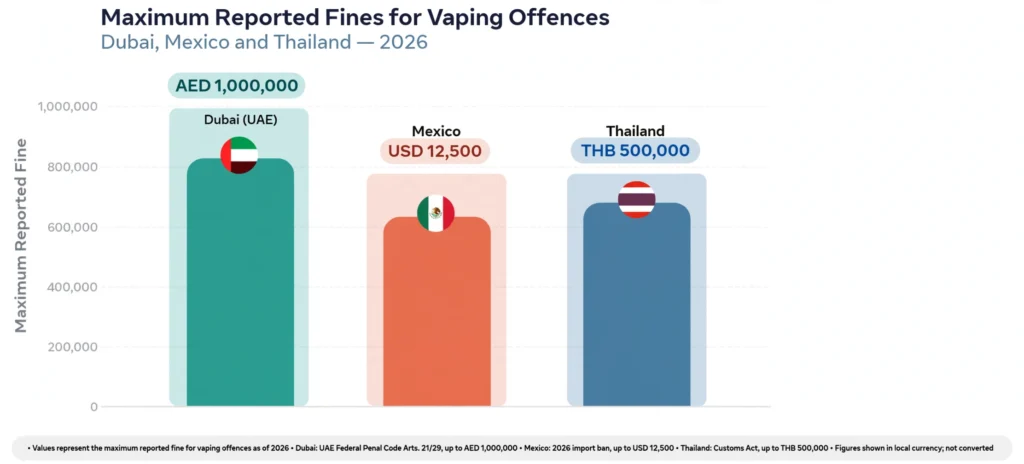
One honest note before the detail: fine figures differ between sources, sometimes a lot. Where reports conflict, this guide says so and gives the range instead of inventing a single confident number. Laws and enforcement change, so treat this as a researched snapshot and check current official travel advice before you fly.
The quick answer: four destinations, four verdicts
| Destination | Can you vape there? | Can you bring your vape? | Worst realistic outcome for a tourist |
|---|---|---|---|
| Dubai, UAE | Yes, 18+, in designated smoking areas only | Yes, personal-use quantities | Fine of AED 200 to AED 2,000 for vaping in the wrong place |
| Mexico | No, effectively banned | No, import is prohibited | Confiscation plus a fine; commercial offences carry prison terms |
| Thailand | No, total ban since 2014 | No, import is prohibited | Confiscation, fines typically 5,000 to 30,000 baht, detention possible |
| UK pubs | It depends on the pub | Yes, vaping is legal in the UK | Being asked to leave; no fine for vaping itself |
If you only remember one line per destination: Dubai is legal with rules, Mexico and Thailand mean leave it at home, and a UK pub means ask before you puff.
Dubai: legal, but only where smoking is allowed
Vaping is legal in Dubai and across the UAE for adults aged 18 and over. The UAE legalised e-cigarettes in April 2019 under strict product rules, and the framework has only tightened since. Every device and e-liquid sold legally must hold ECAS certification, the Emirates Conformity Assessment Scheme, and nicotine is capped at 20mg per ml, the same ceiling as the UK. Buy from licensed retailers only: an uncertified device is not a bargain, it is an illegal product.
The catch is where you can use it. Vaping follows the same public-use rules as smoking. That means designated smoking areas only, and no vaping in malls, restaurants, public transport, government buildings, hospitals, schools, beaches or parks. In practice, most hotels have a marked outdoor smoking area, and that is where you vape. Do not assume an outdoor pavement or a mall entrance counts: if there is no designated area, do not vape there.
Fines for vaping in the wrong place are reported at AED 200 to AED 2,000 depending on the location and the source. Reports differ on exact amounts by location, with public transport and government buildings at the top of the range and mall corridors and restaurants lower down. The honest version is that you should expect a fine in the hundreds to low thousands of dirhams, not a fixed number. What is not ambiguous is the red line on cannabis products: THC, CBD and cannabis-derived vape products are criminal offences under narcotics law, not fines. Never bring them, never buy them there.
Can you bring your own vape to Dubai? Yes, in personal-use quantities, typically a couple of devices and a reasonable e-liquid supply, kept within the 20mg nicotine cap. Pack it in hand luggage, never checked luggage, because of the battery rules.
On arrival, make the hotel your first stop for information, not the street. Ask reception where the designated smoking area is, and use that area for the whole stay. Large malls have marked smoking zones too, usually outdoors near an entrance, but they are easy to miss if you are not looking. If you cannot find a marked area, assume the spot is not allowed. Dubai rewards the traveller who asks first and punishes the one who assumes. Our flying with vapes guide covers the flight rules in full. Our do airports sell vapes guide covers what you can buy at the airport itself.
Mexico: do not bring a vape, full stop
Mexico is the destination that catches the most travellers out, because the ban is recent, absolute, and poorly understood. A constitutional amendment took effect in January 2025, and a General Health Law reform effective 16 January 2026 criminalised the import, sale, distribution and supply of all vaping products, including disposables, refillables, pods, e-liquids and even nicotine-free devices. Commercial offences carry prison terms of 1 to 8 years plus fines. There is no legal vape shop in Mexico anymore, and no legal way to buy one there.
What does that mean for a tourist? The critical detail is the split between possession and import. Mexican law excludes personal possession inside private spaces from criminal prosecution, but importing a device is still prohibited, and customs actively enforces it. In practice, that means your vape is very likely to be confiscated at the airport, and you may face a fine on top. Reported tourist fine figures conflict: one widely cited report puts them around 400 euros, others report over 1,000 US dollars for a single device. This guide will not pretend the number is settled. The safe reading is that the cost is high, unpredictable, and entirely avoidable by leaving the device at home.
Public vaping is also banned under Mexico’s smoke-free laws, which cover beaches, parks, hotel grounds, restaurant patios and transit hubs. Reported fines for public use run up to 3,000 pesos, about 150 euros. Enforcement varies by area, with tourist zones like Cancun, Los Cabos and Puerto Vallarta seeing active patrols, but variation is not a defence: the law applies everywhere.
Do not rely on your resort being relaxed about it. Many hotels now run fully smoke-free policies indoors and enforce the public rules on their own grounds, and resort staff may report violations. A hotel that tolerates a cigarette on a private balcony is not the same as permission to vape by the pool. The safest assumption in Mexico is that there is no place to vape, indoors or outdoors, and planning the trip that way removes the entire risk.
The practical move for Mexico is to plan around not vaping at all. Nicotine replacement products such as patches and gum are the safe legal alternative for the trip, and you can discuss them with a pharmacist before departure. If you are trying to quit nicotine entirely, the trip is also a natural break point: our nicotine-free vape guide maps the 0mg routes for when you are back home, though note that even nicotine-free devices are covered by the Mexican import ban, so do not bring those either.
Thailand: the strictest ban on this list
Thailand has banned e-cigarettes since 2014, and the ban covers everything: importing, selling, possessing and using them, with no exemption for tourists. Heated tobacco devices fall under the same ban. This is the destination where travellers get into the most serious trouble, because the gap between “everyone seems to be doing it” and “it is illegal” is widest here.
The position for travellers is plain: possessing or using any vape, e-cigarette, pod, e-liquid or heat-not-burn device in Thailand can lead to confiscation, heavy fines typically reported at 5,000 to 30,000 baht, detention, and court proceedings. Travellers may have to remain in Thailand until the case is finalised. Those are the figures travellers actually encounter. The statutory maxima behind them are far higher: importing in breach of the ban can carry up to 10 years in prison and fines up to five times the value of the goods. Maximum penalties are not automatic outcomes, but they are the reason this ban deserves more respect than a smoking fine.
Enforcement concentrates in tourist areas, and it has tightened further since a nationwide crackdown began in early 2025. There is also a scam to watch for: fake or corrupt officers demanding cash on the spot. A genuine penalty is handled at a police station, not at an ATM. If anyone demands cash at a cash machine, stay calm, ask for ID, and call the Tourist Police on 1155.
Can you smoke cigarettes in Thailand instead? Yes, cigarettes are legal, though heavily restricted to designated areas, with fines for smoking in public places. But do not treat that as a loophole for vaping: the vape ban is separate and far stricter. Leave every vape, pod, coil and bottle of liquid at home. If you are travelling with a smoker who wants to switch, our best vape for heavy smoker guide is the right reading for after the trip, not before it.
UK pubs: legal, but the landlord decides
This is the section that surprises people. There is no UK-wide law banning vaping indoors. The 2007 indoor smoking ban covers tobacco products only, and vapes are not legally classified as tobacco. So vaping in a pub is not, by itself, against the law. What decides it is the pub.
Almost every pub chain in the UK has chosen to ban vaping indoors: Wetherspoons, Greene King, Marstons, and Mitchells and Butlers, which owns Harvester, O’Neill’s and Toby Carvery, all prohibit it. The reasons are practical: staff cannot easily tell vapour from cigarette smoke at a glance, most customers prefer a vapour-free room, and pubs have spent years becoming family-friendly since the smoking ban. Independent pubs vary, and some allow vaping in a designated area, but the default assumption should be no vaping inside unless a sign or a member of staff says otherwise.
Beer gardens and outdoor seating are the usual exception: vaping is normally fine there if smoking is allowed, though it is still worth checking with staff before puffing at the table. There is no fine for vaping itself in the UK. The worst realistic outcome is being asked to stop, and being asked to leave if you refuse. Refusing to leave is where a civil matter can turn into a police matter, so do not test it.
The same picture holds across England, Wales and Scotland: no UK-wide indoor vaping ban, venues setting their own rules. If you are visiting a pub for the first time, a ten-second question at the bar saves an awkward conversation later. Staff would rather answer the question than enforce the rule, and regulars notice which visitors ask.
One change to watch: vape-free zones under the Tobacco and Vapes Bill are at consultation stage. They are not law yet, and they would need public consultation first. For now, the rule is simple: the law allows it, the venue decides. And remember the age rules that do apply now: from October 29, the age-18 rule covers every nicotine product, including zero-nicotine vapes and pouches, and vape vending machines are banned. Our UK vaping age rules guide covers the full extension. Our UK vape tax guide explains the £2.20 per 10ml duty sitting inside every bottle price.
Packing and arrival: the checklist that keeps you out of trouble
Pack the same way for every trip, then apply the destination rule on top.
Hand luggage only. Vapes go in cabin baggage, never in checked luggage, because of the lithium battery rules. Spare batteries go in a battery case in hand luggage too. No vaping on the plane, ever, and no charging on board unless the airline explicitly allows it.
Check the destination before you pack. This is the step that prevents every confiscation on this page. Dubai: pack personal-use quantities, 20mg max. Mexico and Thailand: do not pack a vape at all, in any bag, including checked luggage. Customs can treat a vape in any bag as an illegal import.
Leave the extras behind. Do not pack THC or CBD liquids for any destination on this list. Do not pack more devices or liquid than a single traveller would personally use. Commercial quantities turn a confiscation into a trafficking question.
Carry the boring paperwork. Keep e-liquid bottles in the liquids bag, keep receipts for expensive devices, and keep your ID handy. None of this guarantees a smooth crossing, but all of it makes a customs conversation shorter.
On arrival, follow the local rule from minute one. Do not vape in the arrivals hall, the taxi queue, or the hotel lobby while you figure out the local rules. In Dubai, find the designated smoking area. In Mexico and Thailand, there is no legal place to vape, so do not start looking for one.
Buy local only where it is legal. In Dubai, buy from licensed retailers and check for ECAS certification. In Mexico and Thailand, there is no legal local purchase, so do not buy from a street seller: an illegal device plus an illegal use is two problems, and the device itself may be fake. Our fake vapes guide shows what to check before you pay anywhere.

What to do if your vape is confiscated
It happens, even to careful travellers. The right response is boring, polite, and short.
Do not argue about the law. If an officer says the device is prohibited, it is prohibited in that moment regardless of what you read online. Arguing turns a confiscation into a detention. Hand it over, ask for a receipt or a written record if one is offered, and note the officer’s name or badge number if it is safe to do so.
Do not offer money. In Thailand especially, never pay cash to an officer on the spot. A genuine penalty goes through a police station with paperwork. If someone demands cash at an ATM, that is the scam pattern: stay calm, ask for ID, and call the Tourist Police on 1155.
Ask what happens next, then follow it. In Dubai, a fine is usually the end of it: pay it through the official channel and move on. In Mexico, you may be fined and released, or referred onward. In Thailand, you may be taken to a police station, and the case may take days. If you are told you must remain in the country until the case is finalised, take that seriously and contact your embassy.
Contact your embassy if you are detained. Your embassy cannot override local law or get you released, but it can provide a list of local lawyers, contact your family, and check on your welfare. That is worth more than it sounds when you are in a police station in a country whose language you do not speak.
After the trip, reset properly. If confiscation cut your trip short on nicotine, do not buy a replacement from the first street seller you meet. Wait until you are home, buy from a proper UK shop, and start again with a legal device. Our best vape guide picks the right legal device for every kind of vaper, and the first week back is a good time to reassess strength and flavour with a clear head.
Can you vape abroad FAQ
Can you vape in Dubai?
Yes, if you are 18 or over, using an ECAS-certified product, and vaping in a designated smoking area. Vaping in malls, restaurants, public transport, government buildings, beaches or parks can draw a fine reported at AED 200 to AED 2,000.
Can you take a vape to Dubai?
Yes, in personal-use quantities, in hand luggage, with nicotine at or under 20mg per ml. THC and CBD vape products are criminal offences, not fines.
Can you vape in Mexico as a tourist?
Effectively no. Importing any vape device is prohibited, customs confiscates devices, and reported tourist fines vary widely. Public vaping is also banned. Leave the device at home.
Can you vape in Thailand as a tourist?
No. Import, sale, possession and use have been banned since 2014 with no tourist exemption. Expect confiscation and fines typically reported at 5,000 to 30,000 baht, with detention and court proceedings possible.
Can you vape in a UK pub?
It depends on the pub. No UK-wide law bans vaping indoors, but almost all chains and most independents ban it inside. Beer gardens usually allow it. Ask staff before you puff.
Can you vape in a UK beer garden?
Usually yes, if smoking is allowed there. It is still worth checking with staff, since some venues ban smoking outdoors too.
What happens if customs takes my vape?
Hand it over without arguing, do not offer cash, and ask what happens next. In Dubai that is usually a fine. In Mexico and Thailand it can mean a police station visit and, in Thailand, a requirement to stay until the case is finalised. Contact your embassy if detained.
Can I bring a vape home to the UK from a trip?
Yes, if the device is legal in the UK. Bring it in hand luggage, keep nicotine at or under 20mg, and buy from proper shops when you are home. The UK ban covers single-use disposables, not refillable devices.
Is it safer to buy a vape at my destination?
Only where it is legal. In Dubai, buy from licensed retailers with ECAS certification. In Mexico and Thailand, there is no legal purchase, so do not buy from street sellers.
What is the safest alternative for a trip to Mexico or Thailand?
Nicotine replacement products such as patches and gum, discussed with a pharmacist before departure. They are legal, discreet, and do not risk confiscation or a fine.
Verdict: pack for the strictest country on your itinerary
Four destinations, one rule: the strictest country on your itinerary decides what goes in your bag. Dubai rewards the prepared traveller, with legal vaping in marked areas and personal-use imports allowed. Mexico and Thailand punish the unprepared one, with confiscation, fines, and in Thailand’s case the real possibility of detention. A UK pub is the easy one: the law allows it, the landlord decides, and asking first costs nothing.
Check the official travel advice before you fly, pack for the strictest stop, and leave the vape at home when the destination says no. The holiday is worth more than the device.