
This page is general information, not medical advice. If you are pregnant and you smoke or vape, the single most useful thing you can do is tell your midwife. She has heard it all before, she will not judge you, and she can get you free help that actually works.
Here is the short answer, and then the detail behind it.
The safest option in pregnancy is to stop both smoking and vaping. Vaping is not risk-free, and nicotine can affect a developing baby. But if you currently smoke and you cannot quit outright, switching to vaping is much less harmful than continuing to smoke. That is the honest middle that UK health guidance holds, and it is the position this guide follows throughout.
If you have never smoked, do not start vaping in pregnancy. There is no version of this where a non-smoker gains anything from a vape.
What the guidance actually says
UK health guidance on this topic is more nuanced than most articles admit, and the nuance matters, because the right advice depends on where you are starting from.
For someone who does not smoke: do not vape in pregnancy. Full stop. Vaping introduces nicotine and vapour chemicals into a pregnancy that does not need them, and the long-term effects of inhaling flavourings and vapour chemicals during pregnancy are not fully understood. Nobody who has never smoked should pick up a vape while pregnant.
For someone who smokes: stop smoking, by whatever route gets you there. The preferred route is licensed nicotine replacement therapy, such as patches, gum or lozenges, used with support from a midwife or stop smoking service. If that has not worked, or if vaping is what is keeping you off cigarettes, then vaping is treated as a harm-reduction step. It is not the goal. The goal is still to stop vaping too, once you are safely off cigarettes.
That distinction, vaping as a bridge away from smoking rather than a new habit, is the part most retailer articles skip. They present vaping as the answer. It is not the answer. It is a lesser harm on the way to the answer.
One more rule sits above all of it: do not do both. Smoking and vaping at the same time exposes you to the full harm of cigarettes plus the nicotine and chemicals of vapour. If you switch, switch fully. If you slip and smoke a cigarette, that is a slip, not a failure, but do not settle into a pattern of alternating between the two.
Why smoking is the real danger
To understand why guidance treats vaping differently from smoking in pregnancy, you need to know what cigarette smoke actually does.
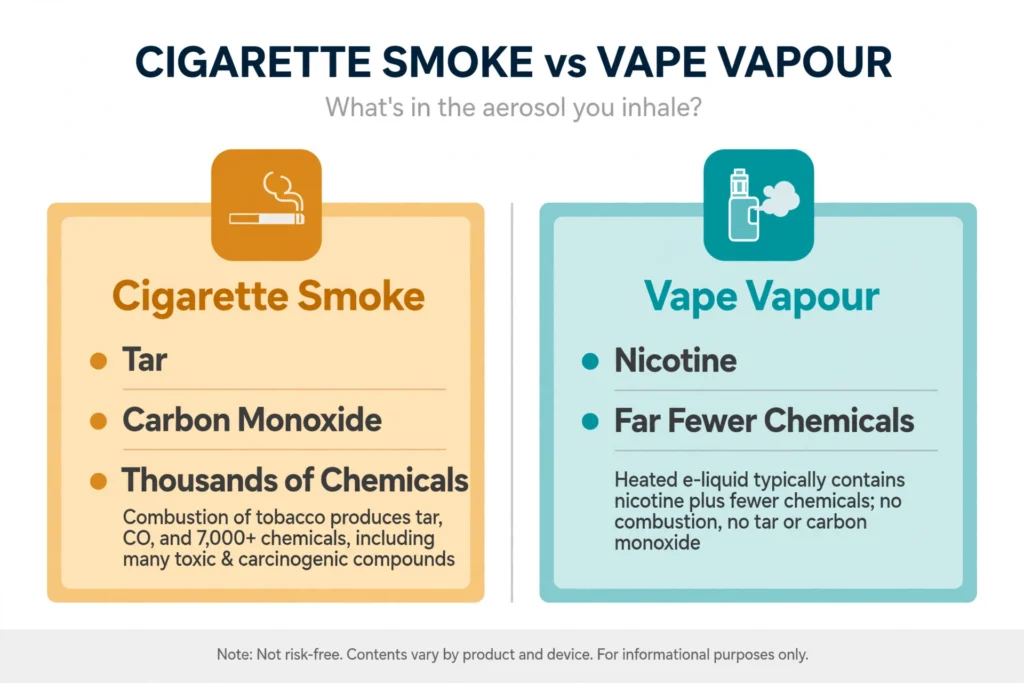
A burning cigarette releases thousands of chemicals. Two of them do most of the damage in pregnancy. Carbon monoxide binds to your blood and reduces the oxygen reaching your baby. Tar coats your lungs and carries carcinogens into your bloodstream. Together with the rest of the chemical mix, they restrict growth, raise the risk of miscarriage, premature birth and low birth weight, and increase the risk of complications with the placenta and of sudden infant death.
Vapour contains none of that. A vape heats liquid into vapour without burning anything, so there is no tar and no carbon monoxide. What vapour does contain is nicotine, plus flavourings and the base liquids that carry them. Nicotine is not harmless in pregnancy, and that is why guidance says to stop vaping too. But nicotine is not the chemical doing the worst damage in cigarette smoke. The smoke is.
That is why the comparison is not “vaping vs nothing”. For a smoker, the comparison is “vaping vs smoking”, and on that comparison vaping is much less harmful. For a non-smoker, the comparison is “vaping vs nothing”, and on that comparison vaping adds risk for no benefit.
What nicotine does, and what it does not do
Nicotine has a bad reputation that is partly borrowed from smoking. It is worth separating the two.
Nicotine is addictive. That is the main reason it is hard to stop. In pregnancy, nicotine can affect a developing baby, which is why guidance says the ideal is no nicotine at all. That is also why licensed nicotine replacement products are preferred over vapes when a pregnant smoker needs help: they deliver nicotine in a controlled way without vapour chemicals, and they come with professional guidance on dose and duration.
What nicotine does not do is produce carbon monoxide or tar. The diseases people associate with smoking come overwhelmingly from the smoke, not from the nicotine alone.
This matters practically. If your midwife offers you nicotine replacement, she is not offering you something “just as bad”. She is offering you the addictive chemical without the smoke that does the real damage. The same logic is why vaping sits between smoking and nicotine replacement on the harm scale: less harmful than cigarettes, more uncertain than a licensed product.
What is still unknown is the long-term picture. Research on vaping in pregnancy is still developing. There is no long-term study following children whose mothers vaped through pregnancy into adulthood, because vaping has not existed long enough. Guidance is based on what is known about nicotine, what is known about the chemicals in vapour at the low levels present, and what is known about smoking. That is enough to say “much less harmful than smoking” and “not proven safe”. It is not enough to say “completely safe”. Any article that tells you vaping in pregnancy is proven safe is guessing.
If you already vape: the decision ladder
If you are pregnant and already vaping, here is the ladder, in order. Start at the top and stop at the first rung you can hold.
Rung one: stop vaping entirely, with support. This is the best outcome. Book a conversation with your midwife or GP, tell them you vape, and ask for help quitting. Free stop smoking services exist in every part of the UK and they support vapers too, not just smokers. They can help with a quit plan, coping strategies for cravings, and, if appropriate, licensed nicotine replacement to ease withdrawal.
Rung two: switch to licensed nicotine replacement. If quitting cold is not working, ask your midwife about patches, gum or lozenges. These are the products guidance prefers in pregnancy. They deliver nicotine without vapour, and your midwife can advise on which form suits you. Some people find oral products like gum or lozenges easier in pregnancy, especially if nausea makes patches uncomfortable. Your midwife can help you choose.
Rung three: keep vaping, but only as a bridge off cigarettes. This rung is for someone who smokes and finds that vaping is the only thing keeping them off cigarettes. If that is you, staying on the vape is better than going back to smoking. But treat it as a bridge, not a destination. Talk to your midwife about it, use the lowest strength that keeps you off cigarettes, and set a date to step down. Do not let a bridge become a permanent address.
The floor: never go back to smoking. Whatever rung you are on, going back to cigarettes is the worst outcome on this ladder. If you slip, it is a slip. Tell your midwife, reset, and keep going. A single cigarette does not undo the benefit of every cigarette you did not smoke.
Notice what is not on this ladder: starting to vape if you have never smoked, and dual use. Both are off the ladder for a reason.
Trimester by trimester: what changes
The advice does not change much by trimester, but the practical picture does.
First trimester. This is when the baby’s major organs form, and it is the period where avoiding nicotine and chemicals matters most. It is also, for many people, the trimester of nausea, exhaustion and food aversions, which makes quitting harder. If you are in the first trimester and still smoking or vaping, the best time to quit is now, and the worst thing you can do is put it off because you feel rough. Tell your midwife at your booking appointment. Early disclosure gets you early support, including a carbon monoxide breath test that shows you exactly where you stand.
Second trimester. By now the nausea often eases and routines settle. This is a good window to make a proper quit plan if you have not yet. If you are still vaping, keep the conversation with your midwife open. Midwives would far rather hear “I am still vaping and I want to stop” than hear nothing.
Third trimester. The baby is growing fast, and the placenta is working hardest. Smoking in the third trimester is strongly linked to restricted growth and low birth weight. If you are still smoking at this point, switching to vaping or nicotine replacement now still helps. It is never too late to benefit from stopping. Use the third trimester to prepare a smoke-free and vape-free home for the baby’s arrival, which matters as much as what you do during pregnancy. The next sections cover that.
At every stage, the same principle applies: quitting earlier is better, quitting later is still worth it, and telling your midwife beats hiding it at every stage.
Zero-nicotine vapes: not a free pass
A common question is whether a 0mg vape solves the problem. It does not, not fully.
Removing nicotine removes one risk, and that is genuinely better than a nicotine vape. Our nicotine-free vape guide explains the 0mg landscape in full. But a 0mg vape still produces vapour containing flavourings and base liquids, and the long-term effects of inhaling those during pregnancy are not fully understood. Health professionals recommend avoiding vaping entirely during pregnancy, including nicotine-free vapes.
There is also a behavioural trap. A 0mg vape keeps the hand-to-mouth habit alive, keeps you in vape shops, and keeps you one stressful day away from buying a nicotine bottle. If the goal is to stop, a 0mg vape can quietly delay it. If you are using a 0mg vape as a stepping stone off nicotine, set a date to stop that too, and tell your stop smoking adviser so they can help you plan it.
The one exception worth naming: if a 0mg vape is what is standing between you and a cigarette, it is still the lesser harm. But it is a bridge, like any other vape in this guide, not a destination.
Breastfeeding: nicotine in milk, and why you should keep feeding
The breastfeeding question has a reassuring answer and a careful one.
First, the reassuring part: if you vape or smoke, you should still breastfeed. Breast milk is the best food for your baby, it protects against infections, and health guidance is clear that the benefits of breastfeeding outweigh the risks of nicotine exposure through milk. Do not stop breastfeeding because you vape.
Now the careful part: nicotine does pass into breast milk. When you vape, nicotine enters your bloodstream and some of it reaches your milk. That is why the same ladder applies after birth. The safest option is no nicotine. The preferred quit aid is licensed nicotine replacement, discussed with your midwife, GP or health visitor. If vaping is what keeps you off cigarettes, it is still better than smoking, and you should carry on breastfeeding.
Three practical steps reduce exposure while you work on quitting.
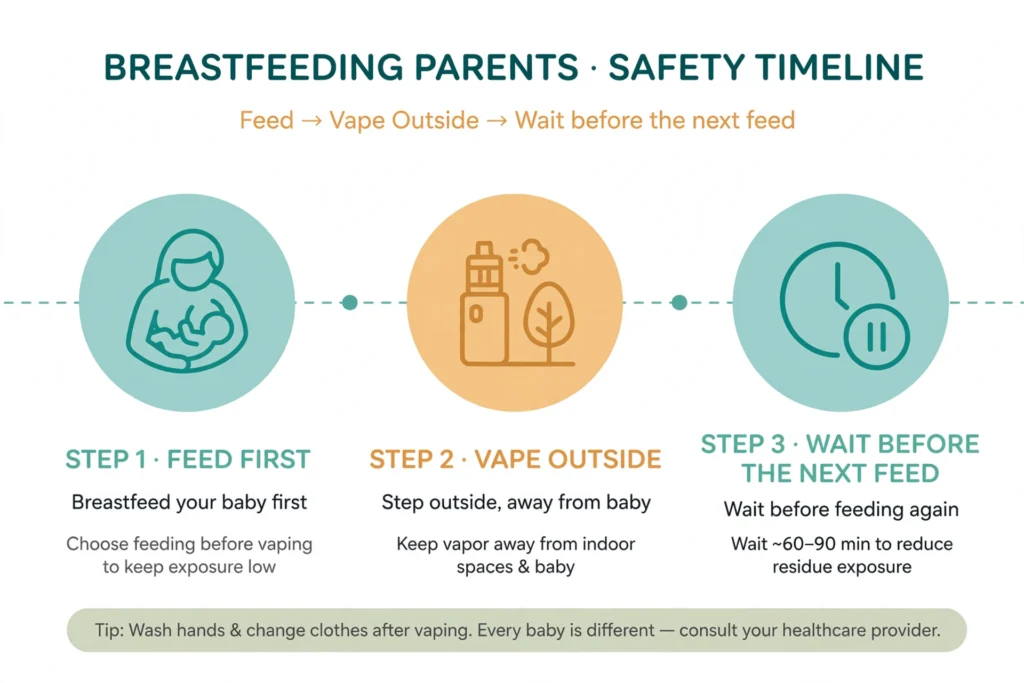
Feed first, vape after. Vape straight after a feed rather than before one, so your body has the longest possible time to process the nicotine before the next feed.
Vape outside, away from the baby. This is about secondhand vapour as well as milk. Do not vape in the same room as your baby, in the car with your baby, or while holding your baby. Step outside, and change your top if it smells of vapour before picking the baby up.
Keep working toward quitting. The weeks after birth are exhausting and a terrible time to white-knuckle a quit attempt alone. Ask your health visitor about stop smoking support. Postnatal support exists, and it is designed for exactly this situation: a new parent, short on sleep, trying to do the right thing.
One more point for the early days: partners and visitors matter here too. If your partner vapes or smokes, the same outside-only rule should apply to them. A vape-free home protects the baby from secondhand vapour and from the far greater risk of secondhand smoke.
Partners, secondhand vapour, and the house
Pregnancy does not happen in isolation, and neither does quitting.
If your partner smokes, their smoking affects your pregnancy. Secondhand smoke in pregnancy increases the risk of miscarriage, stillbirth and sudden infant death, and it makes it far harder for you to quit. The single most helpful thing a smoking partner can do is quit alongside you, or at minimum smoke only outside, away from you, and change clothes before coming back in. If your partner vapes, the same outside-only rule applies, even though secondhand vapour is not thought to carry the same risks as secondhand smoke. Caution costs nothing here.
Make the house vape-free and smoke-free before the baby arrives. That means no vaping indoors, no smoking indoors, and no ashtrays or vape kits left on tables. It also means thinking about storage. E-liquid bottles, especially nicotine liquid, are poisonous if swallowed, and a curious toddler can open a bottle faster than you expect. Store every vape, bottle and spare coil high up, locked away, and out of sight. Our vape battery safety guide covers safe storage in full, including the battery rules that matter once a baby is crawling.
If you live with other smokers or vapers, have the conversation early. “No vaping in the house once the baby is here” is easier to agree in advance than to negotiate at 3am with a newborn.
Getting help: what actually happens when you ask
Many people avoid telling their midwife they smoke or vape because they expect a lecture. What actually happens is far more useful.
At your booking appointment, your midwife will ask about smoking. Tell her the truth, including vaping. She will offer a carbon monoxide breath test, a quick and painless check that shows whether you have been exposed to smoke. She can then refer you to a free stop smoking service, which is staffed by people whose entire job is helping pregnant people quit. They will build a plan around you, not a generic leaflet.
What that support looks like: regular check-ins, help identifying your triggers, coping strategies for cravings, and, if appropriate, licensed nicotine replacement products. Some services can supply nicotine replacement free of charge during pregnancy. If you are vaping, they can help you plan a step-down, including when to drop strength and when to stop entirely.
If you would rather not wait for a referral, you can self-refer to your local stop smoking service, or speak to your GP or pharmacist. The point is that you do not have to do this on willpower alone. The evidence is consistent that support doubles the chance of quitting, and it is free.
If you are worried about being judged, remember what midwives see every day. They see people in far harder situations than yours, and they see them quit. You are not the first pregnant person to vape, and you will not be the last. Asking for help is the move that separates the two groups.
Can you vape when pregnant FAQ
Can you vape when pregnant?
The safest option is to stop both smoking and vaping. If you currently smoke and cannot quit otherwise, switching to vaping is much less harmful than continuing to smoke, but it should be a bridge to quitting, not a permanent habit. Talk to your midwife about the best route for you.
Is it safe to vape while pregnant?
No vape is proven safe in pregnancy. Vaping is not risk-free, and nicotine can affect a developing baby. It is much less harmful than smoking, but the goal is still to stop.
What if I smoked or vaped before I knew I was pregnant?
Do not panic. Many people smoke or vape in the earliest weeks before they know. What matters is what you do now. Tell your midwife, stop as soon as you can, and get support. Beating yourself up about the weeks before you knew helps nobody, least of all the baby.
Can you vape 0mg while pregnant?
A nicotine-free vape removes the nicotine risk but still produces vapour containing flavourings and base liquids whose long-term effects in pregnancy are not fully understood. Health professionals recommend avoiding vaping entirely during pregnancy, including 0mg vapes.
Can I vape while breastfeeding?
It is better to stop, and licensed nicotine replacement is the preferred quit aid. But if vaping keeps you off cigarettes, carry on breastfeeding, because the benefits of breast milk outweigh the risks. Feed first, vape outside afterwards, and keep working toward quitting.
Will my midwife judge me for vaping?
No. Midwives support pregnant people who smoke and vape every day. Telling her gets you free support, a quit plan, and access to nicotine replacement. Hiding it gets you none of that.
Can my partner vape around me while I am pregnant?
They should not vape in the same room as you, and ideally not in the house at all. Secondhand vapour is not thought to carry the same risks as secondhand smoke, but the cautious choice is outside only. If your partner smokes, the case for outside only is stronger still.
Is it too late to quit in the third trimester?
No. Quitting at any point in pregnancy helps. The earlier the better, but stopping in the third trimester still reduces risks and sets up a smoke-free home for the baby.
Are nicotine pouches better than vaping in pregnancy?
Nicotine pouches are not a recommended product in pregnancy either. Licensed nicotine replacement products are the preferred option, because they are regulated as medicines with professional guidance behind them. Our nicotine pouches vs vapes comparison covers how the two compare in general, but in pregnancy the answer is the same: talk to your midwife before using any nicotine product.
What if I quit smoking but still vape?
You have already made the biggest gain. The next step is to quit vaping too, with support. Set a date, tell your stop smoking adviser, and step down. If you are struggling, that is a reason to ask for more help, not a reason to go back to cigarettes.
Verdict: the ladder, one more time
If you do not smoke, do not vape in pregnancy. If you smoke, stop, by whatever route works, and treat vaping as a bridge, not a destination. If you already vape, work the ladder: stop entirely with support, or switch to licensed nicotine replacement, or keep vaping only while it keeps you off cigarettes, and never go back to smoking.
Tell your midwife. Use the free support. Make the house vape-free before the baby arrives. And if you slip, reset and keep going. A pregnancy is nine months long, and every smoke-free, vape-free day in it counts.
For context on the wider rules around vaping in the UK, our UK vaping age rules guide covers who can buy what. If you are choosing a device after pregnancy, our best vape guide is the right reading for that decision. If you are a heavy smoker working on quitting, our best vape for heavy smoker guide covers the devices that actually hold up. And if you want to understand the technique side for a future quit attempt, our how to vape guide walks through it step by step.