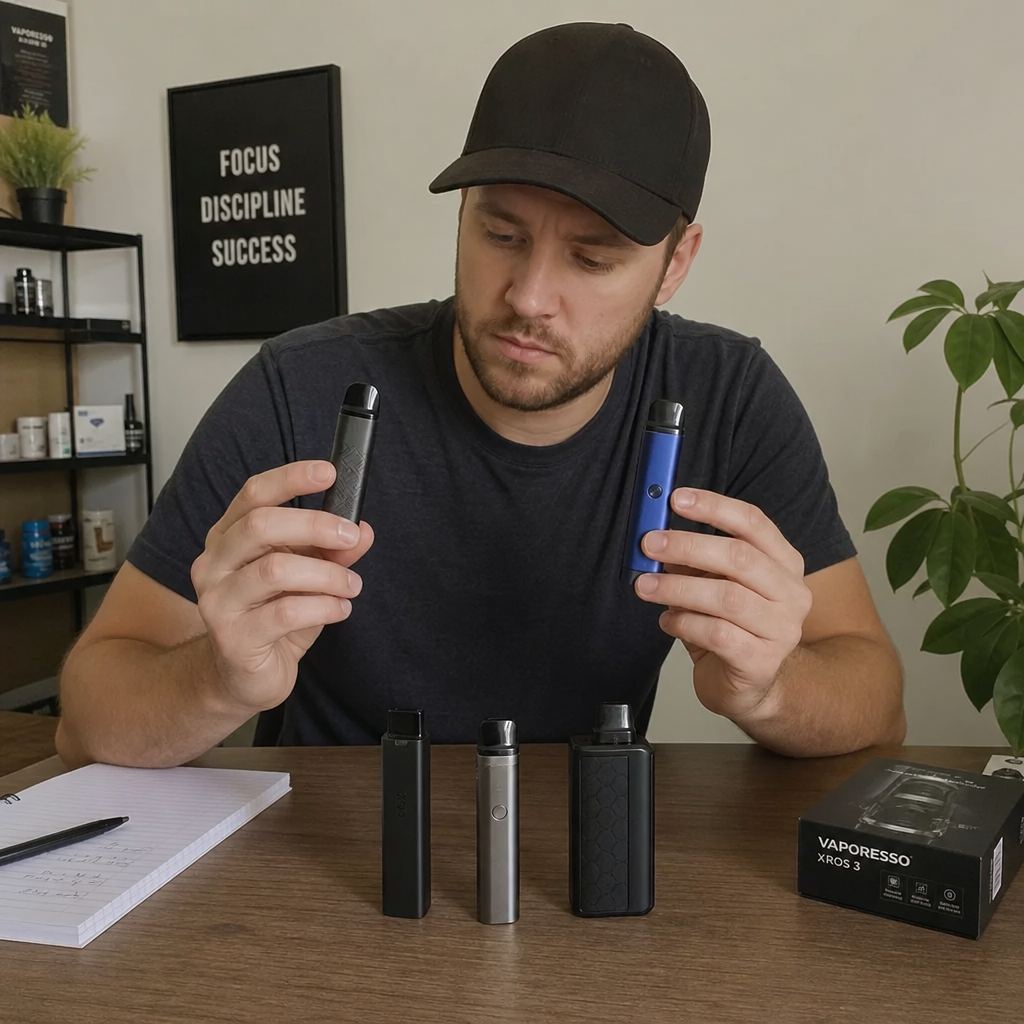

Most quit-vaping advice reads like it was written by someone who never had a device in their pocket. Just throw it away. Just stop. You have already thought of that. The reason it has not worked is not willpower. It is the lack of a plan that treats the two problems separately: the nicotine your body expects, and the habit your hands expect.
This guide tackles both. Pick your method, handle the nicotine, survive the first 72 hours, and know what to do when a craving or a bad day shows up. No lectures. Just the plan.
This guide is general information, not medical advice. If you have personal medical questions, talk to your GP or pharmacist.
Start by knowing your number
Before you pick a method, check your label. Strength is printed as mg/mL or a percentage: 50 mg/mL is 5%, 20 mg/mL is 2%.
Then answer three quick questions:
- What strength are you vaping?
- How much do you get through in a week: a disposable, two pods, a 60 ml bottle?
- Do you reach for it within 30 minutes of waking up?
If the answer to the third question is yes, your dependence is on the stronger side, and a planned taper or some support will make the first week meaningfully easier. If you vape lightly and mostly in social situations, you may do fine stopping outright. Answer honestly, so you pick a method built for you.
Two honest ways to quit, and who each one suits
Stopping outright
You pick a date, get rid of everything the night before, and stop. It is the fastest route to nicotine-free and the hardest first week. Withdrawal peaks in the first few days and then eases, but that week is where most quits fail.
It suits lighter vapers, shorter-term users, and people who do better ripping the bandage off. If this method has worked for you before, that track record counts.
The catch: going it alone has the lowest success rate. Stopping outright works far better with backup: a friend who knows your date, a quitline, a text program, or a GP who knows you are trying.
Stepping down
You reduce your nicotine strength in stages over several weeks, then stop. Each drop is small enough that withdrawal stays manageable, and by the end you are barely feeding the chemical side of the habit.
It suits heavy users on high-strength salts, anyone who has failed at stopping outright before, and anyone who needs the hand-to-mouth routine while the dependence shrinks.
The catch: a taper only works if you do not compensate. Hitting a 6 mg liquid twice as hard as you hit 50 mg defeats the ladder. Write the schedule down, buy the strengths ahead of time, and do not keep a higher-strength emergency bottle in the drawer.
Neither method is morally superior. The best one is the one you will actually follow for the next month.
The nicotine step-down ladder
Here is a taper in practice. Spend two to four weeks on each rung. If cravings spike after a drop, you went down too fast: hold that rung one more week instead of climbing back up.
| Rung | Strength | What to buy |
|---|---|---|
| 1 | 50 mg/mL (5%) | Your current disposables or high-strength salt pods |
| 2 | 20 mg/mL (2%) | Standard pods or bottles, the legal maximum in the UK and EU |
| 3 | 10-12 mg/mL (1%) | Mid-strength refillable bottles |
| 4 | 6 mg/mL (0.6%) | Low-strength bottles |
| 5 | 3 mg/mL (0.3%) | Very light bottles |
| 6 | 0 mg/mL | Nicotine-free liquid or pods, then stop the device too |
A few practical notes on the ladder:
- On disposables, changing strength means changing the device. Buy one lower-strength disposable at a time so you cannot reach back up the ladder mid-week.
- On refillable pod kits, you control the strength completely. This is the easiest hardware for tapering.
- Drop one rung, not two. The jump from 50 mg to 6 mg in one go is an abrupt quit wearing a taper costume.
- The last rung, zero nicotine, is about breaking the hand-to-mouth loop. Give it one to two weeks, then stop the device. Lingering on zero-nicotine vaping for months just moves the habit instead of ending it.
If you started vaping through switching from smoking, tell your plan about that history. Step the vape down without drifting back to cigarettes, and if the worry is slipping back, read how cigarettes vs vaping compare before a craving rewrites the history.
Quit night: what to do with your device and juice
The night before your quit date, do a full sweep: the spare in the jacket pocket, the pod kit in the car, the half bottle on the shelf, the charger by the bed. A backup kept just in case becomes the plan. Everything goes.
What to do with it all:
- Disposables and dead pods: these contain lithium batteries, so skip the household bin. Most supermarkets, electronics shops, and recycling points take small batteries and e-waste. Bag them up and drop them off on quit day itself.
- Leftover e-liquid: nicotine bottles are hazardous to children and pets. Do not use them up to finish them off, that is just one more day of full-strength vaping. Seal them for the same e-waste collection as the devices.
- Chargers and cables: bag them with the devices. A charger on the nightstand is a reminder with a plug.
- Tell one person. Text a friend or family member your quit date tonight. Saying “I am quitting vaping tomorrow” turns a private intention into something you have to live up to.

The first 72 hours: an hour-by-hour playbook
The first three days are the peak. Nicotine leaves your system quickly, which is why cravings come on strong and early. The upside: the chemical side of withdrawal is short. What you are really fighting is a wave pattern. Cravings rise, peak within a few minutes, and fall. Every wave you ride out is one your brain learns it can survive.
Run the same four moves on every craving. Coaches call them the 4 D’s:
- Delay. Do not decide anything for five minutes. Set a timer. The wave will already be falling by the time it rings.
- Deep breathe. Slow breath in through the nose, slower out through the mouth. It pulls you off autopilot, and it mimics the breathing rhythm of vaping without the nicotine.
- Drink water. Sip it slowly. Cold water works best. It occupies your mouth and your hands, the two things vaping kept busy.
- Do something else. Change rooms, step outside, text your person, do ten push-ups, chew gum. Motion beats willpower.
Now script your danger zones before they arrive:
- The morning reach. Brush your teeth immediately, drink a full glass of water, and eat breakfast before you check your phone.
- The commute. Keep gum or mints in the car or bag. Put on a podcast or playlist you only use for this drive, so the drive gets a new ritual.
- Work and study breaks. Breaks are the hardest because vaping was the break. Take the walk without the device. Step outside, stretch, call someone. The break still exists, it just does not need vapour in it.
- After meals. This is the strongest trigger for many people. Brush your teeth straight after eating. The mint taste makes vaping unappealing, and the routine gives your mouth a job.
- The evening wind-down. This is where boredom cravings live. Plan the evenings of the first week in advance: a show, a game, a walk, an early night. An unplanned evening is a vaping evening.
- Alcohol and social settings. For the first two weeks, consider skipping the situations where you always vaped. If you go, tell people you have quit, and keep your drink in your dominant hand.
Sleep will probably be rough for a few nights. Protect the basics: same bedtime, no caffeine after midday, screens off before bed. If sleeplessness drags past a couple of weeks, raise it with your GP or pharmacist.
Withdrawal, day by day
Everyone’s timeline is a little different, but the pattern below is what most people experience. Read it now so day three does not feel like a surprise attack.
| Timeframe | What you may feel | What helps |
|---|---|---|
| Hours 0-24 | First cravings, restlessness, a short fuse | Water, food, movement. Stay busy through the early urges. |
| Days 1-3 | The peak. Strong urges, irritability, trouble sleeping, low mood, bigger appetite | The 4 D’s on every craving. Exercise, even a 15-minute walk. Tell your person how it is going. |
| Days 4-7 | Urges ease but concentration feels fuzzy and mood wobbles | Routine. Regular meals, regular sleep, planned evenings. |
| Weeks 2-4 | Intermittent cravings, mostly tied to old triggers | Trigger swaps from the next section. Start re-entering old settings on your terms. |
| Month 2 and beyond | Occasional urges, usually around stress or alcohol | A pre-planned response for your personal danger zones. They get rarer and weaker. |
Two things worth knowing. First, appetite usually goes up, since nicotine suppresses hunger. Keep crunchy snacks and fruit around, and do not turn this into a second battle. Second, some people cough more in the first week or two. It is uncomfortable and it usually passes.
Rewire the habit, not just the chemical
Long after the nicotine is gone, the habit loop can linger: the hand lift, the inhale, the pause, the exhale. That loop was rehearsed thousands of times. You break it by giving each trigger a replacement until the new response becomes automatic.
Write these down in the form “when X, I will Y”:
- When I finish a meal, I will brush my teeth and take a short walk.
- When I feel stressed at work, I will step outside for five minutes and breathe.
- When I am bored in the evening, I will pick up the thing I planned instead of my phone.
- When someone near me vapes, I will remember my reason and change the subject, or step away.

Keep your mouth and hands supplied for the first month: sugar-free gum, mints, toothpicks, crunchy snacks, a water bottle that never leaves your side. Exercise is the best craving killer most people ignore. A brisk walk often takes the edge off an urge, and it fixes the restlessness that makes evenings hard.
Not sure what the habit costs you? A disposable or two a week adds up fast over a year, and our breakdown of vape juice prices shows how weekly spending compounds. Money is not the deepest reason to quit, but it is an excellent daily reminder.
Zero-nicotine vaping: a bridge, not a destination
Somewhere in the plan, usually at the bottom of the ladder or right after stopping outright, people ask about zero-nicotine vapes. Here is the honest version.
As a short transition step, they do a real job: they separate the two problems. The chemical dependence is already handled, and the zero-nic device handles the hand-to-mouth ritual while your brain rewires.
As a destination, they fail. Months of zero-nicotine vaping keeps the entire ritual alive: the breaks, the hand lift, the social cue, the spending. The ritual is half the addiction. Use the bridge, then cross it. One to two weeks, then the device goes too.
For the full picture on nicotine-free products and how they fit a quit plan, our nicotine-free vaping guide walks through it.
Some people look at other nicotine products as a temporary step. If you are curious, this nicotine pouches comparison lays out the trade-offs. Whatever bridge you use, the rule is the same: it is temporary, it has an end date, and the end date is written down.
If you slip: the no-shame restart
Most successful quitters needed more than one attempt. A slip is data, not a verdict.
There is a difference between a slip and a relapse. A slip is one device, one evening, one bad day. A relapse is deciding the quit is over. The slip only becomes the relapse if the story in your head changes from “that was a mistake” to “I guess I cannot do this.”
The no-shame restart protocol:
- Get rid of the device immediately. Do not finish it since you already slipped. That is the addiction negotiating.
- Do the 24-hour analysis. What was the trigger? Where were you, what were you feeling? Write it down. That trigger gets its own “when X, I will Y” line.
- Tell your person. Say you slipped, name what set it off, and share the fix. Shame grows in silence, plans grow in daylight.
- Reset the date, not the goal. You are not starting from zero. You are starting from experience, and your next attempt is smarter.
Never let one bad evening erase a week of clean days. The days you did not vape still count.
When to bring in free help
You do not have to do this on willpower alone, and using support is not a sign the quit is not real. Most countries run free quit services: quitlines with trained coaches, text-message programs, and in the UK, stop smoking services that support vapers too. A short call before your quit date gives you a plan and a person.
Your GP or pharmacist can talk through nicotine replacement options like patches, gum, or lozenges, and whether they fit your situation. They can also help if you used vaping to step away from cigarettes and worry about drifting back. Say so out loud to a professional. That is exactly the kind of problem quit services exist to solve.
If low mood, anxiety, or trouble sleeping stick around well past the first month, bring that to your GP too. Most of it is withdrawal and it fades. Anything that does not fade deserves a proper conversation.
The long game
Quitting vaping is not a single decision. It is a few hundred small ones, made easier each time by the plan you wrote before you needed it. The cravings get rarer. The triggers get quieter. One day you will walk past a vape shop and feel nothing.
Start tonight. Know your number, pick your method, write your date down, and clear the drawer. The hardest part was deciding. The rest is just following the plan.