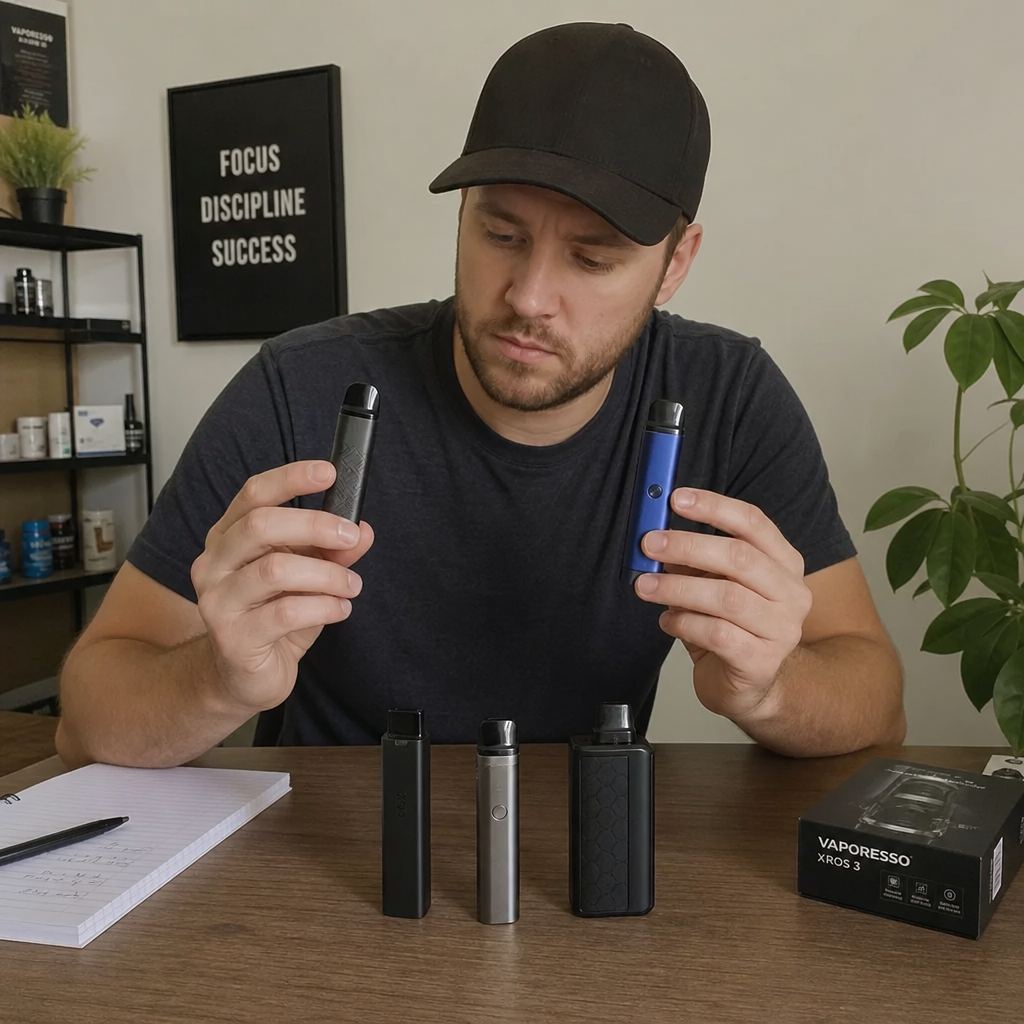

You take your first pull, lean back expecting that smooth cloud you have seen a hundred times on video, and instead your throat closes up and you are coughing like you inhaled a fistful of pepper. Sound familiar? You are not broken, your device is probably not broken, and you are certainly not alone. Coughing when you start vaping is one of the most common new-vaper complaints, and it has a short list of very fixable causes.
This guide works through every one of them, from the liquid in your tank to the way you draw, with a quick diagnosis table up front so you can skip straight to your fix. One note before we start: this is general information for vapers, not medical advice. If a cough sticks around, gets worse, or shows up with other symptoms, the right move is a doctor, not another settings tweak.
The 30-second diagnosis: match your cough to the cause
Before you change anything, figure out what kind of cough you have. Most vaping coughs fall into one of these eight patterns.
| What you are experiencing | Likely cause | Your fastest fix |
|---|---|---|
| Harsh burn in the throat on every puff, mostly with strong disposables | Nicotine strength too high for you | Switch to a lower strength (try 10mg instead of 20mg in the UK, or 25mg instead of 50mg in the US) |
| Dry, scratchy throat that builds up over a session | High-PG e-liquid drying out your mouth and throat | Move to a 50/50 or higher-VG blend, and sip water |
| You cough only on the inhale, the moment vapour hits | Wrong draw technique, usually DTL on an MTL device or pulling too hard | Slow down: small mouth pulls, then breathe in gently (more below) |
| Acrid, burnt-plastic taste plus a violent cough | Dry hit or burnt coil | Refill the tank, prime the new coil for 5-10 minutes, replace the coil |
| Cough gets worse the longer a session goes on | Chain vaping and dehydration | Put the device down for 20 minutes and drink water |
| Huge hot clouds that slam the back of your throat | Wattage too high or airflow wide open on a sub-ohm setup | Drop the wattage, close the airflow a little |
| Chesty cough in your first weeks after quitting cigarettes | Your lungs clearing out old smoke residue | Usually settles on its own; keep vaping gently and stay hydrated |
| Tickly cough only with certain flavours, especially ice or cinnamon | Flavour irritation or PG sensitivity | Try an unflavoured or mellow fruit liquid in a higher-VG mix |
If you spotted yourself in the table, jump to the matching section below.
1. Your body is still learning the language of vapour
The number one reason new vapers cough is the least scary one: novelty. Your throat and lungs have spent years breathing one thing, and vapour is a different substance with different density, temperature, and chemistry. The cough reflex is doing exactly what it evolved to do, reacting to something unfamiliar in the airway.
There is also a quitting angle. If you recently switched from cigarettes, your lungs start clearing out tar and mucus once the smoke stops arriving, and that clean-out cough can coincide with your first vaping weeks. It feels like the vape is causing it, but often your body was going to cough anyway. This quitter’s cough usually fades within a couple of weeks.
What helps here is patience plus the gentler technique in section 3. Most adjustment coughs are far better within one to two weeks.

2. The liquid is usually the culprit: nicotine strength and PG ratio
If the adjustment cough was last week’s problem and you are still coughing in week three, look at your bottle. Two ingredients do most of the throat work in any e-liquid: nicotine and propylene glycol (PG).
Nicotine strength: the harshness dial
Nicotine is the main source of throat hit, that sharp sensation at the back of the throat. Some hit is normal and even satisfying, but too much strength turns every puff into a cough trigger. This bites hardest in two situations: you are using a US disposable at 50mg (5%) when 20mg would satisfy you, or you are running freebase nicotine at 12mg or 18mg in a high-powered device, which hits far harder than the same strength in a low-power pod.
In the UK and EU, e-liquid strength is capped at 20mg per ml by law. In the US, disposables commonly run at 50mg, which is genuinely harsh for anyone who was not a very heavy smoker. Dropping one or two strength steps is the single fastest fix for a nicotine cough. Nicotine salts deliver strength more smoothly than old-style freebase nicotine, so if you need to stay high, salts are the gentler vehicle.
When you shop for your next bottle, check the e-liquid cost guide too: lower-strength liquids cost the same as high-strength ones, so there is no financial reason to stay at a cough-inducing level.
PG: the throat-hit amplifier
Every e-liquid is mostly a mix of PG and VG (vegetable glycerin). PG carries flavour and creates throat hit; VG creates clouds and feels smooth. A 70/30 PG/VG blend, the classic UK mouth-to-lung mix, can feel scratchy to sensitive throats. A 50/50 blend calms it down, and a high-VG blend is the smoothest of all.
Some people are also genuinely sensitive to PG: itchy throat, tickly cough, a dry feeling that water only partly fixes. If that sounds like you, try a higher-VG liquid, as long as your device can wick it (thin PG-heavy liquids suit small pods; thick high-VG liquids suit bigger coils with larger wicking ports).
3. You are inhaling it like a cigarette, and your throat notices
Here is the technique mismatch that causes half of all first-week coughs. Many beginners take a huge, fast drag straight into the lungs, the way they might have attacked a cigarette, or the way they have seen cloud-chasers do it on video. On a mouth-to-lung device at 20mg, that is a recipe for an instant coughing fit.
The fix is the slow two-step draw. First, pull gently into your mouth, like sipping a thick milkshake through a straw. Two or three seconds is plenty. Then breathe it down with a slow inhale into the lungs, or just hold it briefly and exhale through the nose.
Smaller puffs beat heroic ones. A 2-second gentle pull gives you the nicotine and the flavour with a fraction of the throat punishment of a 5-second lung-buster.
4. Your device is shouting when it should be whispering
Sometimes the cough is a hardware complaint, and your device is trying to tell you something.
Dry hits and burnt coils are the worst offenders. When the cotton wick inside your coil runs dry, it burns instead of vaporising liquid, and the resulting puff tastes like scorched plastic and triggers a violent cough. It happens when you vape a tank down to empty, chain-vape faster than the wick can re-soak, or install a fresh coil without priming it. The fix: keep liquid above the wick ports, wait 5-10 minutes after installing a new coil so it saturates, and replace any coil that tastes even slightly burnt. A burnt coil never recovers.
Too much power is the second hardware cause. Sub-ohm devices push big hot clouds that irritate more than cool, thin vapour. If your device has adjustable wattage, drop it by 10 watts and see if the cough eases. If your kit has preset device power modes, the lowest or eco mode is usually the kindest to your throat.
Wide-open airflow has a similar effect: more air means a bigger, airier lung hit that can overwhelm a sensitive throat. Closing the airflow ring halfway tightens the draw, cools the vapour, and often ends the cough on the spot.
Spitback and flooding deserve a mention too. If your coil is flooded with excess liquid, tiny hot droplets can spit up the mouthpiece and land on your throat, causing sharp coughing. A quick flick of the device (mouthpiece down, into a tissue), a fresh coil, and gentler puffs usually sort it.
If all of this sounds like more fiddling than you want, fixed-wattage disposables take settings out of the equation entirely. Our roundup of the best disposable vapes sticks to devices that behave themselves out of the box.
5. You have not drunk anything since breakfast
Vaping is mildly dehydrating. PG and VG are hygroscopic, meaning they pull moisture from their surroundings, and your mouth and throat are the surroundings. Chain-vape for an hour without water and your throat dries out, the vapour starts feeling scratchy, and the coughing starts.
The fix is almost embarrassingly simple: keep water next to you when you vape and actually drink it. If your cough always arrives halfway through a long session and fades after a break and a drink, dehydration was your whole problem.

6. The flavour factor: ice, cinnamon, and everything intense
Flavourings are the least-discussed cough trigger. Menthol and “ice” flavours, cinnamon and spicy blends, and very sweet dessert liquids can irritate sensitive throats, especially at high strength. If you cough with one specific flavour but not others, you have found your answer: that flavour is not for you. Rotate to a mellow fruit or tobacco flavour, or try an unflavoured base to confirm the flavouring was the issue.
When the cough is not the vape’s fault: red flags
Most vaping coughs respond to the fixes above within days. But a cough is also your body’s alarm system, and some alarms should not be snoozed with a settings change.
See a GP or doctor promptly if:
- The cough lasts more than 3 weeks despite changing liquid, strength, and technique
- You are coughing up blood, or phlegm that looks unusual or persists
- You have chest pain, wheezing, or shortness of breath
- You have unexplained weight loss, fever, or night sweats alongside the cough
- The cough is getting steadily worse instead of better
These are the same thresholds doctors use for any persistent cough, vaping or not. This article is general information, not medical advice, and nothing here replaces a professional opinion about your own health. If you want a broader picture of what is known about vaping and the body, our side effects guide collects the established facts without the hype in either direction.
Your 7-day fix-it plan
If you want a structured approach instead of guessing, run this sequence. Change one thing at a time so you know what worked.
Day 1: Technique. Switch to slow mouth-to-lung pulls: gentle 2-3 second draw into the mouth, then a soft inhale. Halve your puff size.
Day 2: Hydration. A glass of water every vaping session, with real breaks between sessions.
Day 3: Airflow and power. Close your airflow halfway. If adjustable, drop wattage by about 10 watts.
Day 4: Coil check. Any burnt taste at all means a new coil, primed for a full 10 minutes.
Day 5: Strength step-down. Drop one nicotine level, or switch the same strength from freebase to salts.
Day 6: Ratio change. Try a 50/50 blend, or higher-VG liquid if your device can wick it.
Day 7: Flavour audit. If one flavour always triggers you, retire it and try something mellow.
If you reach day 7 still coughing and none of the steps helped, that is your signal to stop troubleshooting hardware and book the GP appointment from the red-flag section above.
Frequently asked questions
Is it normal to cough when you first start vaping? Yes, it is extremely common. The throat needs time to adjust to vapour, the draw technique is different from smoking, and most beginners start on a nicotine strength or PG ratio that is harsher than they need. For most people it settles within one to two weeks of gentler technique.
Why do I cough when I vape but I never coughed smoking? Cigarette smoke and vapour irritate the airways differently. Smoke dulls the throat’s response, while vapour, especially high-PG vapour, can feel sharper and drier. Your cough reflex is simply reacting to a new stimulus.
Does vaping make a smoker’s cough worse at first? It can feel that way, because your lungs are clearing old residue at the same time as adjusting to vapour. This combined phase usually passes within a few weeks.
Will switching to a lower nicotine strength stop the coughing? Often, yes. Nicotine is the biggest single contributor to throat harshness. Dropping from 20mg to 10mg, or from 50mg to 25mg, fixes the cough for a large share of vapers. Nicotine salts are also smoother than freebase at the same strength.
Can the wrong PG/VG ratio make me cough? Absolutely. High-PG liquids are the classic cause of dry, scratchy throat coughs. Moving from 70/30 PG/VG to 50/50, or to a high-VG blend on a suitable device, is one of the most reliable fixes there is.
Should I stop vaping if I keep coughing? A mild cough in the first week or two while you adjust is not a reason to panic. But a cough that persists beyond a few weeks, worsens, or comes with other symptoms is a reason to see a doctor, not to keep troubleshooting your device.
The bottom line
A vaping cough is nearly always a message, not a mystery. Too much nicotine, too much PG, the wrong draw, a tired coil, an empty water glass: the list of causes is short and every one has a fix you can try today. Work through the diagnosis table, change one variable at a time, and give your throat a week of gentle treatment.