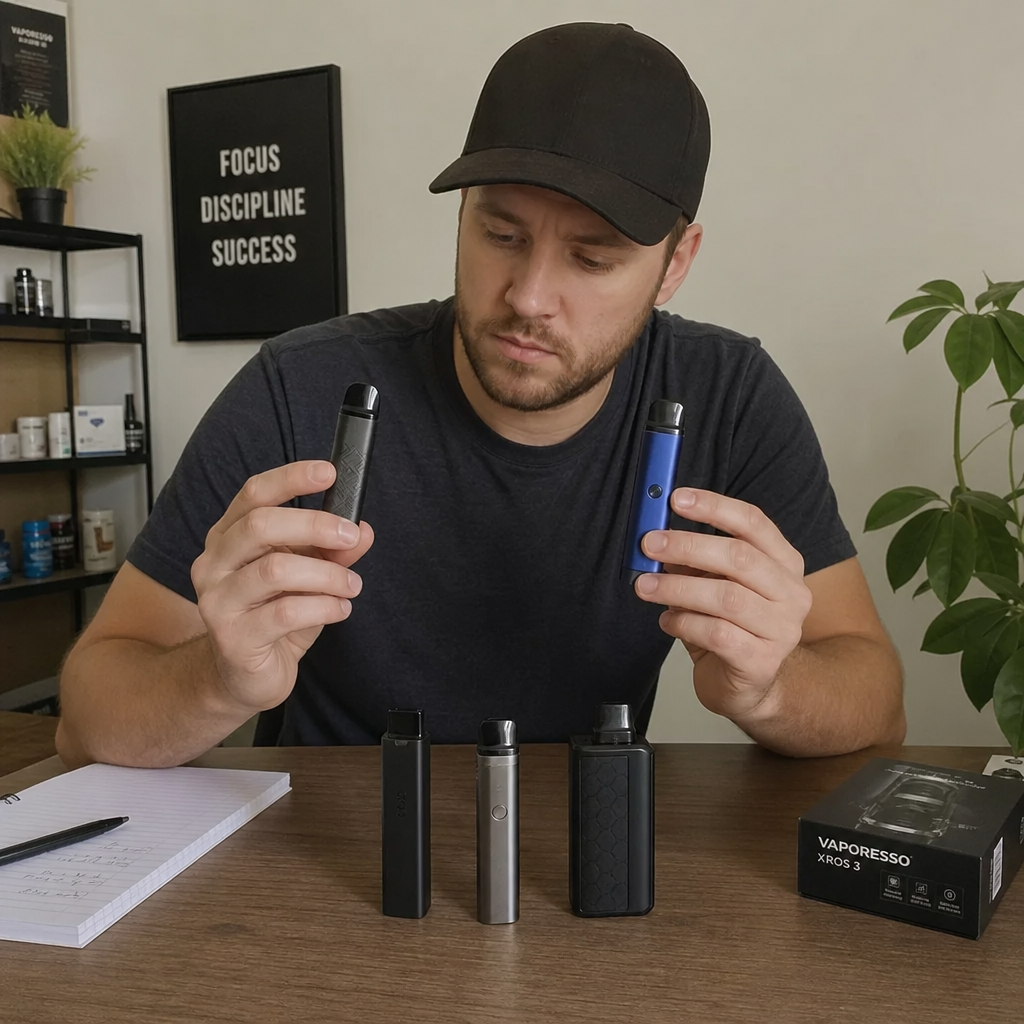

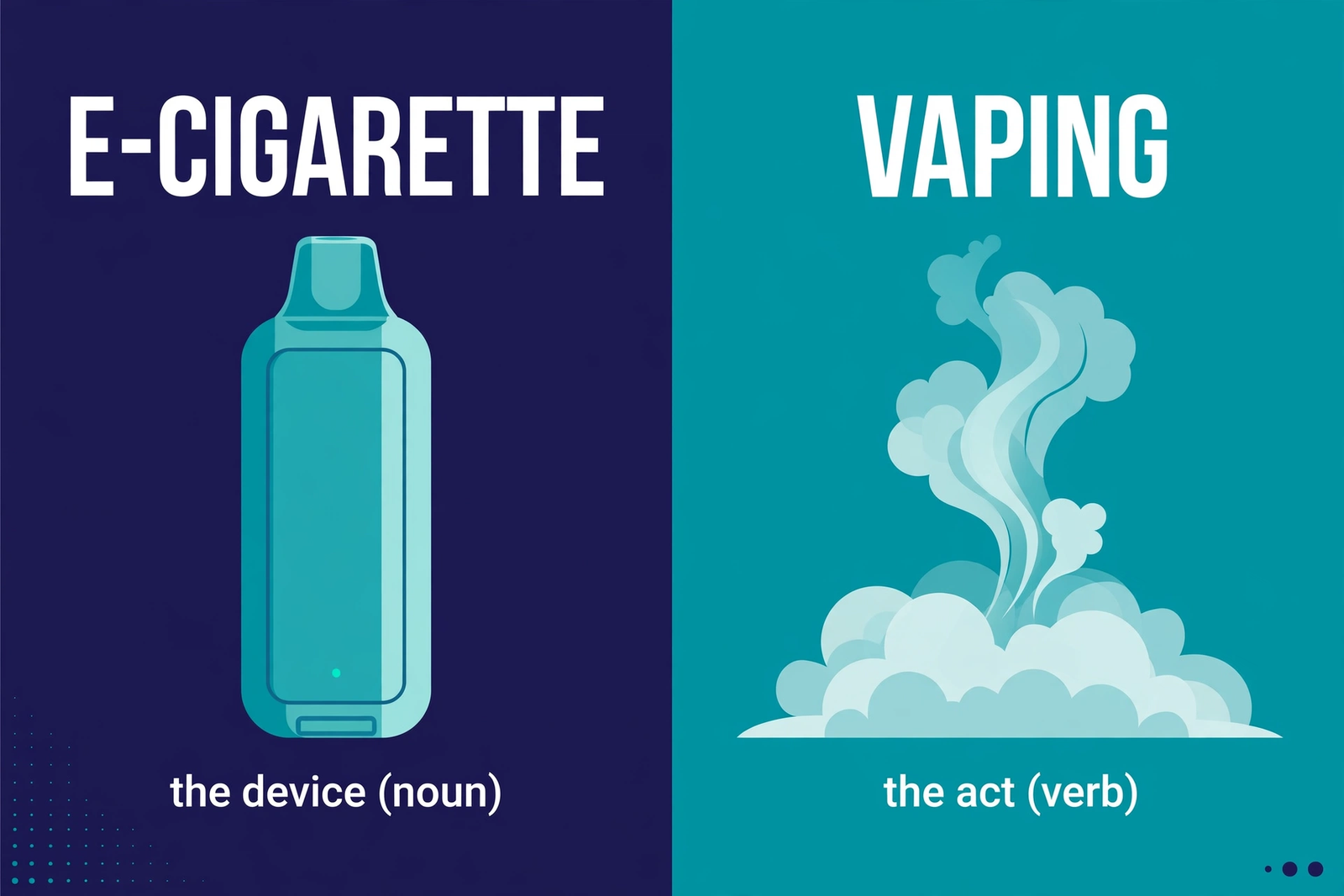
The 10-second answer: Not exactly. An e-cigarette is the device you hold. Vaping is what you do with it. One is a noun, the other is a verb. In everyday conversation people swap them freely and nobody gets confused, but in law, medicine, and regulation the difference actually matters. This guide is about the words. Nothing here is about health effects.
How "e-cigarette" got its name first
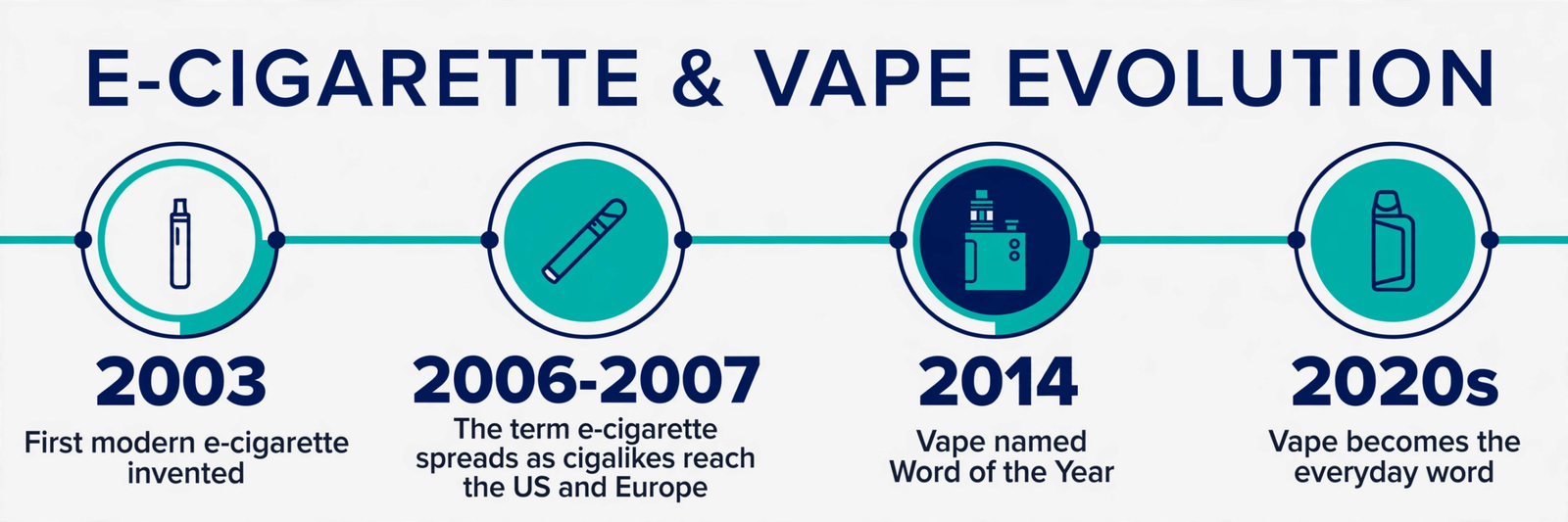
The story starts in 2003, when Chinese pharmacist Hon Lik built the first modern e-cigarette after losing his father to a smoking-related illness. His employer, the company Ruyan, put the product on sale in China in 2004. By 2006 and 2007, the devices were reaching the United States and Europe, and the word traveled with them.
Back then, the devices were designed to look like real cigarettes: white cylinders with glowing tips that lit up orange when you puffed. They were called "cigalikes," and the name "e-cigarette" was pure marketing logic. It told smokers exactly what this was supposed to be: a cigarette, but electronic. The "e-" prefix did the same job it did for "e-mail." It said: the thing you already know, in a new form.
For the first few years, "e-cigarette" was the only word anyone used. News anchors said it. The first laws were written around it. Early adopters even called themselves e-smokers. If you bought one in 2008, the box said "electronic cigarette" and nothing else.
Then "vape" stole the spotlight
Around 2009, the devices stopped looking like cigarettes. Hobbyists started building bigger, box-shaped mods with refillable tanks, variable voltage, and coils they wrapped by hand. Calling a fist-sized metal box an "e-cigarette" started to feel absurd, because it looked nothing like a cigarette and the name no longer described it.
Online communities needed a word for what they were actually doing, and "vaping" filled the gap. It described the visible vapor, not the hardware. Forums, then shops, then mainstream media picked it up. By 2014 the shift was official: Oxford Dictionaries named "vape" its Word of the Year, noting that usage had more than doubled in twelve months.
From there, "vape" swallowed everything. Shops became vape shops. The liquid became vape juice. The community became vapers. In 2026, almost nobody walks into a store and asks for an "electronic cigarette" unless they are reading from a legal document.
The grammar trick that settles it
If you remember one thing from this guide, make it this: an e-cigarette is a noun, vaping is a verb.
| E-cigarette | Vaping | |
|---|---|---|
| Part of speech | Noun (a thing) | Verb (an action) |
| What it names | The device in your hand | The act of using the device |
| Example sentence | "I bought a new e-cigarette." | "I was vaping outside." |
| Everyday synonyms | Vape, e-cig, vape pen, pod, disposable | None, it is the action itself |
| Where you will see it | Laws, packaging, medical forms | Conversation, forums, reviews |
Asking whether e-cigarettes are the same as vaping is a bit like asking whether a car is the same as driving. Related, inseparable, but not the same word doing the same job.
Four reasons everyone mixes them up anyway
1. The devices used to look like cigarettes. The original name made perfect sense for cigalikes. The name stuck around for a decade after the devices changed shape, so today "e-cigarette" gets used for everything from a tiny disposable to a box mod the size of a deck of cards.
2. "Vape" became both a noun and a verb. This is where it gets messy. People say "pass my vape" (noun, the device) and "I’m going to vape" (verb, the act). Once one word did both jobs, the older distinction blurred beyond recognition. Browse any shop’s shelf of best disposable vapes and you will see the devices labeled "vapes," not "e-cigarettes."
3. The media uses them interchangeably. Headlines say "e-cigarette" because it sounds formal and "vaping" because it sounds current, sometimes in the same paragraph. Readers absorb both as synonyms and never get a reason to separate them.
4. The "e-" prefix is quietly dying. Few people say "e-mail" anymore, it is just email. The same fade happened here. "E-cigarette" lost ground to "vape" in everyday speech and now survives mostly in legal and medical writing, where precision is mandatory and tradition is sticky.
The whole family, decoded
"E-cigarette" and "vaping" are just the parents. The family has grown, and each member names something specific:
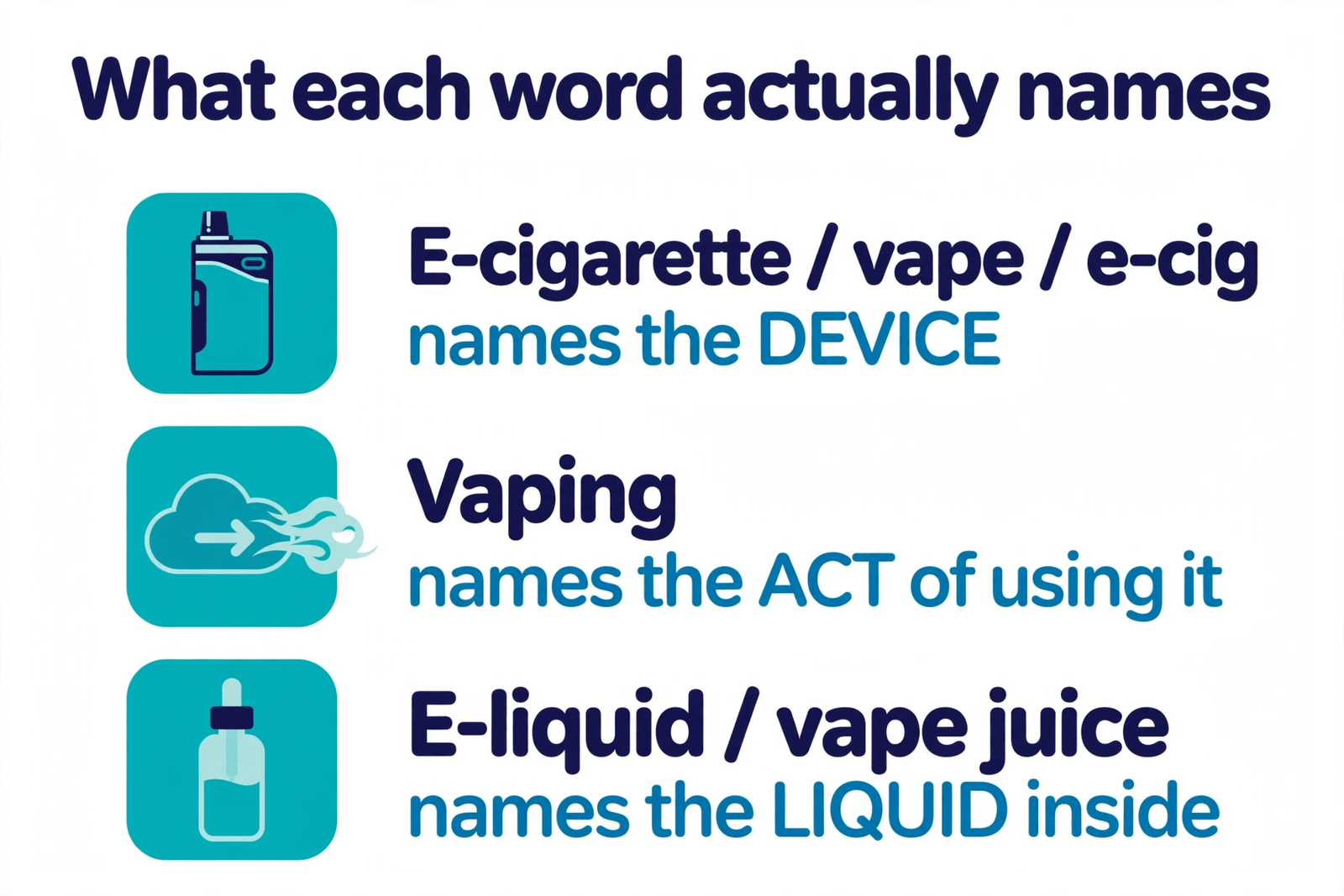
- E-cig: lazy shorthand for e-cigarette. Same device, fewer syllables.
- Vape pen: the slim, pen-shaped devices of the early 2010s. The term stuck as a generic word for simple devices even though most modern ones are not pen-shaped at all.
- Pod / pod system: a device that uses replaceable pods instead of a refillable tank. The word names the format, not a different category.
- Mod / box mod: larger, customizable devices. Short for "modified," a leftover from the hobbyist era when people built their own hardware.
- Disposable: a single-use e-cigarette, prefilled and discarded when it runs out. The format behind today’s bestsellers, including the device in our SBX 25K review.
- E-liquid / vape juice: the liquid inside the device, not the device itself. Prices vary wildly by brand and bottle size, which is why we track vape juice prices as its own topic.
- ENDS: electronic nicotine delivery systems. Regulator-speak, mostly American.
- NVP: nicotine vaping products. The term you will see in British and Australian official documents.
Notice the pattern: every noun names either the device, a device format, or the liquid. "Vaping" stands alone as the only word for the act.
What the rule-makers mean by each word
This is where the distinction stops being trivia. Regulators choose their words carefully, and the word they choose decides what gets regulated.
In the United States, federal regulators use ENDS, short for electronic nicotine delivery systems, as the umbrella category, and e-cigarettes are regulated as tobacco products. When an American law says "electronic cigarette," it almost always means the physical product being sold. When agencies talk about "vaping," they usually mean the behavior, as in youth vaping rates or vaping prevalence surveys. The device word carries the legal force.
In the United Kingdom, official language leans the other way. Government pages talk about "vapes" and "vaping" far more than "e-cigarettes," and formal documents use "nicotine vaping products." The product rules still define the device category in law, but the public-facing word is vape. The UK’s new vaping duty is written around the product itself, which is why our breakdown of the UK vape tax focuses on what counts as a taxable product rather than what anyone calls it at the till.
Across the European Union, the Tobacco Products Directive sticks with "electronic cigarettes" and "refill containers," keeping the older device-first vocabulary in the legal text even though nobody uses those words at the counter.
The pattern is simple: laws name the device, campaigns name the behavior. If you are reading a ban, a tax rule, or an age restriction, look for the device word. That is the one a court would enforce.
So can you use them interchangeably?
In everyday conversation: yes, and everyone will understand you. Saying "I bought a vape" or "I bought an e-cigarette" points at the same object on the shelf. Reviews like our Geek Bar Pulse X breakdown call the same device both names without confusing a single reader.
In formal contexts: no. On a medical form, a customs declaration, or a legal document, use the exact word the form uses. If it asks about "e-cigarette use," do not get creative with synonyms.
And avoid the one mix-up that actually causes trouble: an e-cigarette is not a cigarette. The "e-" does real work in that word. An e-cigarette contains no tobacco leaf and nothing burns. People new to the topic sometimes hear "cigarette" and stop listening at the prefix. If you are explaining it to someone, "it is a vape, not a cigarette" clears things up faster than any dictionary definition.
The question you’re probably really asking
Let us be honest: many people who search this phrase are not confused about grammar. They want to know whether e-cigarettes and vaping are the same thing in the sense that matters, meaning what it does to you. That is a health question, not a vocabulary question, and it has its own full answer in our cigarettes vs vaping comparison. This guide is about the words. That one is about the body.
Quick-fire answers
Is a vape an e-cigarette?
Yes. "Vape" is the modern everyday noun for the same device.
Is vaping the same as smoking?
No. Smoking burns tobacco. Vaping heats liquid into an aerosol. Different words, different actions, different devices.
What does ENDS mean?
Electronic nicotine delivery systems. It is the regulatory umbrella term, used mostly in the United States. Only a small number of products have made it through full FDA authorization, which you can see in our FDA authorized vapes list.
Why do laws still say "e-cigarette"?
Because the first laws were written when cigalikes ruled the market, and legal language changes slowly. The device on the shelf may be called a vape, but the statute still says e-cigarette.
Does it matter what I call it?
Only in formal settings. Everywhere else, say "vape" and move on with your day.